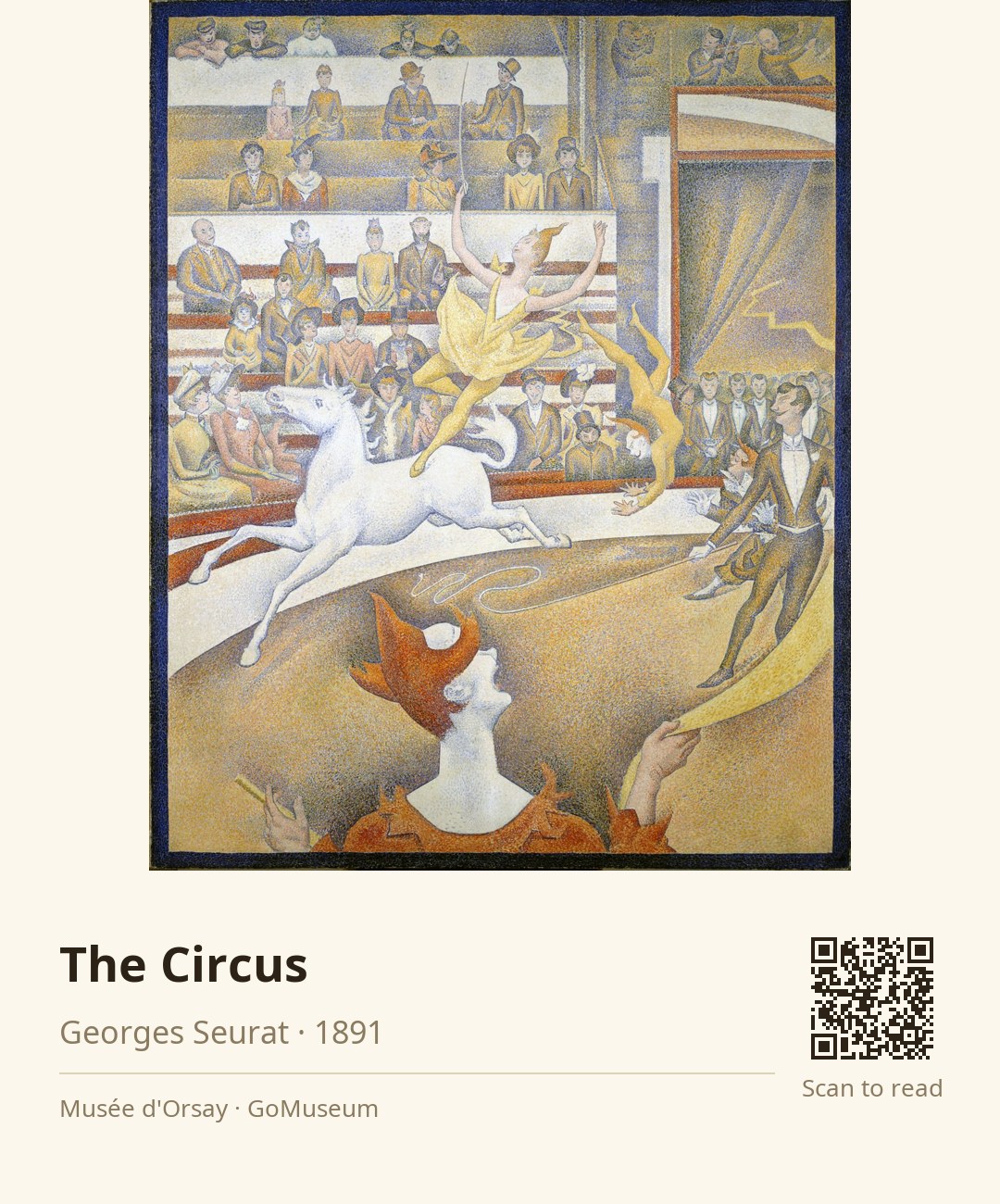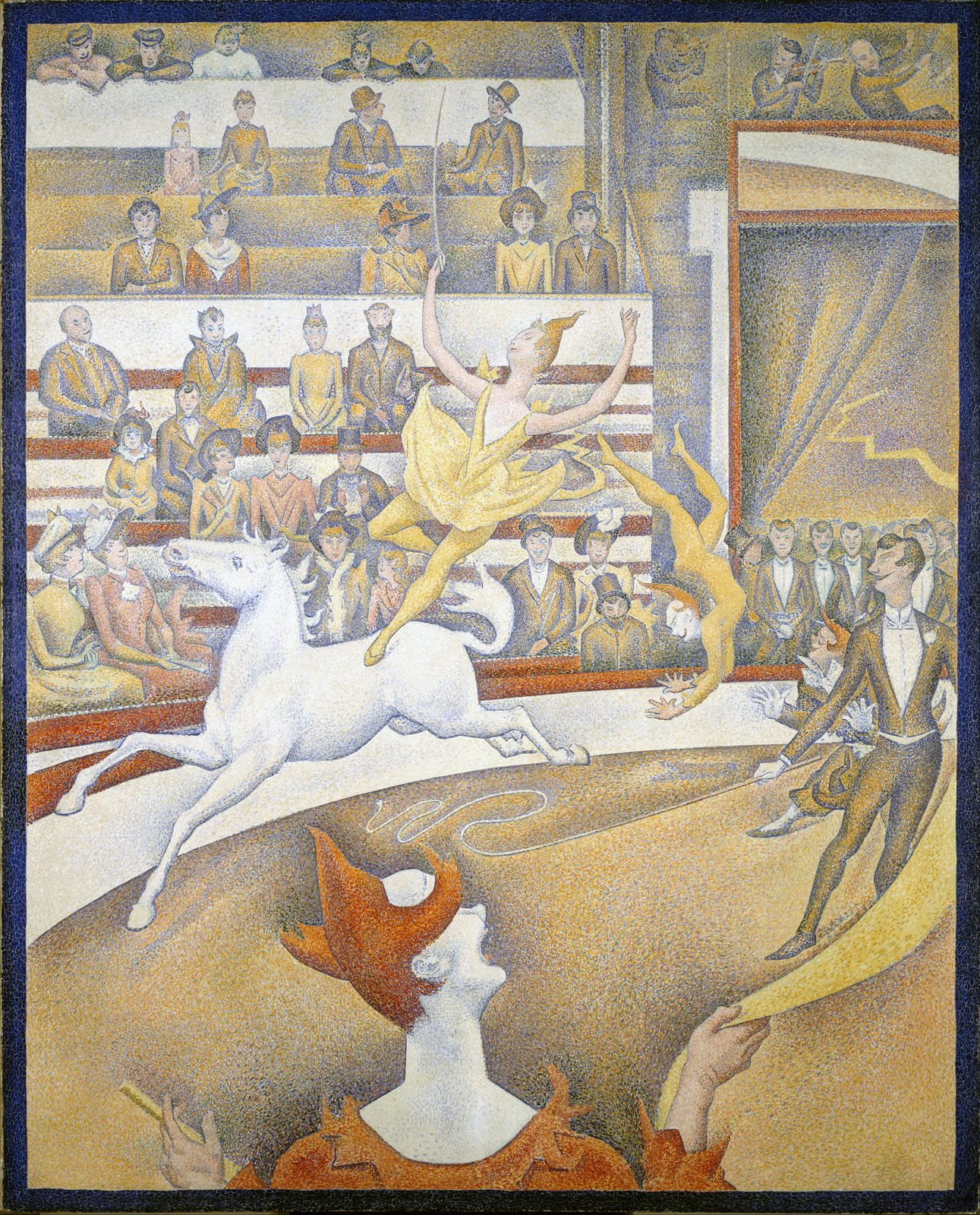
Look closely at Seurat's "The Circus." Notice how the vibrant colors dance across the canvas, especially the striking reds and yellows that seem to pulse with energy. The female performer on the horse is not just a figure; her pose captures a moment of precarious balance, as if she might leap into the air at any second.
This sense of movement is crucial because it reflects the thrill of the circus itself—a world of excitement and danger. Seurat was fascinated by how colors and lines could evoke emotion, and here, he uses his pointillist technique to create a dynamic scene that feels alive. The audience, seated in rows, contrasts sharply with the fluidity of the performers, highlighting the social divides of Parisian life in the late 19th century.
Created in 1891, this was Seurat's last work, left unfinished at his untimely death. It’s a poignant reminder of the fleeting nature of life and art. As you take in the scene, consider: what emotions does this moment evoke for you? Are you drawn to the thrill of the performance, or do you feel the weight of the audience's gaze?
Georges Seurat was a French post-Impressionist artist born on December 2, 1859, in Paris. He is best known for developing pointillism, a technique that uses tiny dots of color to create optical blending. Seurat's character was marked by a unique blend of sensitivity and logical precision, which drove his innovative approach to art. His most famous work, "A Sunday Afternoon on the Island of La Grande Jatte," completed between 1884 and 1886, is a monumental piece that showcases various social classes enjoying leisure time in a park. This painting not only exemplifies his mastery of color theory but also played a pivotal role in the evolution of modern art, marking the beginning of Neo-Impressionism.
Seurat's artistic journey began with formal training at the École des Beaux-Arts, where he honed his skills in drawing and color. Despite facing rejection from the Paris Salon, he found a platform with the Société des Artistes Indépendants, where he exhibited his groundbreaking works. His influence extended beyond his lifetime, inspiring movements such as Fauvism and Cubism. Seurat's legacy as a pioneer of modern art is underscored by his meticulous approach to composition and color, making him a central figure in the history of 19th-century painting. He passed away on March 29, 1891, leaving behind a profound impact on the art world.
Seurat's 'The Circus' was created in 1891, marking the artist's last major work before his untimely death. This painting was exhibited at the Salon des Indépendants in Paris, where it was shown in an unfinished state, a poignant reflection of Seurat's life cut short. The audience's reaction was mixed; while some critics found the figures stiff, others later recognized its innovative approach as a precursor to Cubism. After the exhibition, the painting returned to Seurat's mother, who hung it in the room where he passed away. It eventually made its way into the hands of Paul Signac and later John Quinn, who donated it to the Louvre in 1927. Today, it resides in the Musée d'Orsay, a testament to Seurat's lasting impact on the art world.
In 'The Circus,' Seurat employs his signature pointillist technique, meticulously applying tiny dots of color that blend optically when viewed from a distance. This method creates a vibrant interplay of colors, particularly the dominant reds and yellows that pulse with energy. The composition is cleverly structured, dividing the canvas into two distinct spaces: the dynamic performers on the lower right and the rigidly seated audience on the upper left. Notice how the swirling lines and curves of the performers contrast with the straight rows of the audience, emphasizing the social divides of the time. The use of a deeper blue border around the canvas not only frames the action but also enhances the brightness of the colors within. Seurat's deliberate choices in color and line create a sense of movement and emotional intensity, capturing a fleeting moment of circus excitement.
Created in 1891, it showcases Seurat's innovative pointillism technique, where tiny dots of color blend optically rather than physically mixed on the canvas. This method not only transformed how color and light were perceived in painting but also influenced a generation of artists, paving the way for movements like Cubism. Critics later recognized its social commentary, as the painting juxtaposes the lively circus performers with a rigidly structured audience, reflecting societal hierarchies. Remember, this artwork is not just a circus scene; it's a lens into the complexities of social interaction and artistic innovation at the turn of the century.
A fascinating tidbit about 'The Circus' is that it was painted during a period when Seurat was experimenting with the ideas of color theory and optical effects, influenced by scientific studies of light and color. Interestingly, the unfinished areas of the painting, where the grid of blue lines and white ground are still visible, provide a glimpse into Seurat's meticulous process and the challenges he faced in achieving his vision.
The Circus Médrano, where the painting is set, was located near Seurat's studio and was a popular entertainment venue in Paris, influencing his artistic themes. This proximity allowed him to immerse himself in the vibrant circus culture, which he depicted in several works.
When first exhibited, the painting was criticized for its unfinished quality, with some critics describing the figures as stiff. However, this very incompleteness later contributed to its recognition as a pioneering work that foreshadowed movements like Cubism.