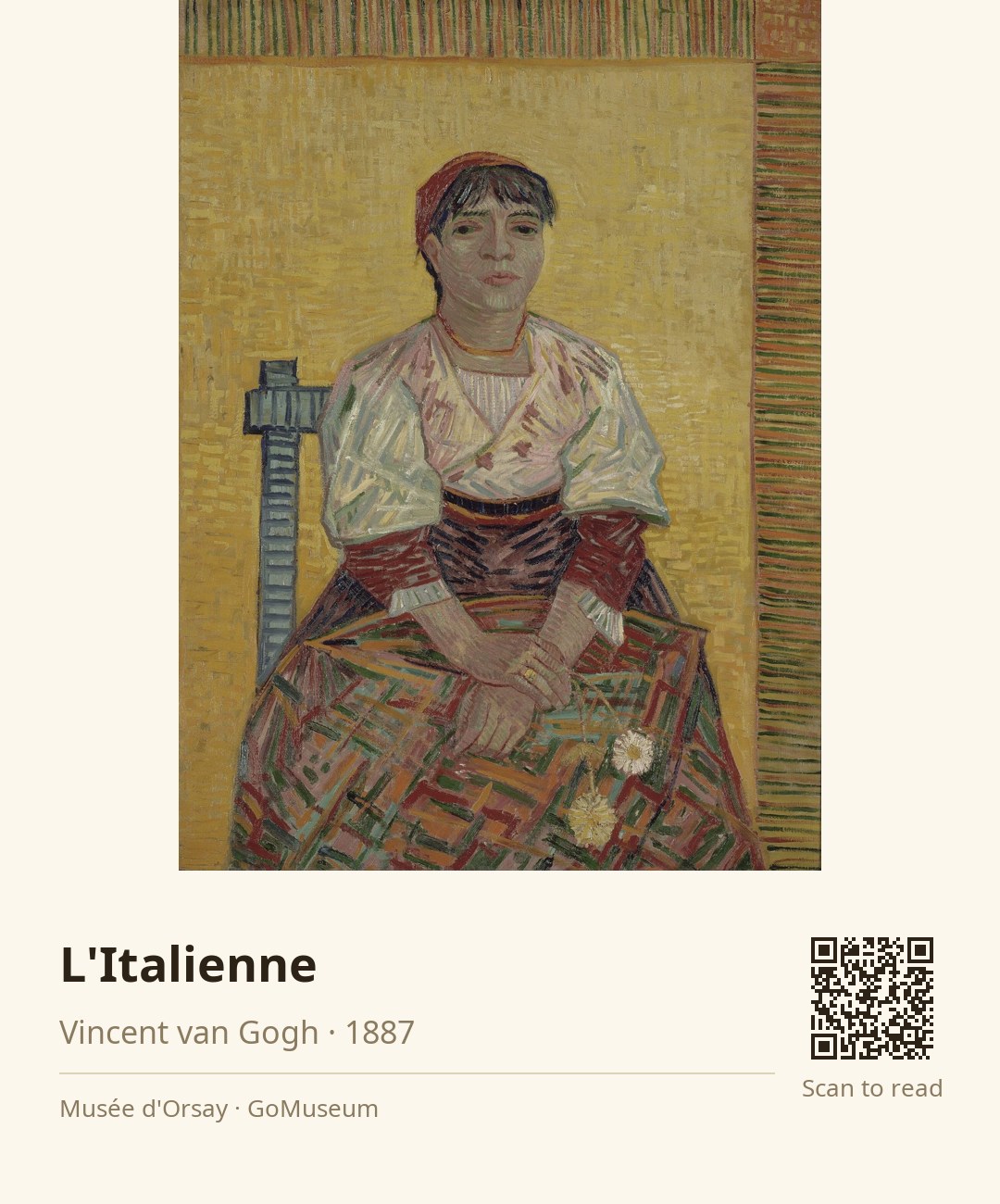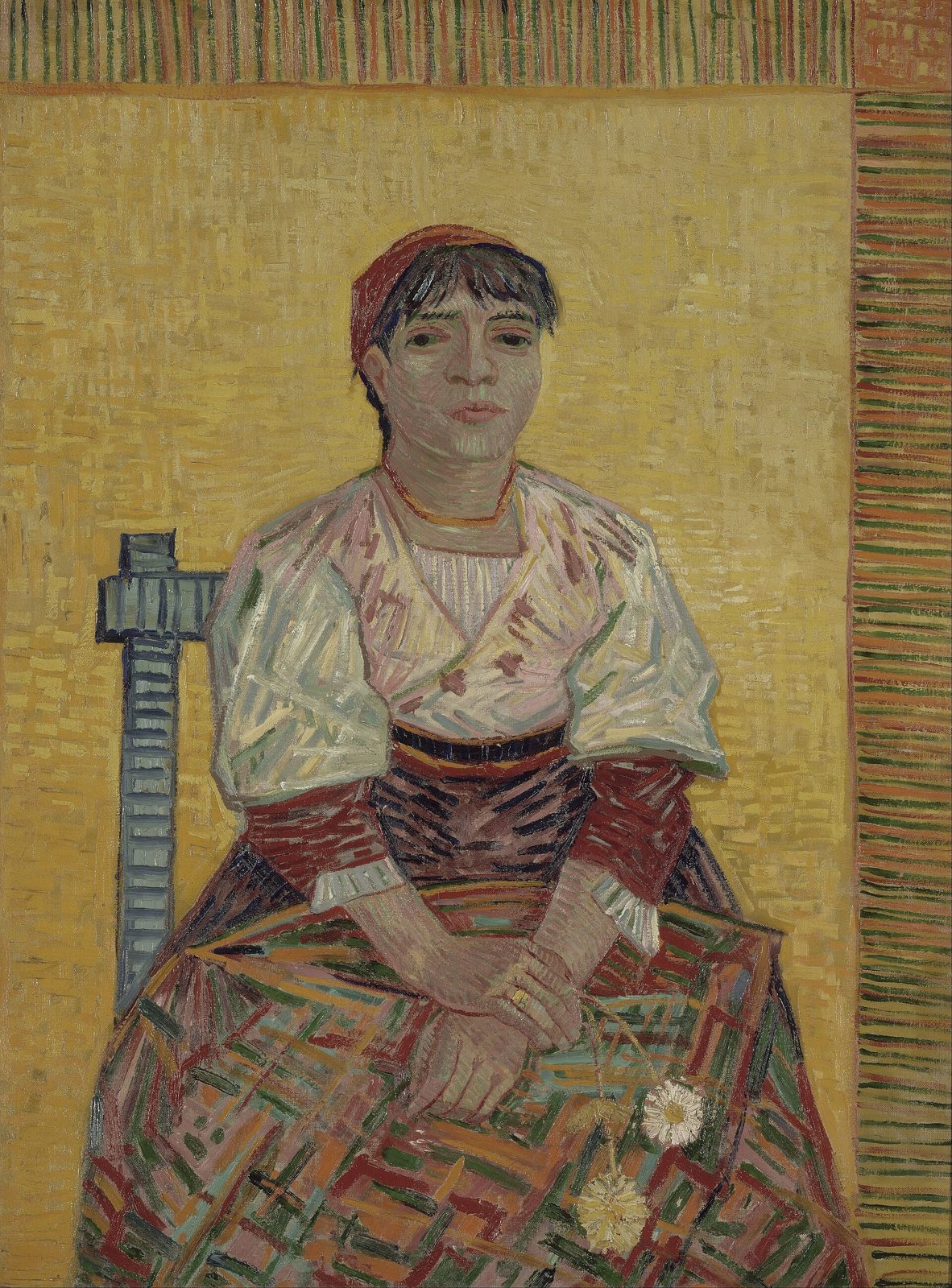
Take a moment to really look at "L'Italienne." Notice how the woman, likely Agostina Segatori, gazes directly at you, her vibrant red scarf framing her face. The boldness of her folkloric attire contrasts sharply with the bright yellow background, creating a striking visual impact that pulls you in.
These details aren’t just for show; they reflect Van Gogh’s fascination with color and emotion. The flatness of the background strips away any distractions, allowing you to focus solely on her presence.
Painted in 1887 during Van Gogh's Paris period, this portrait reveals his shift towards a more expressive style, influenced by the avant-garde artists he encountered. It’s a glimpse into his world, where personal connections and artistic innovation intertwined.
As you stand here, think about the relationship Van Gogh had with Agostina. What stories might she have shared with him over coffee at the café? Let that curiosity linger as you absorb the depth of this moment captured on canvas.
Vincent van Gogh was a Dutch Post-Impressionist painter born on March 30, 1853, in Zundert. He is renowned for his vibrant use of color and expressive brushwork, which laid the groundwork for modern art. Despite creating around 2,100 artworks in just over a decade, including 860 oil paintings, he struggled with mental illness and poverty throughout his life. His early career as an art dealer was marked by disillusionment, leading him to pursue painting in 1881.
Van Gogh's intense passion for art was evident in his correspondence with his brother Theo, who provided emotional and financial support. His works evolved significantly after moving to Paris in 1886, where he mingled with avant-garde artists. His time in Arles in 1888 marked a peak in his creativity, producing iconic series like sunflowers and wheat fields.
Tragically, van Gogh's life ended in suicide at 37, after years of battling his demons. Initially unrecognized, he gained fame posthumously, becoming a symbol of the tortured artist. His legacy influenced movements like Fauvism and Expressionism, securing his place as one of the most significant figures in art history.
Vincent van Gogh painted 'L'Italienne' in 1887, during a transformative period in his life while living in Paris. This portrait is believed to depict Agostina Segatori, a model and the owner of the Café du Tambourin, where Van Gogh often spent time. Their brief romantic relationship added a layer of intimacy to this work. The painting was first shown in exhibitions across Europe, including notable displays in London and New York, and it has since found a permanent home at the Musée d'Orsay in Paris. Over the years, 'L'Italienne' has passed through various hands, including the Van Gogh-Bonger family and the gallery of Paul Rosenberg, before becoming part of the museum's collection. Its reception has evolved, initially overshadowed by Van Gogh's struggles, but later celebrated as a significant piece reflecting his innovative approach to color and form.
As you gaze at 'L'Italienne,' pay attention to the bold brushwork that Van Gogh employs. The strokes are dynamic, almost restless, creating a sense of movement that breathes life into Agostina's figure. Notice how the vibrant red of her scarf contrasts with the flat, bright yellow background. This choice strips away distractions, focusing your attention on her expression and attire. The composition is structured yet intimate, with Agostina's direct gaze inviting you into her world. The lack of perspective enhances her presence, making her the undeniable focal point of the canvas. Van Gogh's technique here is a departure from traditional portraiture, emphasizing emotional resonance over realism, a hallmark of his evolving style during this period.
Did you know that this painting, L'Italienne, captures a moment from Van Gogh's brief romance with Agostina Segatori? She wasn't just a model; she owned a café where artists gathered, and her vibrant personality left a mark on Van Gogh's life and work. This portrait, painted in 1887, reflects not only his affection for her but also his evolving style during his time in Paris, where he was influenced by the avant-garde artists around him.
The chair is painted in a way that only a corner is visible, suggesting a sense of intimacy and focus on Agostina rather than the surrounding environment.
The bright yellow background in 'L'Italienne' reflects Van Gogh's exploration of color during his Paris period, a time when he was influenced by the vibrant palettes of the avant-garde artists around him.