The Pale Complexion of True Love
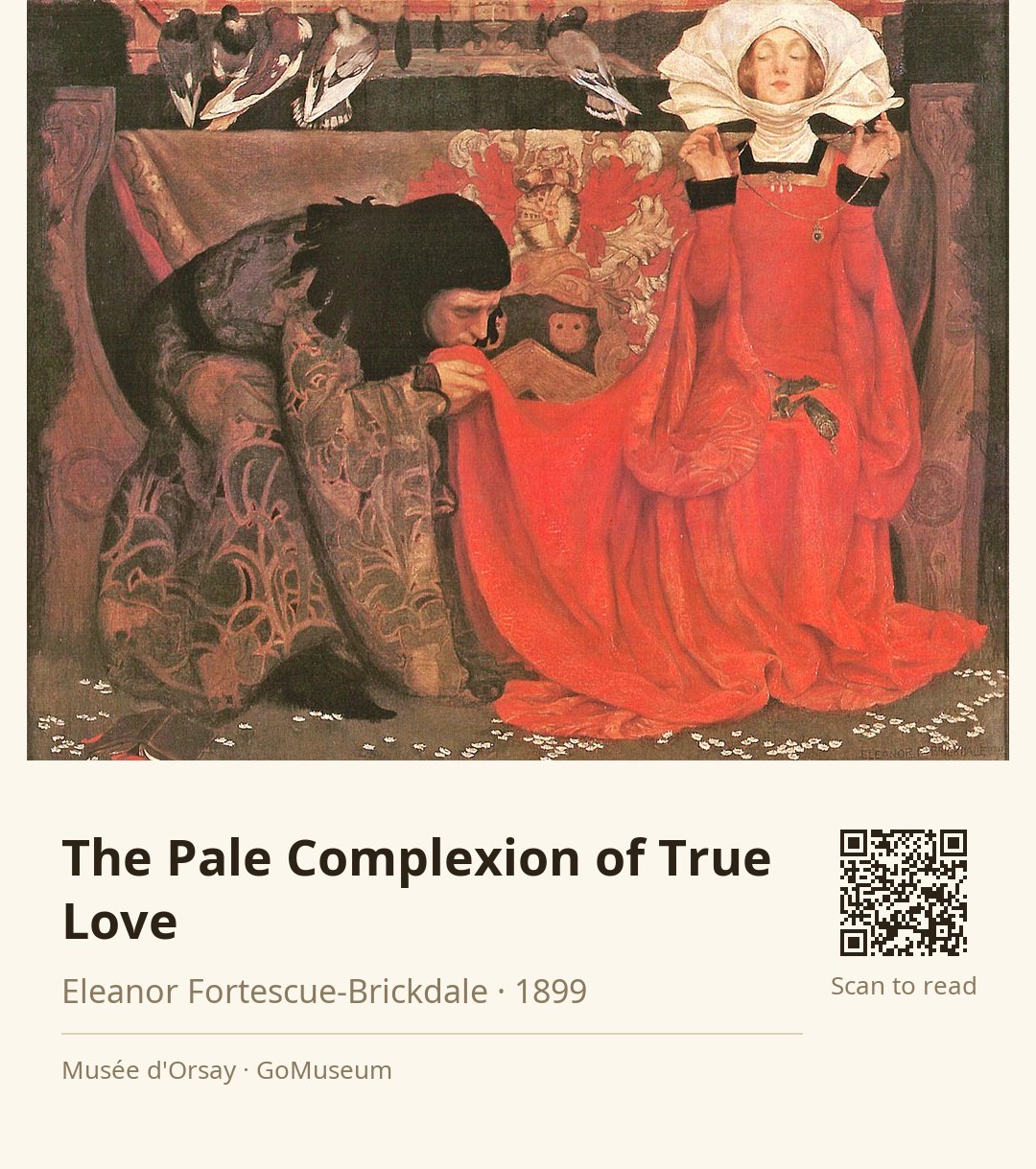
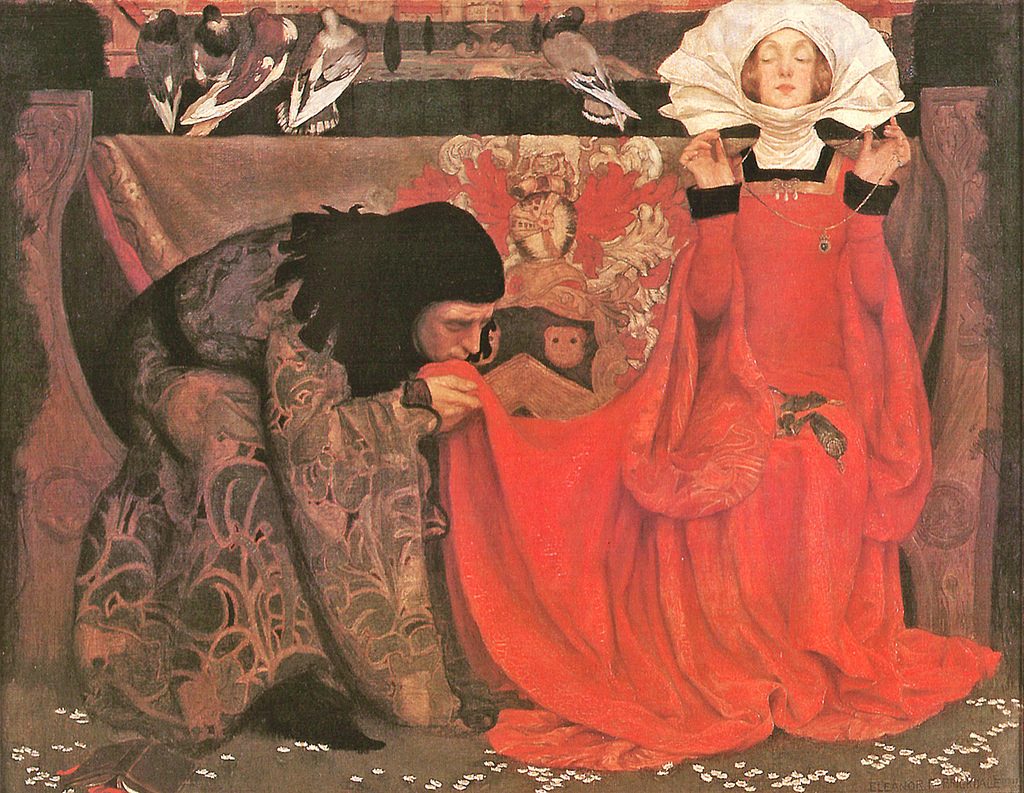
🎧 This work has audio narration — listen in the appThe vibrant red garment worn by the standing figure in "The Pale Complexion of True Love" draws the eye immediately, contrasting sharply with the muted tones of the richly patterned robe of the kneeling figure. This kneeling figure, with their lips gently kissing the hem of the garment, evokes a sense of devotion and intimacy that permeates the entire scene. The closed eyes of the standing figure suggest a moment of transcendence, as if they are lost in a reverie, while the pigeons perched above add a layer of serenity and peace to the composition.
Fortescue-Brickdale's choice of deep reds and browns, along with the intricate detailing of the clothing, reflects her Pre-Raphaelite influences, emphasizing emotion and narrative over mere representation. The decorative tapestry in the background, featuring a coat of arms, hints at a story of nobility or heritage, while the scattered white flowers on the floor symbolize purity and love. This intimate interaction between the figures invites viewers to ponder themes of love and sacrifice, resonating with the romantic ideals of the late 19th century.
Eleanor Fortescue-Brickdale was a British artist born on January 25, 1872, in Surrey. A late exponent of Pre-Raphaelitism, she was known for her oil and watercolor paintings, book illustrations, and stained glass designs. Educated at the Crystal Palace School of Art and the Royal Academy Schools, she quickly gained recognition, exhibiting her work at the Royal Academy and winning a prize for a design in 1896.
Her notable works include "The Pale Complexion of True Love" and a series of illustrations for Tennyson's "Idylls of the King." Fortescue-Brickdale was also a pioneer among women in art, becoming the first female member of the Royal Institute of Oil Painters in 1902 and later an associate of the Royal Society of Painters in Water Colours.
Her designs for stained glass, particularly memorials after World War I, reflect her deep Christian faith. Fortescue-Brickdale's legacy endures through her contributions to the Pre-Raphaelite movement and her influence on subsequent generations of artists. She passed away on March 10, 1945, and is buried in Brompton Cemetery, London.
The painting showcases Fortescue-Brickdale's meticulous brushwork and vibrant color palette, dominated by deep reds and muted browns. Her technique involves layering paint to create rich textures, particularly in the elaborate garments of the figures. The standing figure's red garment is striking, drawing the viewer's eye and symbolizing passion and love. The kneeling figure's delicate kiss at the hem is rendered with soft, fluid strokes, enhancing the intimacy of the moment. The background tapestry, detailed with a coat of arms, adds depth and context, while the scattered white flowers on the floor symbolize purity. Fortescue-Brickdale's composition is intimate, focusing on the connection between the figures, inviting viewers to feel the emotional weight of the scene.