 Image: Nardac Gulliver · Rodney · Rama · Rama
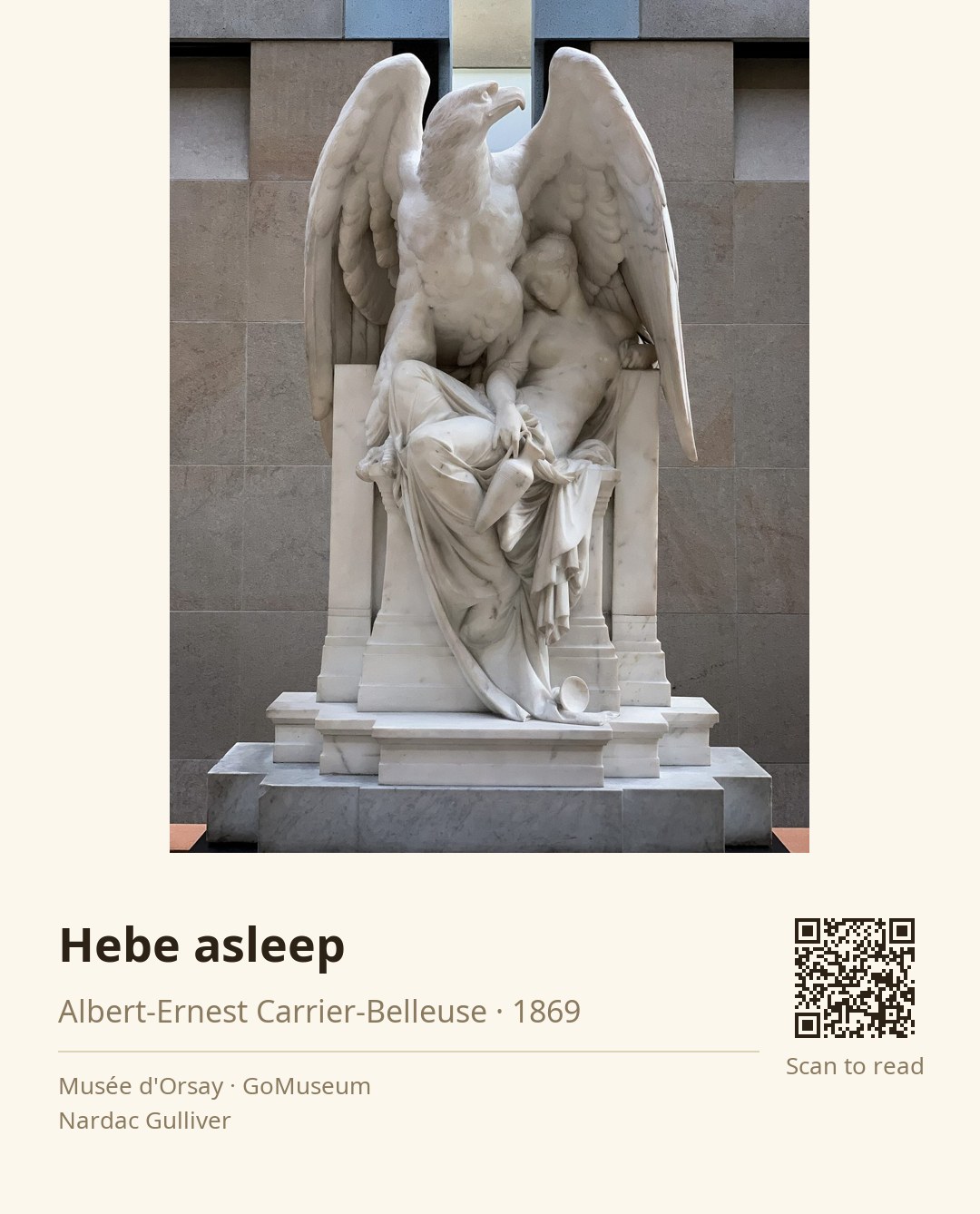
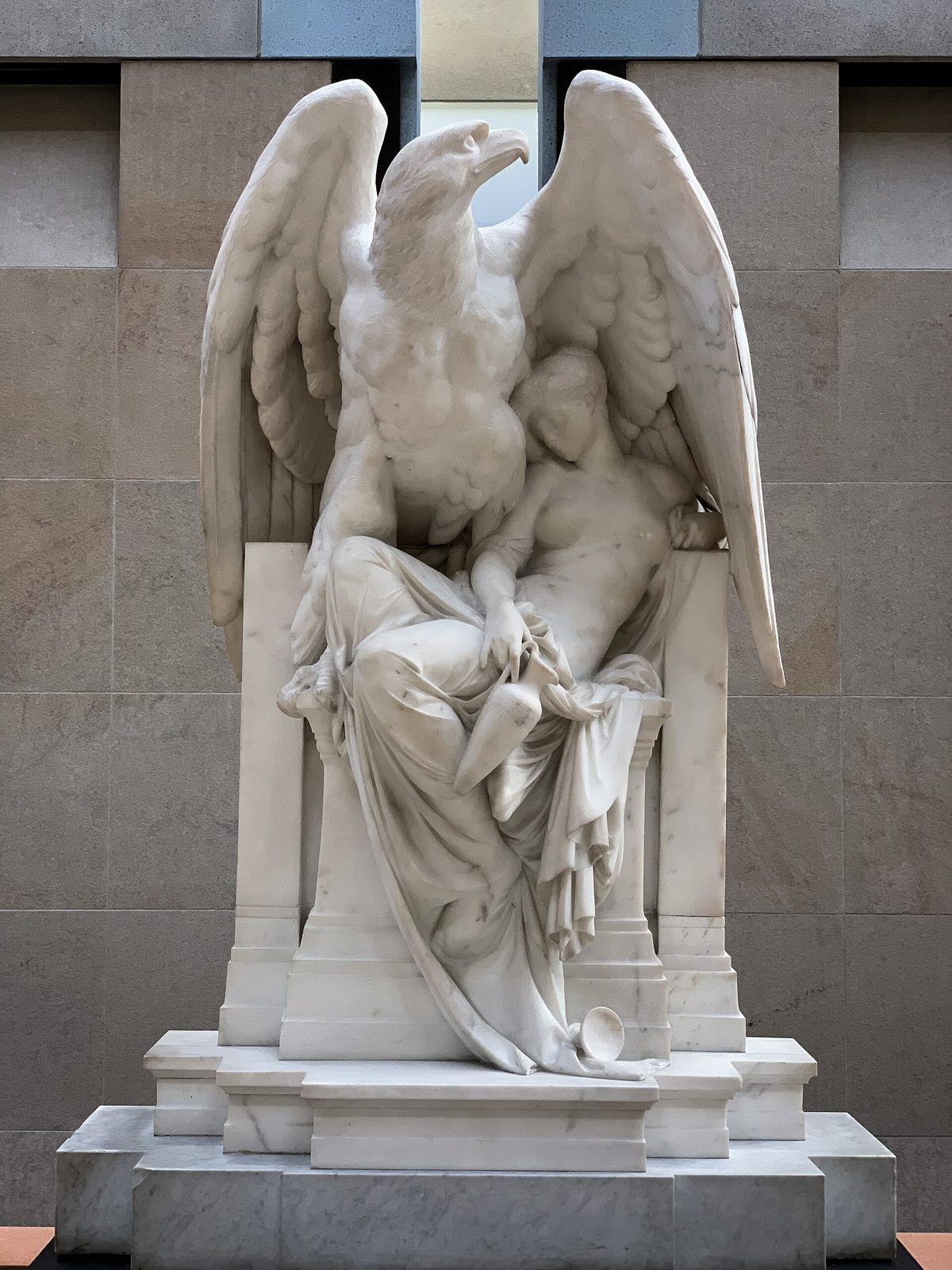
The graceful figure of Hebe, draped in flowing fabric, reclines peacefully against the powerful form of an eagle, its wings spread wide in a protective embrace. The eagle's head, turned slightly, reveals a sharp beak and intricately detailed feathers that contrast with the smooth marble surface of the sculpture. This juxtaposition between the softness of Hebe's pose and the strength of the eagle highlights the theme of divine protection, as Hebe, the cupbearer to the gods, symbolizes youth and vitality.
Carrier-Belleuse's choice to depict Hebe in a state of slumber suggests a moment of tranquility, inviting viewers to reflect on the interplay between strength and vulnerability. The eagle, often associated with Jupiter, reinforces the idea of guardianship, while the delicate folds of fabric cascading around Hebe evoke a sense of serenity and grace. This work embodies the artist's ability to blend mythological themes with a naturalistic style, showcasing his mastery of marble and his keen attention to detail.
Created in 1869, "Hebe Asleep" was exhibited at the 1873 Universal Exposition in Vienna, where it contributed to Carrier-Belleuse's growing reputation as a leading sculptor of the 19th century.
Albert-Ernest Carrier-Belleuse was a prominent French sculptor born on June 12, 1824, in Anizy-le-Château. He began his artistic journey as a goldsmith's apprentice and studied under David d'Angers at the École des Beaux-Arts. His career flourished in the mid-19th century, marked by versatility in style, from unembellished realism to neo-Baroque exuberance. Carrier-Belleuse's most notable work includes the terra cotta piece "The Abduction of Hippodameia," showcasing his ability to blend mythological themes with intricate craftsmanship.
He played a significant role in the art community, co-founding the Société Nationale des Beaux-Arts in 1862 and receiving the Légion d'honneur for his contributions. His workshop in Paris became a hub for artists, including a young Auguste Rodin, who worked as his assistant. Carrier-Belleuse's influence extended beyond France, with works in England and Belgium, and he served as artistic director at the Manufacture nationale de Sèvres.
Carrier-Belleuse's legacy is characterized by his impact on decorative arts and his role in modernizing styles in sculpture. He passed away on June 4, 1887, leaving behind a rich body of work that continues to be celebrated in art history.
Crafted from exquisite marble, Carrier-Belleuse's 'Hebe Asleep' showcases his remarkable skill in sculpting. The smooth surface of the marble contrasts beautifully with the intricate detailing of the eagle's feathers and the flowing fabric draped around Hebe. You can almost feel the softness of her skin and the weight of the fabric as it cascades around her form. The artist's technique, known as 'taille avec mise aux points,' involves careful chiseling and polishing, allowing for both the delicate textures of the drapery and the powerful presence of the eagle to coexist in harmony. This mastery of material not only highlights the figures but also evokes a sense of life and movement within the stone.
Created in 1869, 'Hebe Asleep' was commissioned during a time when Carrier-Belleuse was gaining significant recognition in the art world. The piece was exhibited at the 1873 Universal Exposition in Vienna, a major event that showcased the best of contemporary art and innovation. Carrier-Belleuse's work was well-received, contributing to his growing reputation as a leading sculptor of the 19th century. The sculpture, with its mythological theme and naturalistic style, resonated with audiences, reflecting the artistic trends of the time.
Did you know that Carrier-Belleuse was not only a sculptor but also an influential figure in the decorative arts? He served as the artistic director at the Manufacture nationale de Sèvres, where he modernized the style and collections, blending traditional craftsmanship with contemporary aesthetics. His workshop became a hub for many artists, including Rodin, who would later become a monumental figure in sculpture himself.
Auguste Rodin worked as his assistant between 1864 and 1870.
One of his notable terra cotta works is The Abduction of Hippodameia, which depicts a centaur kidnapping a bride.