Vue de toits
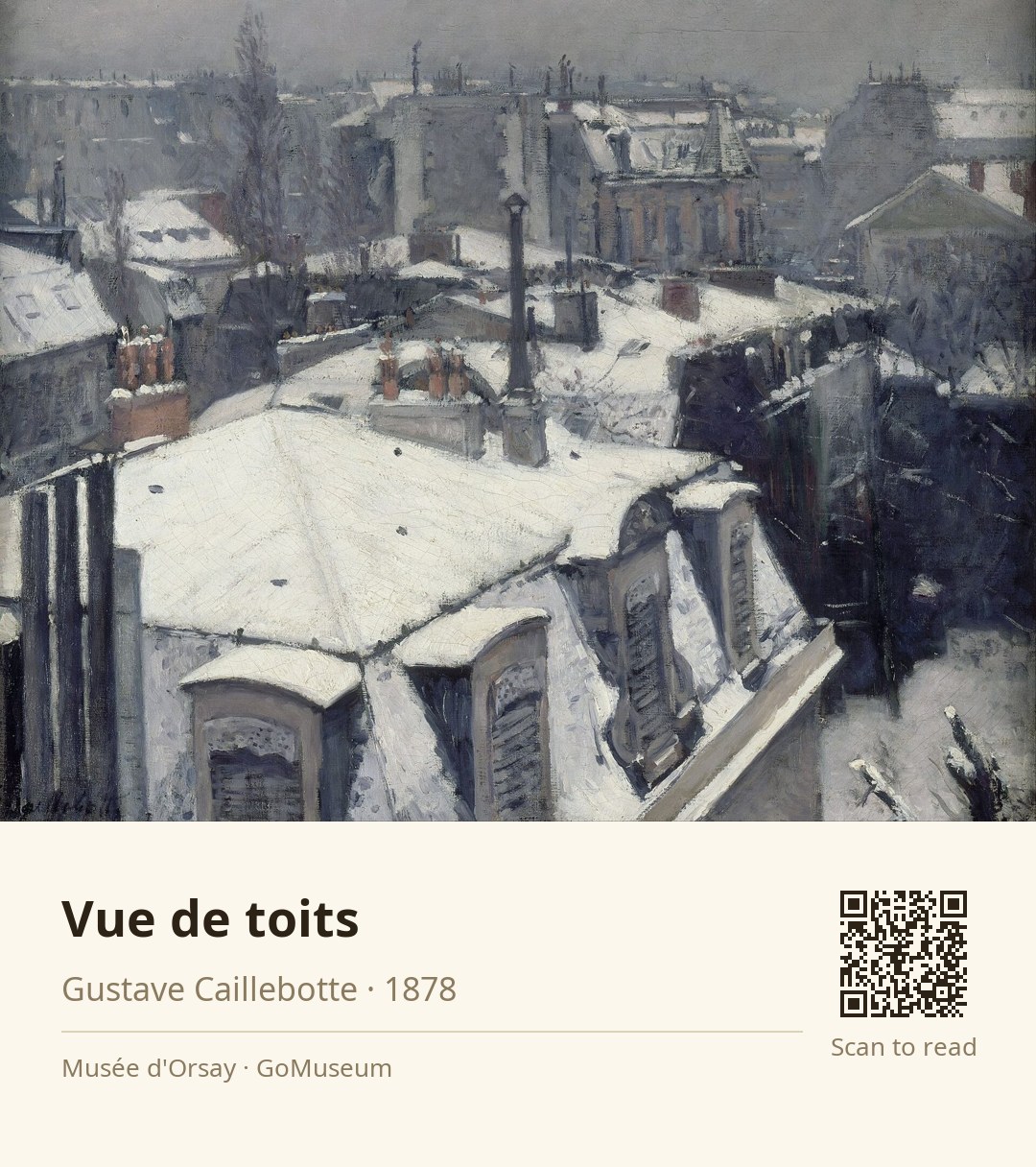
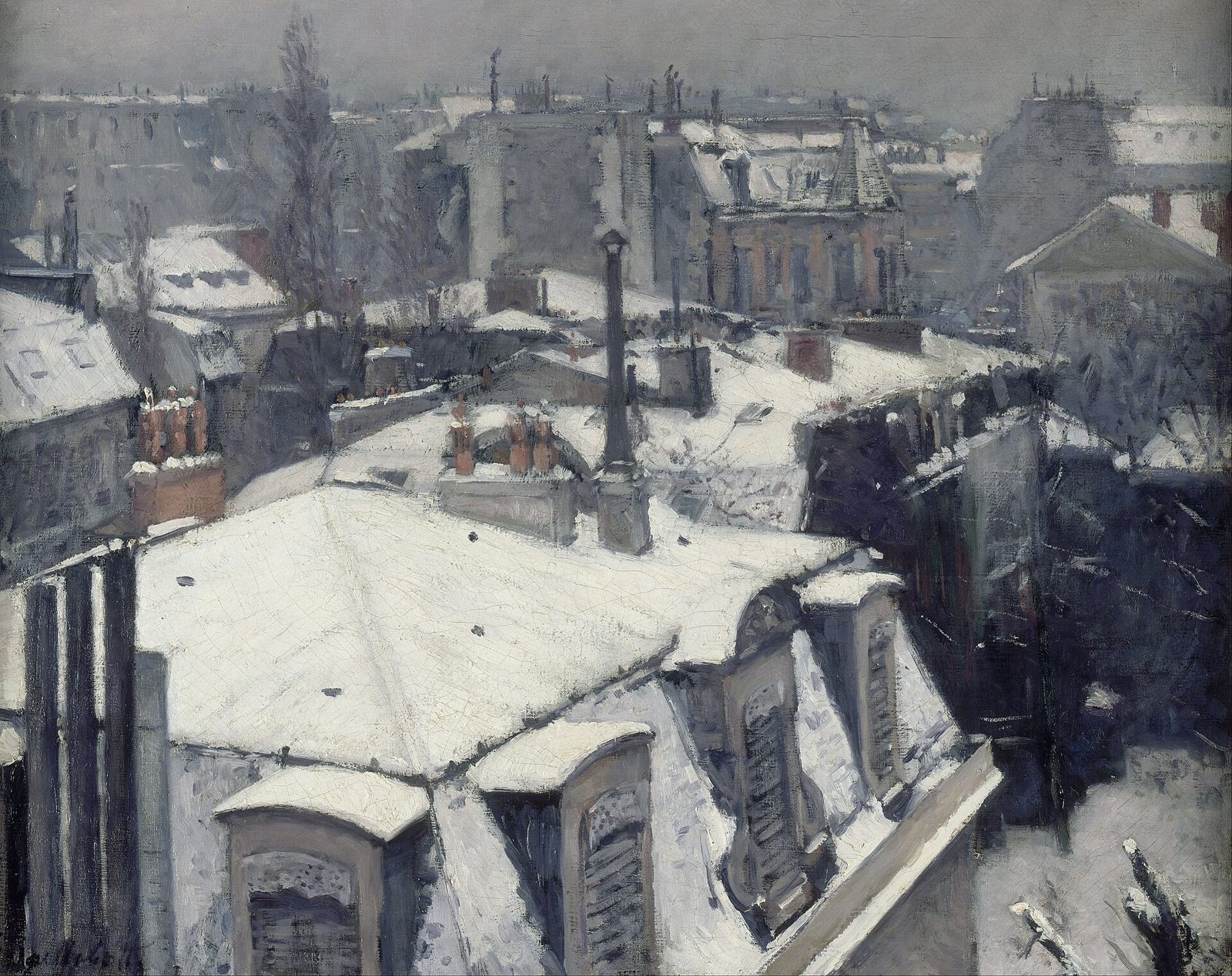
🎧 This work has audio narration — listen in the appTake a moment to really look at "Vue de toits" by Gustave Caillebotte. Notice how the rooftops of Paris are blanketed in snow, creating a serene yet somber atmosphere. The way the grays and whites blend together gives a sense of stillness, almost as if time has paused in this winter scene.
These details matter because they reflect not just the beauty of the city, but also Caillebotte’s emotional state during a difficult period in his life. The high vantage point, likely from a balcony, offers a unique perspective that invites you to ponder the lives of those below, hidden under the snow. It’s a stark contrast to the vibrant life of Paris, hinting at the melancholy that Caillebotte felt after losing family members around this time.
Created in 1878, this painting was part of the fourth Impressionist Exhibition in 1879, where it initially went unnoticed compared to his more popular works. Yet today, it stands out as a significant piece, showcasing Caillebotte’s innovative approach to urban landscapes, influenced by photography.
As you take in this scene, think about how the quiet of the snow-covered rooftops might echo the quiet moments in your own life. What stories do you think are hidden beneath that layer of snow?
Gustave Caillebotte was a French painter born on August 19, 1848, into an affluent Parisian family. His upbringing afforded him the luxury of pursuing art, which he began seriously after serving in the Franco-Prussian War. Caillebotte's early works reflected a realistic style, often capturing contemporary life with a focus on urban scenes and laborers, as seen in his notable painting "The Floor Scrapers." His artistic journey was intertwined with the Impressionist movement, where he played a dual role as both a creator and a patron, supporting fellow artists like Monet and Degas.
Despite his contributions, Caillebotte's work was often overshadowed by his more famous contemporaries, and he did not receive significant recognition until long after his death on February 21, 1894. His collection of Impressionist works, bequeathed to the French state, became a cornerstone of the movement's legacy. Caillebotte's unique perspective, blending realism with the emerging Impressionist style, positioned him as a pivotal figure in art history, though it took a century for his contributions to be fully acknowledged through retrospectives and exhibitions. His legacy continues to resonate, illustrating the complexities of artistic recognition and the evolution of modern art.
Gustave Caillebotte's 'Vue de toits' was painted during the winter of 1878-79 and first exhibited at the fourth Impressionist Exhibition in Paris in 1879. Despite being one of 25 works he presented, it initially went unnoticed amid more popular pieces. The painting remained in Caillebotte's studio until 1894 when his brother Martial donated it to the Musée du Luxembourg. It then moved to the Louvre in 1929, the Galerie nationale du Jeu de Paume in 1947, and finally found its home at the Musée d'Orsay in 1986.
As you gaze at 'Vue de toits', take a moment to appreciate Caillebotte's masterful handling of light and color. The predominantly gray palette evokes the chill of winter, while subtle variations in tone create depth and texture in the snow-covered rooftops. Notice how the high vantage point not only alters your perspective but also emphasizes the starkness of the urban landscape. The composition is carefully structured, with the horizon line placed unusually high, allowing the viewer to feel the weight of the sky above. This choice enhances the painting's somber mood, echoing Caillebotte's personal struggles during this period. The brushwork, while precise, carries a sense of restlessness, almost as if the city beneath is alive despite the stillness of the snow.
Unlike his contemporaries who often focused on pastoral scenes, Caillebotte brought the gritty reality of Paris rooftops to life, capturing the atmospheric effects of snow in a way that was both innovative and haunting. This painting, shown at the fourth Impressionist Exhibition in 1879, initially received little acclaim, overshadowed by his more popular works. Caillebotte's unique vantage point and monochromatic palette invite viewers to see the beauty in the mundane, making this piece a significant departure from traditional landscape painting.
One surprising aspect of 'Vue de toits' is how it initially flopped at the fourth Impressionist Exhibition in 1879. Despite Caillebotte showcasing 25 works, this particular painting didn’t attract much attention. Audiences were more drawn to his portraits and nautical scenes. It’s fascinating to think that what we now consider a significant piece of art was once overlooked, perhaps because its unique perspective of urban rooftops in the snow was so different from the pastoral scenes that were popular at the time.
Caillebotte's 'Vue de toits' presents an urban landscape from a high vantage point, which was uncommon in French painting of the time. This perspective invites viewers to see the city from above, emphasizing the architectural features and the quietness of the snow-covered rooftops.
During the time he painted 'Vue de toits', Caillebotte was grappling with significant personal loss, including the deaths of family members. This emotional weight is reflected in the somber atmosphere of the painting, which captures a sense of melancholy and stillness.
When first exhibited in 1879, 'Vue de toits' went largely unnoticed compared to Caillebotte's more popular works. However, it has since gained recognition as an important piece in the Impressionist canon, showcasing Caillebotte's innovative approach to urban landscapes.