Shepherdess with her Flock
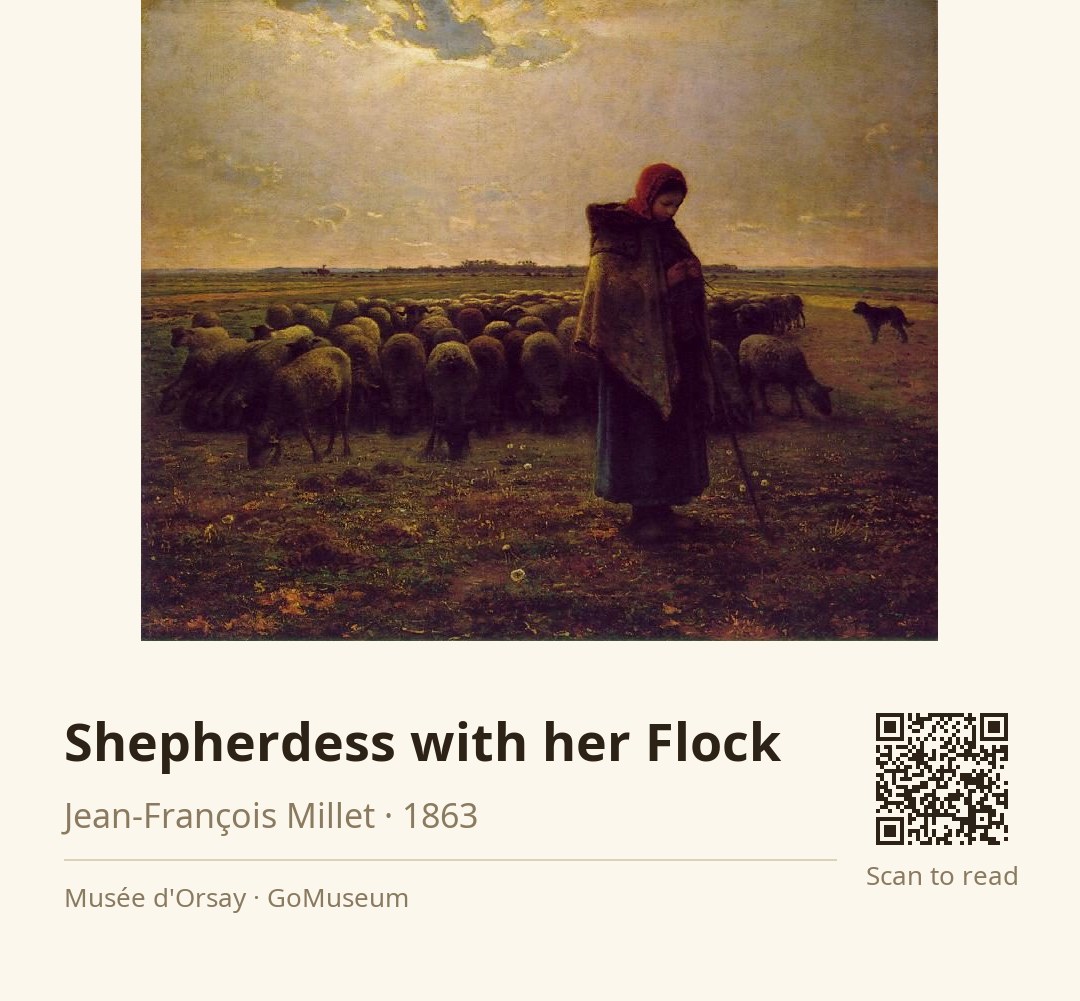
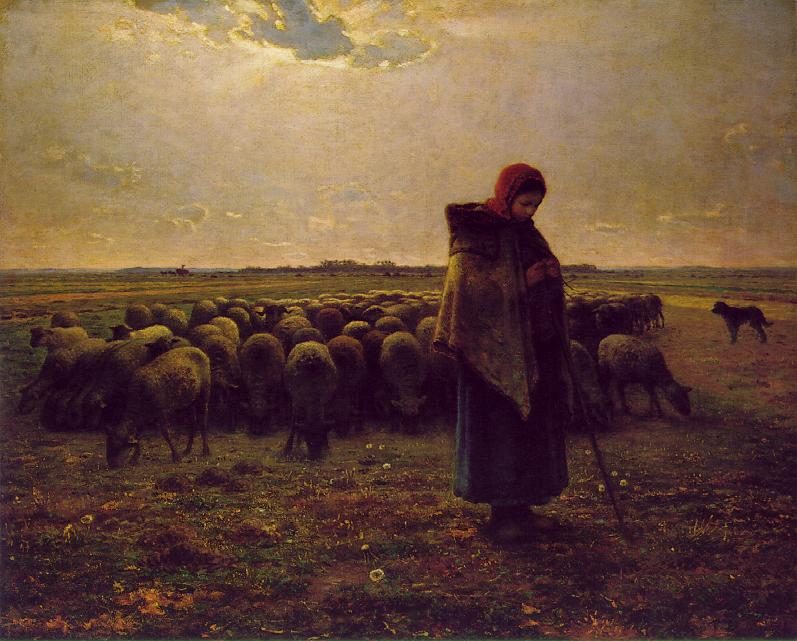
🎧 This work has audio narration — listen in the appTake a moment to really look at "Shepherdess with her Flock" by Jean-François Millet. Notice how the young shepherdess stands slightly off-center, her gaze focused on the wool she’s working with. Her modest clothing, especially that striking red hood, contrasts beautifully with the soft, golden light that bathes the entire scene.
These details matter because they pull you into a world of calm and harmony, a snapshot of rural life that Millet cherished.
Millet painted this in 1863, a time when he was captivated by the idea of depicting the pastoral life he knew so well from his own upbringing in Normandy. This painting was a hit at the Paris Salon in 1864, praised as a masterpiece that captured the essence of rural tranquility.
As you stand here, think about the connection between the shepherdess and her flock. What stories might they share in this serene landscape? What does this moment say about the relationship between humans and nature? Let that linger in your mind as you take in the beauty of this artwork.
Jean-François Millet was a pivotal figure in 19th-century French art, born on October 4, 1814, in Gruchy, Normandy. As a founding member of the Barbizon school, he is celebrated for his profound depictions of peasant life, embodying the Realism movement. Millet's early years were steeped in agricultural labor, which deeply influenced his artistic themes. After studying under various artists, he moved to Paris, where he initially struggled but eventually gained recognition for his work.
Millet's paintings often highlighted the dignity of rural laborers, showcasing their struggles and connection to the land. His notable works, such as "The Gleaners" and "The Angelus," reflect a shift from idealized pastoral scenes to a more authentic representation of contemporary social conditions. Despite facing criticism early in his career, he found success in the mid-1850s, producing masterpieces that resonated with the public and critics alike.
Millet's legacy lies in his ability to elevate the everyday lives of farmers to the realm of fine art, influencing generations of artists and solidifying his place in art history as a champion of the working class. He passed away on January 20, 1875, in Barbizon, leaving behind a rich body of work that continues to inspire.
Jean-François Millet's 'Shepherdess with her Flock' was created in 1863, a time when the artist was deeply immersed in the themes of rural life that resonated with his own upbringing in Normandy. The painting was first exhibited at the Paris Salon in 1864, where it garnered significant acclaim, being described as a 'masterpiece' and a 'refined canvas.' This success was particularly meaningful to the middle-class audience of the time, who were drawn to idealized representations of peasant life. Interestingly, Millet had expressed a desire to depict a shepherdess as early as 1862, indicating that this theme was a personal obsession for him. After its initial exhibition, the state sought to acquire the painting, but Millet chose to sell it to collector Paul Tesse instead. Over the years, it changed hands several times before becoming part of the Louvre's collection in 1909, thanks to the legacy of Alfred Chauchard. In 1986, it found its permanent home at the Musée d'Orsay in Paris.
In 'Shepherdess with her Flock,' Millet employs a masterful technique that combines meticulous brushwork with a rich palette to evoke a sense of tranquility and harmony. The composition is carefully structured, with the shepherdess slightly off-center, drawing the viewer's eye across the canvas. Notice how the golden light envelops the scene, creating a backlight that enhances the textures of the sheep's wool and the shepherdess's modest clothing. The use of color is particularly striking; the vibrant red of the hood contrasts beautifully with the softer hues of the landscape, making her the focal point. Millet's brushwork is both delicate and expressive, capturing the gentle movement of the sheep and the serene demeanor of the shepherdess. The depth of the painting is achieved through the layering of colors and the depiction of paths that lead the eye toward the horizon, inviting you to explore the idyllic rural setting.
The painting was particularly esteemed by the middle classes in Paris, who preferred idealized representations of peasant life, indicating a societal longing for a simpler, pastoral existence amidst the complexities of urbanization.
Millet's use of backlighting and the way he captured light in 'Shepherdess with her Flock' anticipated techniques that would later be embraced by Impressionist artists, showcasing his innovative approach to luminosity.