Les raboteurs de parquet
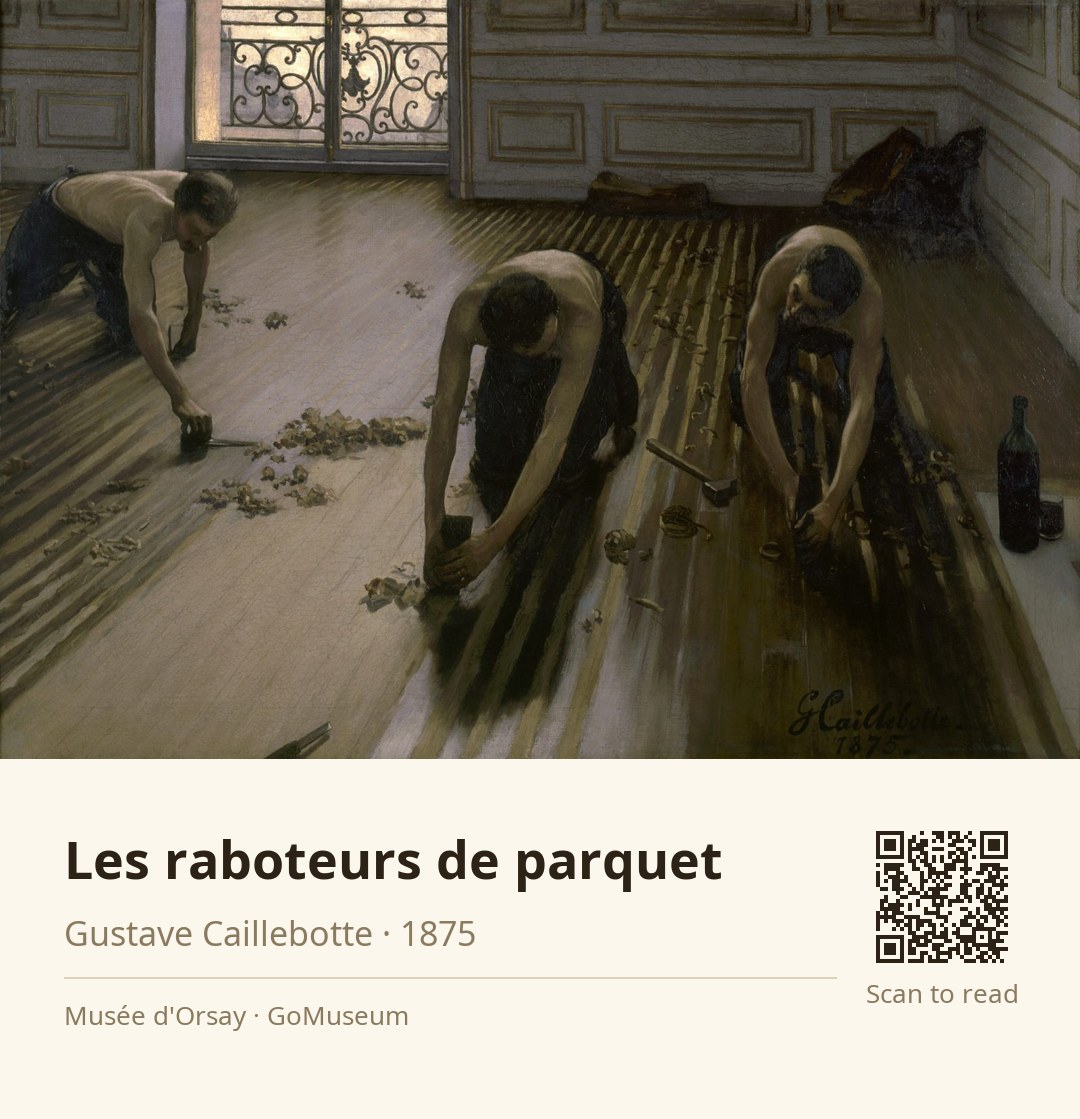
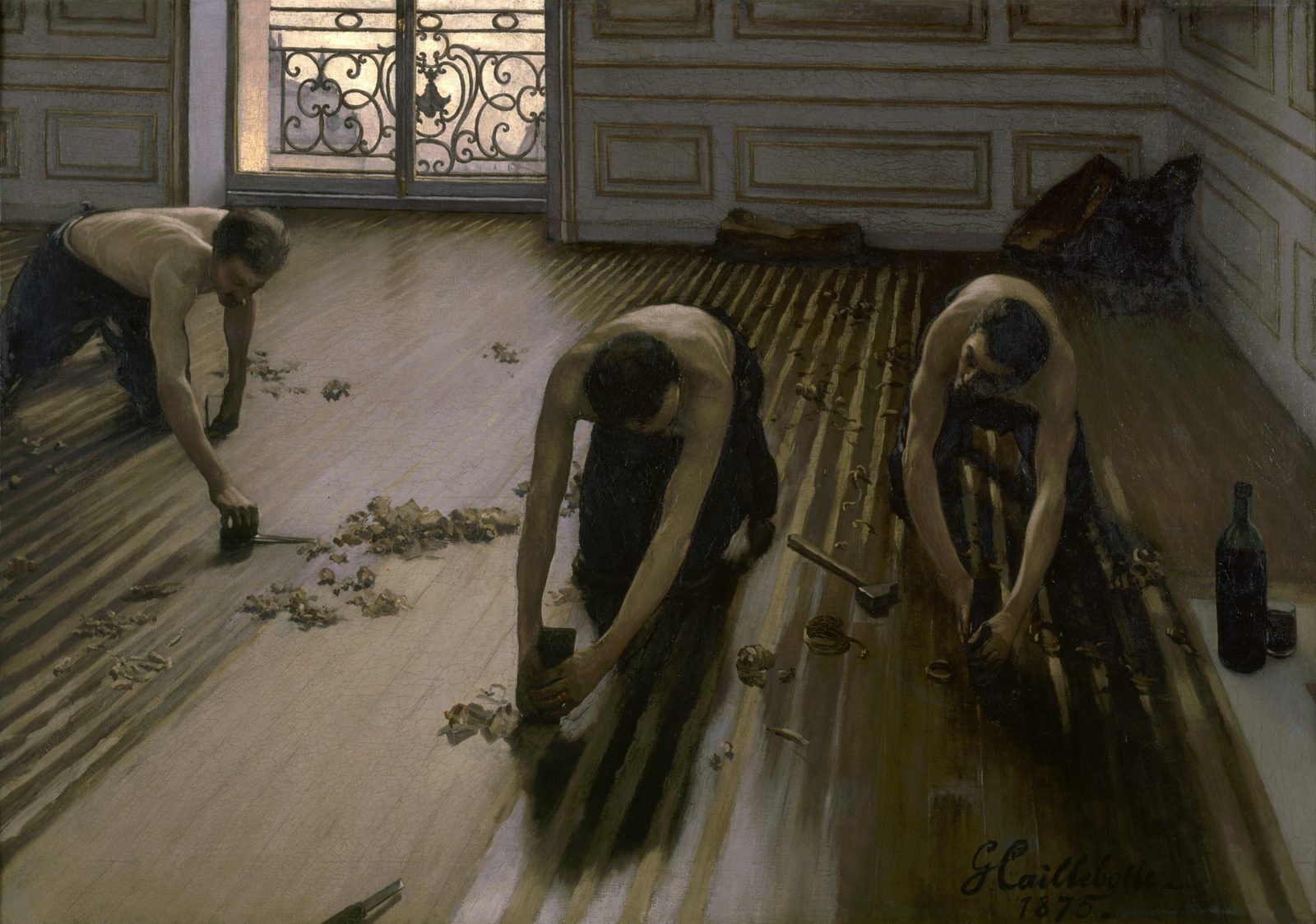
🎧 This work has audio narration — listen in the appTake a moment to really look at "Les raboteurs de parquet" by Gustave Caillebotte. Notice how the three workers are positioned on their knees, their bodies bent and engaged in the labor of scraping a wooden floor. The way their torsos are exposed, glistening in the light streaming through the window, captures a raw honesty about manual labor that was quite revolutionary for its time.
These details matter because they challenge the norms of traditional art, which often glorified heroic or idealized subjects. Here, Caillebotte presents the working class not as mere background figures but as the true protagonists of modern life. The nudity of the workers, far from being vulgar, emphasizes their physicality and strength, transforming them into symbols of dignity and hard work in an urban setting.
Painted in 1875, this piece was initially rejected by the Salon, deemed too shocking for its portrayal of laborers in a bourgeois apartment—Caillebotte's own studio, no less. Instead, it found its place at the second Impressionist exhibition in 1876, where it began to gain recognition for its innovative perspective and composition.
As you stand here, think about how Caillebotte's work invites us to reconsider our views on labor and the everyday lives of those who often go unnoticed. What stories do you think these workers might tell if they could speak?
Gustave Caillebotte was a French painter born on August 19, 1848, into an affluent Parisian family. His upbringing afforded him the luxury of pursuing art, which he began seriously after serving in the Franco-Prussian War. Caillebotte's early works reflected a realistic style, often capturing contemporary life with a focus on urban scenes and laborers, as seen in his notable painting "The Floor Scrapers." His artistic journey was intertwined with the Impressionist movement, where he played a dual role as both a creator and a patron, supporting fellow artists like Monet and Degas.
Despite his contributions, Caillebotte's work was often overshadowed by his more famous contemporaries, and he did not receive significant recognition until long after his death on February 21, 1894. His collection of Impressionist works, bequeathed to the French state, became a cornerstone of the movement's legacy. Caillebotte's unique perspective, blending realism with the emerging Impressionist style, positioned him as a pivotal figure in art history, though it took a century for his contributions to be fully acknowledged through retrospectives and exhibitions. His legacy continues to resonate, illustrating the complexities of artistic recognition and the evolution of modern art.
Gustave Caillebotte painted 'Les raboteurs de parquet' in 1875, a time when the art world was dominated by traditional depictions of beauty and heroism. This painting, however, was a bold departure from the norm, showcasing the raw reality of laborers at work in a bourgeois apartment—Caillebotte's own studio, no less. Initially, the painting was rejected by the Salon of 1875, deemed too shocking for its portrayal of nude workers engaged in manual labor. The jurors labeled it 'vulgar', reflecting the era's discomfort with such subjects. However, Caillebotte found a more receptive audience at the second Impressionist exhibition in 1876, where it began to gain recognition. Critics were divided; some praised its technical execution, while others dismissed it as anti-artistic. Despite the mixed reviews, the painting marked a significant moment in art history, as it was one of the first to elevate the working class to the forefront of modern life. Over the years, it changed hands several times, eventually becoming part of the collection at the Musée d'Orsay, where it resides today.
Caillebotte's technique in 'Les raboteurs de parquet' is a fascinating blend of realism and Impressionism. The composition is striking, with the viewer's perspective positioned above the three workers, creating an intimate yet observational feel. Notice how the natural light streams through the window, illuminating the scene and highlighting the muscular torsos of the laborers. The brushwork is meticulous; Caillebotte employs careful drawing and modeling to achieve a sense of depth and dimension. The nudity of the workers is not gratuitous but serves to emphasize their physicality and the dignity of their labor. The repetition of forms—the curved backs, the angles of the tools—creates a rhythmic harmony throughout the piece. This focus on the male nude in a contemporary setting was groundbreaking, challenging the conventions of the time. The painting's scale, measuring 102 by 146.5 centimeters, allows for an immersive experience, drawing you into the world of these laborers and their honest toil.
One surprising aspect of 'Les raboteurs de parquet' is that it was initially rejected by the prestigious Salon of 1875, which shocked many. The jurors deemed the depiction of working-class men in their trade, especially in such a raw and unidealized manner, as 'vulgar.' This rejection deeply hurt Caillebotte, who then showcased the painting at the second Impressionist exhibition in 1876, where it found a more appreciative audience.
Caillebotte's viewpoint is notably elevated, positioning the observer above the workers, which creates an intimate yet observational experience, contrasting with the more traditional frontal perspectives common in academic art.
Coming from a wealthy family, Caillebotte had the privilege to explore themes of the working class, which was uncommon for artists of his social standing, allowing him to depict laborers with dignity and realism rather than idealization.
The nudity of the workers was deemed shocking and vulgar by the Salon jurors, reflecting a broader societal discomfort with depicting the working class in such an honest and unembellished manner, which was a significant departure from traditional artistic norms.