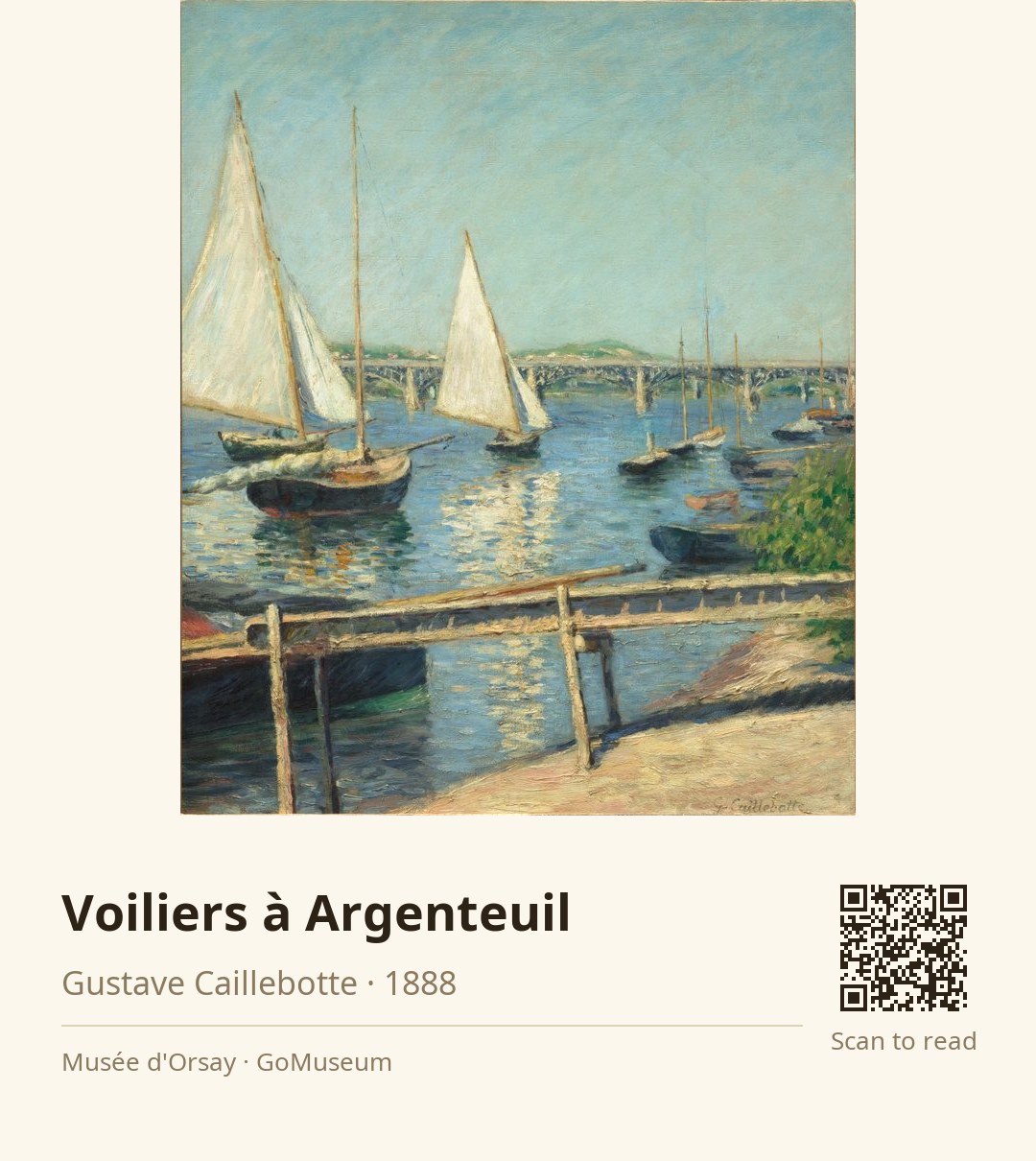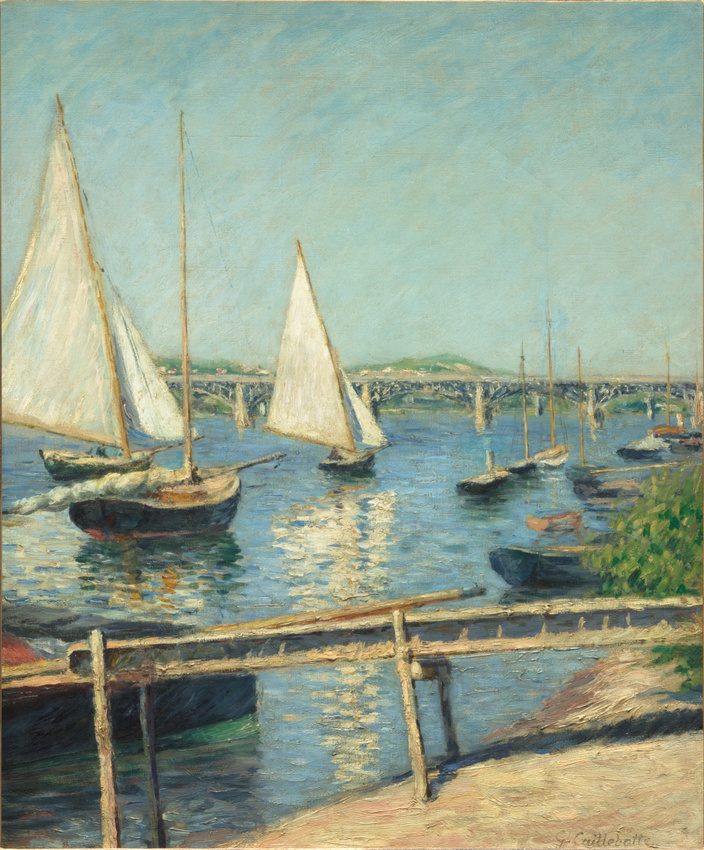
Voiliers à Argenteuil
🎧 This work has audio narration — listen in the appTake a moment to soak in the vibrant scene before you in Gustave Caillebotte's "Voiliers à Argenteuil." Notice how the sunlight dances on the water, creating a shimmering effect that almost invites you to dip your toes into the Seine. Look closely at the two sailboats, their white sails billowing against the blue sky, perfectly capturing a moment of leisure on the river.
These details matter because they reveal Caillebotte's deep passion for sailing and the outdoors, a love that was a significant part of his life. The way he paints the water with delicate lines reflects not just a technical skill, but an emotional connection to the landscape. This was a shift in his style, moving towards the Impressionist technique that emphasizes light and color over strict realism.
Caillebotte painted this piece in 1888, during a time when he was exploring the joys of life along the Seine, particularly in Argenteuil, where he owned a house. While critics at the time dismissed his work as outdated compared to the bold innovations of his contemporaries, today, we recognize his unique contributions to Impressionism.
As you stand here, think about what this scene might have felt like for Caillebotte. What stories do you imagine the boats could tell if they could speak?
Gustave Caillebotte was a French painter born on August 19, 1848, into an affluent Parisian family. His upbringing afforded him the luxury of pursuing art, which he began seriously after serving in the Franco-Prussian War. Caillebotte's early works reflected a realistic style, often capturing contemporary life with a focus on urban scenes and laborers, as seen in his notable painting "The Floor Scrapers." His artistic journey was intertwined with the Impressionist movement, where he played a dual role as both a creator and a patron, supporting fellow artists like Monet and Degas.
Despite his contributions, Caillebotte's work was often overshadowed by his more famous contemporaries, and he did not receive significant recognition until long after his death on February 21, 1894. His collection of Impressionist works, bequeathed to the French state, became a cornerstone of the movement's legacy. Caillebotte's unique perspective, blending realism with the emerging Impressionist style, positioned him as a pivotal figure in art history, though it took a century for his contributions to be fully acknowledged through retrospectives and exhibitions. His legacy continues to resonate, illustrating the complexities of artistic recognition and the evolution of modern art.
Gustave Caillebotte's 'Voiliers à Argenteuil' was painted in 1888, during a transformative period in his artistic journey. This piece was showcased at the 1888 exhibition of the XX in Brussels, a time when the art world was buzzing with the innovations of post-Impressionism. Despite Caillebotte's efforts, his work was met with criticism, deemed outdated compared to the bold styles of his contemporaries. The painting reflects his passion for sailing, a hobby he pursued fervently at his home in Argenteuil, which he purchased in 1887. After his death in 1894, Caillebotte's collection of Impressionist works became a cornerstone for the movement, although it took decades for his contributions to be fully appreciated. Today, 'Voiliers à Argenteuil' resides in the Musée d'Orsay, a testament to its enduring significance in the Impressionist canon.
As you gaze at 'Voiliers à Argenteuil,' take a moment to appreciate Caillebotte's masterful technique. The painting measures 65 by 55.5 centimeters, and the way he captures the shimmering water is nothing short of extraordinary. Notice how he employs small, delicate brush strokes to create a dynamic surface on the Seine, reflecting the light in a way that feels almost alive. Caillebotte borrowed from Claude Monet's approach, using pure colors to depict the sunlight's dance on the water. The composition is carefully structured, with the sailboats positioned to draw your eye across the canvas, while the horizon features the iconic wooden bridge of Argenteuil, grounding the scene. This balance of detail and atmosphere invites you into a moment of serene leisure, making you feel the gentle breeze and warmth of the sun.
One surprising aspect of Caillebotte's life is his deep passion for sailing, which is beautifully reflected in 'Voiliers à Argenteuil.' He was not just a painter but also a skilled sailor and a member of the Paris Sailing Club. In fact, he bought a boat in Argenteuil, where he often painted, allowing him to immerse himself in the very scenes he depicted.
His family's wealth allowed Caillebotte to be a patron of many Impressionist artists, providing financial support and helping to organize exhibitions, which played a crucial role in promoting the movement despite his own work being initially overlooked.
When 'Voiliers à Argenteuil' was first exhibited in 1888, it was criticized as being outdated compared to the more avant-garde works of post-Impressionists, reflecting the shifting tastes in the art world at that time.