Venus in Paphos
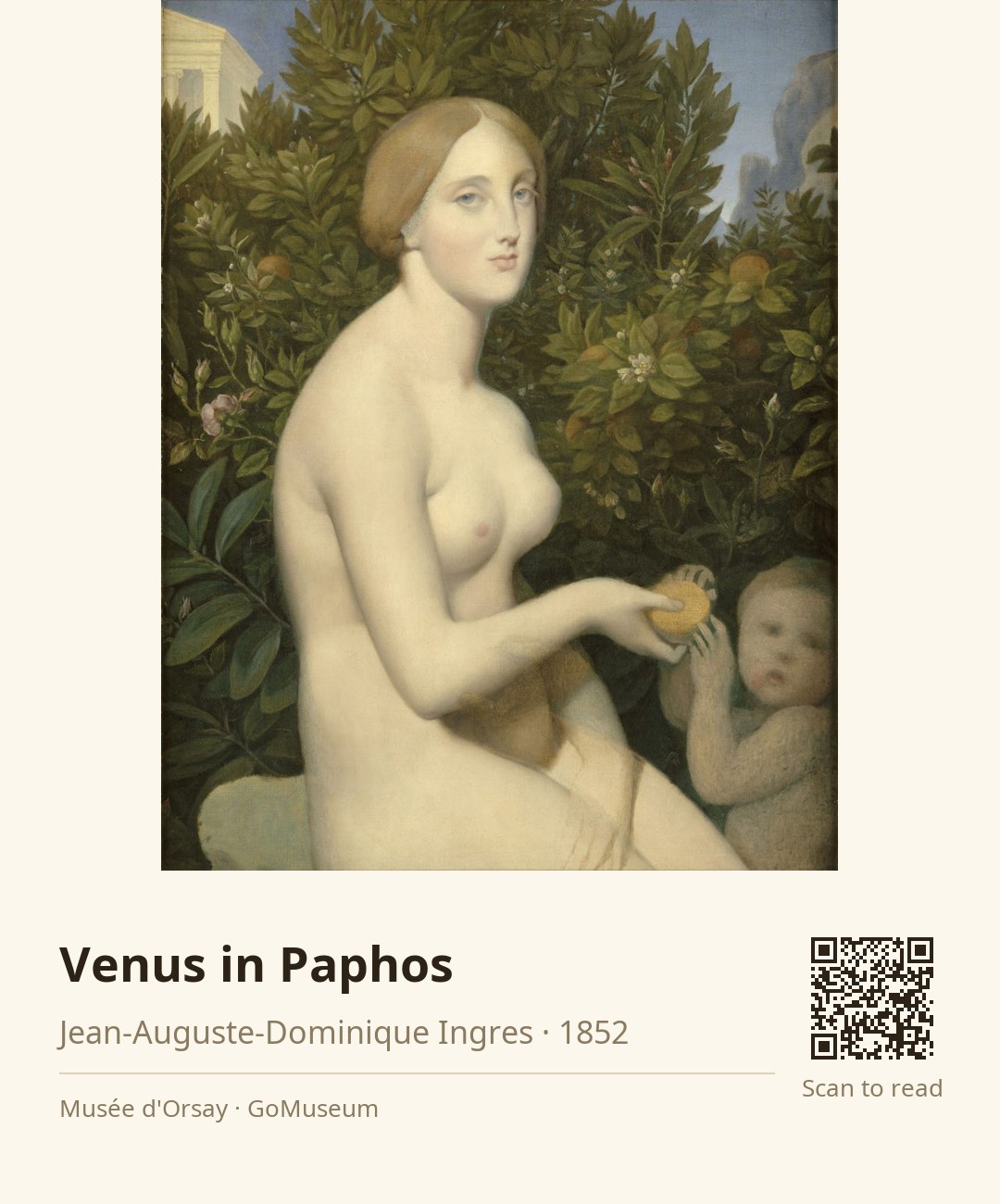
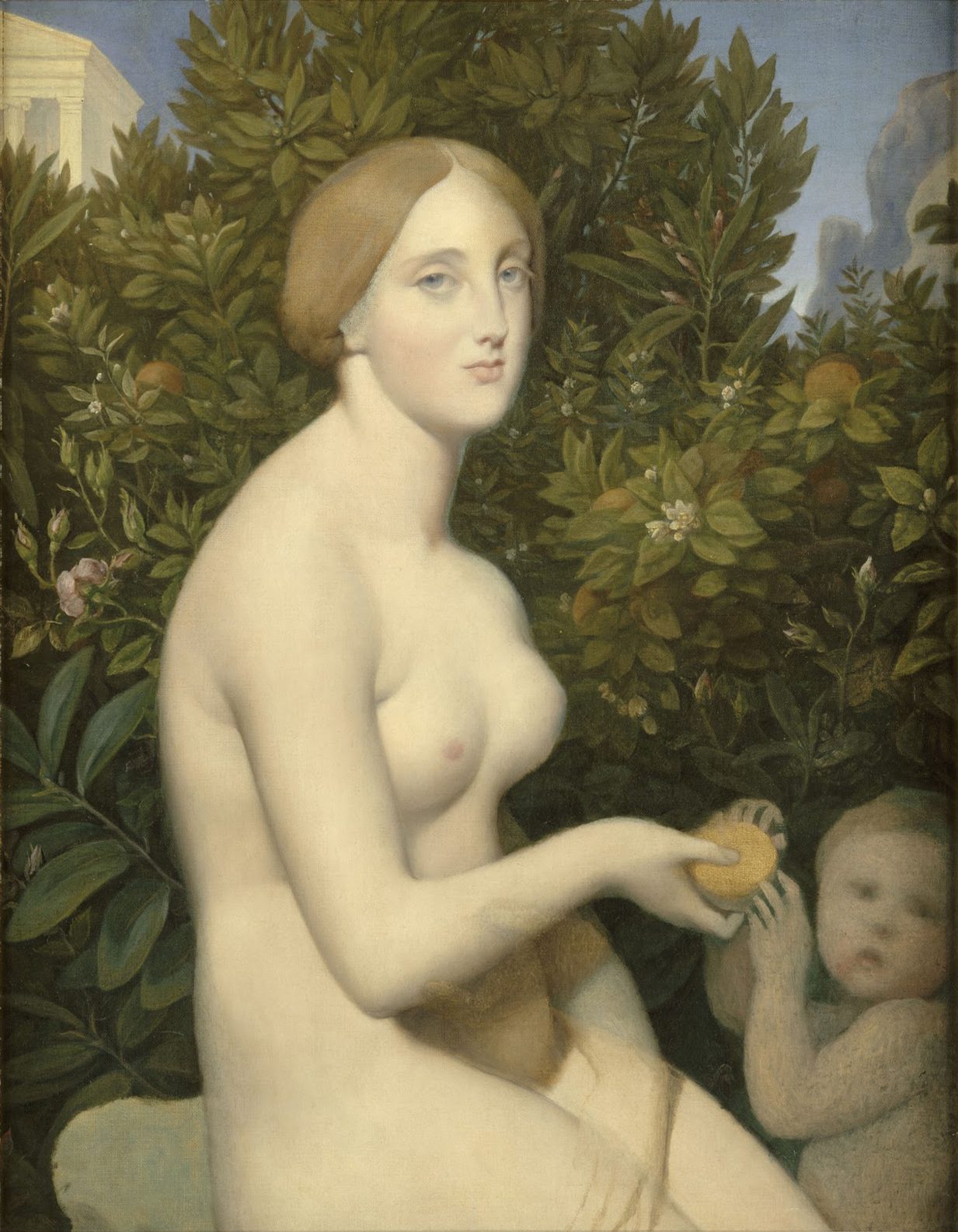
🎧 This work has audio narration — listen in the appTake a moment to really soak in the beauty of "Venus in Paphos." Look closely at the way Venus is posed, her body elegantly draped against the lush greenery, and notice how her gaze meets yours with a captivating confidence. That slight tilt of her head and the way she holds the fruit—it's not just a casual gesture; it’s a symbol of temptation and desire, drawing you into her world.
This painting, created by Jean-Auguste-Dominique Ingres in 1852, is more than just a depiction of the goddess of love; it’s a masterclass in the interplay of light and shadow, and the delicate rendering of skin tones that almost seems to glow. Ingres was known for his meticulous attention to detail, and here, you can see how he captures the softness of Venus’s skin against the vibrant backdrop, making her the undeniable focal point of the piece.
Interestingly, Ingres painted this work in his studio, keeping it close until his death, which adds a layer of intimacy to the piece. It was only later that it found its way to public view, allowing us to appreciate the artist's vision and the beauty of mythological storytelling.
As you stand here, think about the timeless nature of beauty and desire. What does Venus represent for you?
Jean-Auguste-Dominique Ingres was a pivotal figure in French Neoclassicism, born on August 29, 1780, in Montauban. He was the son of a versatile artist, which nurtured his early artistic inclinations. Ingres studied under Jacques-Louis David in Paris, where he developed a commitment to academic traditions, aspiring to elevate history painting above all genres. His early career was marked by struggles, as critics dismissed his style as archaic, yet he persevered, achieving recognition with works like "The Vow of Louis XIII" in 1824.
His portraits, characterized by expressive distortions, became his most celebrated contributions, influencing modern artists such as Matisse and Picasso. Ingres's time in Italy, from 1806 to 1824, was crucial; he immersed himself in the study of Renaissance masters, which shaped his distinctive style. Despite facing criticism for his meticulous approach, he remained steadfast in his vision of beauty, emphasizing drawing over color.
Later in life, he returned to Paris, where he continued to create significant works, including "The Turkish Bath." Ingres's legacy endures as a bridge between classical traditions and modern art, embodying the tension between adherence to established norms and the evolving landscape of artistic expression. He passed away on January 14, 1867, leaving behind a profound impact on the art world.
Jean-Auguste-Dominique Ingres painted 'Venus in Paphos' in 1852, a work that remained in his studio until his death in 1867. After his passing, the artwork was passed to his widow, who entrusted it to Paul Flandrin, a fellow artist and family friend. Following Flandrin's death in 1902, the painting changed hands to Adrien Mithouard. It wasn't until 1981 that 'Venus in Paphos' entered public collections, now residing in the Musée d'Orsay in Paris.
As you gaze at 'Venus in Paphos,' notice how Ingres masterfully employs light and shadow to create depth and dimension. The soft, almost ethereal quality of Venus's skin is achieved through delicate layering of paint, which gives her an almost luminous appearance. The brushwork is meticulous, with fine lines defining her form and the lush greenery surrounding her. The composition is carefully structured; Venus is positioned in a way that draws your eye across the canvas, from her graceful pose to the vibrant fruit in her hand, which symbolizes temptation. The contrasting colors—her pale skin against the rich greens and earthy tones—heighten the sense of allure. The vertical format of the painting adds to the sense of grandeur, making Venus appear almost regal, as if she is a goddess in her own right.
Interestingly, the model for Venus was Madame Antonie Balaÿ, who was born in 1833. Ingres's choice of a real-life figure to embody the goddess adds a layer of intimacy and realism to the mythological scene, bridging the gap between the divine and the human. This connection between model and subject reflects Ingres's dedication to portraying beauty in a way that feels both timeless and personal.
After Ingres's death, the painting remained with his widow before being passed to Paul Flandrin, and later to Adrien Mithouard, illustrating its journey through personal collections before finally entering public view in 1981.