Vase of Peonies on a Pedestal
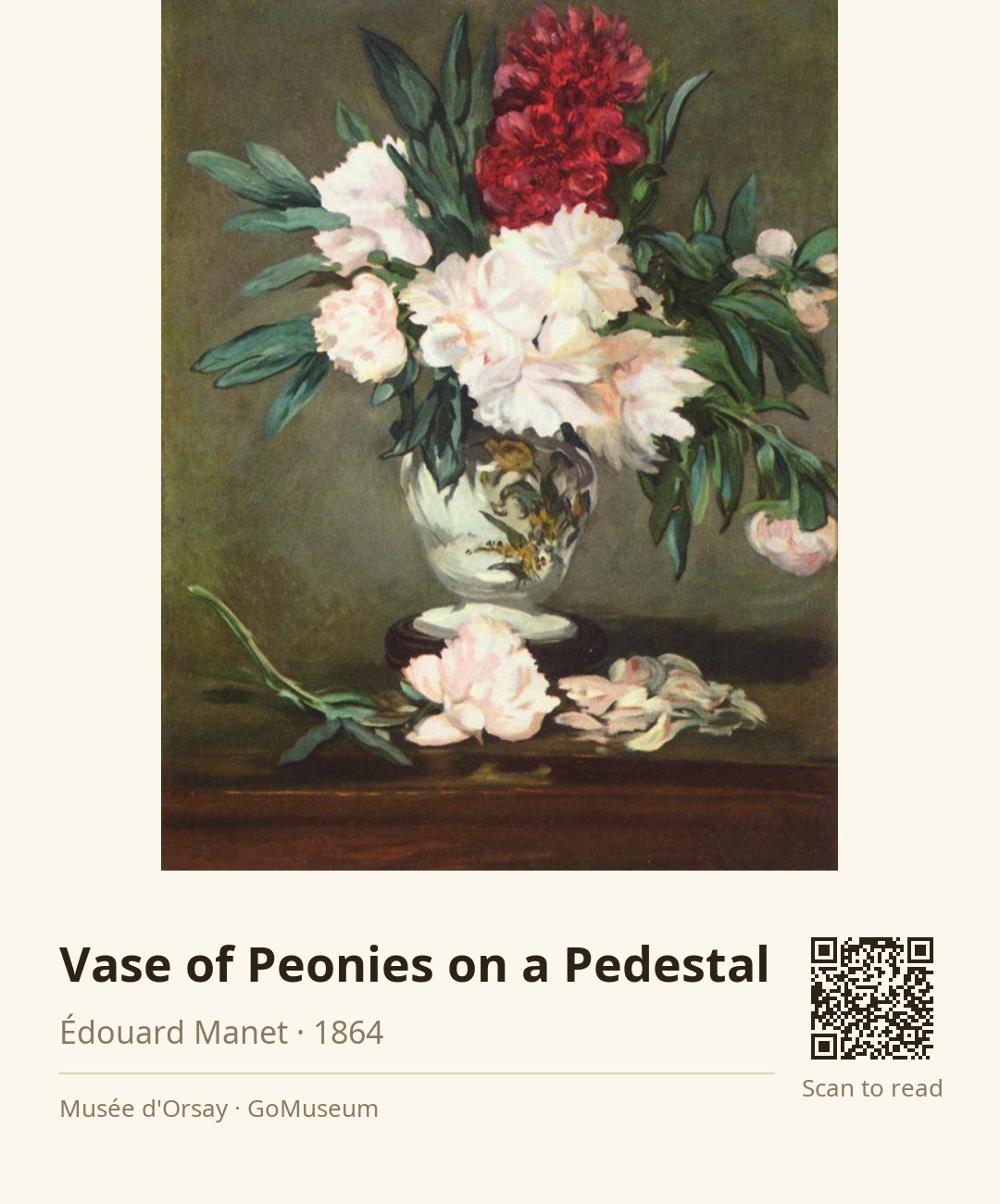
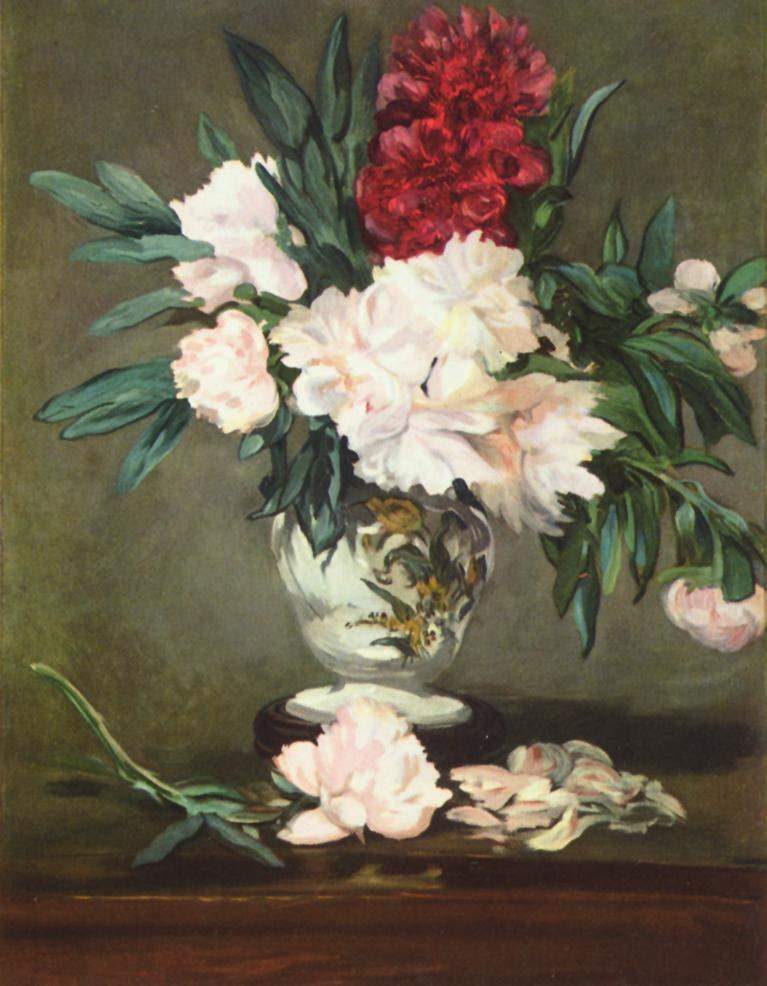
🎧 This work has audio narration — listen in the appThe vibrant peonies in this still life burst forth with a mix of white and deep red blooms, their lush green leaves framing the ornate vase that cradles them. A single pink peony lies on the wooden surface in the foreground, accompanied by scattered petals, inviting a closer look at the delicate brushwork that captures their texture and the glossy surface of the vase.
This arrangement not only showcases Manet's skill in rendering the beauty of flowers but also reflects his innovative approach to still life, elevating it beyond mere decoration to a subject worthy of serious artistic exploration. Painted in 1864, during a time when Manet was establishing his reputation, this work exemplifies his transition from traditional subjects to a more modern interpretation of everyday life. The dark green background contrasts sharply with the vibrant colors of the peonies, drawing the viewer's eye and enhancing the flowers' prominence.
Édouard Manet, born on January 23, 1832, in Paris, emerged as a pivotal figure in 19th-century art, bridging Realism and Impressionism. From an affluent family, he initially faced pressure to pursue a naval career but instead dedicated himself to painting, influenced by his uncle and the Old Masters. His early works, including "The Luncheon on the Grass" and "Olympia," sparked controversy and challenged traditional artistic norms, marking him as a revolutionary force.
Manet's style, characterized by loose brushwork and a focus on contemporary life, diverged from the meticulous techniques of his predecessors. He often depicted modern Parisian scenes, capturing the essence of leisure and social dynamics. Despite initial rejection from the art establishment, he gained recognition among progressive artists and became a mentor to the Impressionists.
Throughout his life, Manet formed connections with influential figures like Baudelaire and Zola, who defended him against critics. His later works, such as "A Bar at the Folies-Bergère," showcased his evolving style and mastery of color. Manet's contributions to art history are profound; he is celebrated not only for his innovative techniques but also for elevating still life and modern subjects to the forefront of artistic expression. He passed away on April 30, 1883, leaving behind a legacy that continues to inspire artists today.
Édouard Manet's 'Vase of Peonies on a Pedestal' was painted in 1864, a pivotal year as he was solidifying his reputation in the art world. This piece was first exhibited at the Martinet in Paris in 1865, where it garnered attention, though not all of it was positive. It later appeared at the 1867 Paris Exposition and was featured again at the Exposition Universelle in 1900, showcasing its enduring appeal. The painting was part of Manet's personal collection until 1872, after which it changed hands several times, including a notable ownership by the art dealer Durand-Ruel.
Manet's slightly slapdash style intrigued young artists and brought new business to his studio, marking a shift in artistic approaches.
Manet was born into an affluent family with strong political ties, but he chose to pursue a career in painting instead of following his father's wishes for him to join the navy.