 Image: Sailko
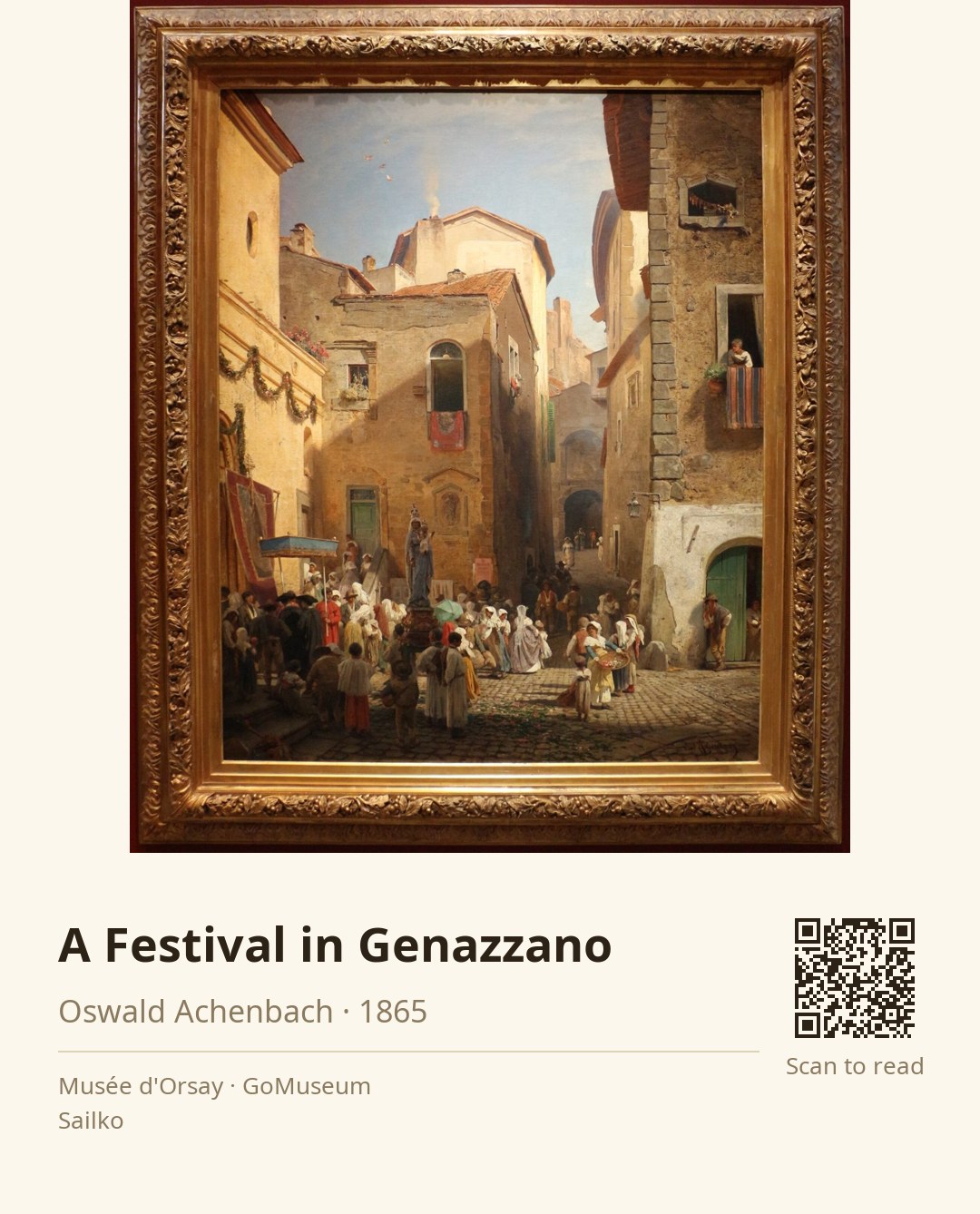
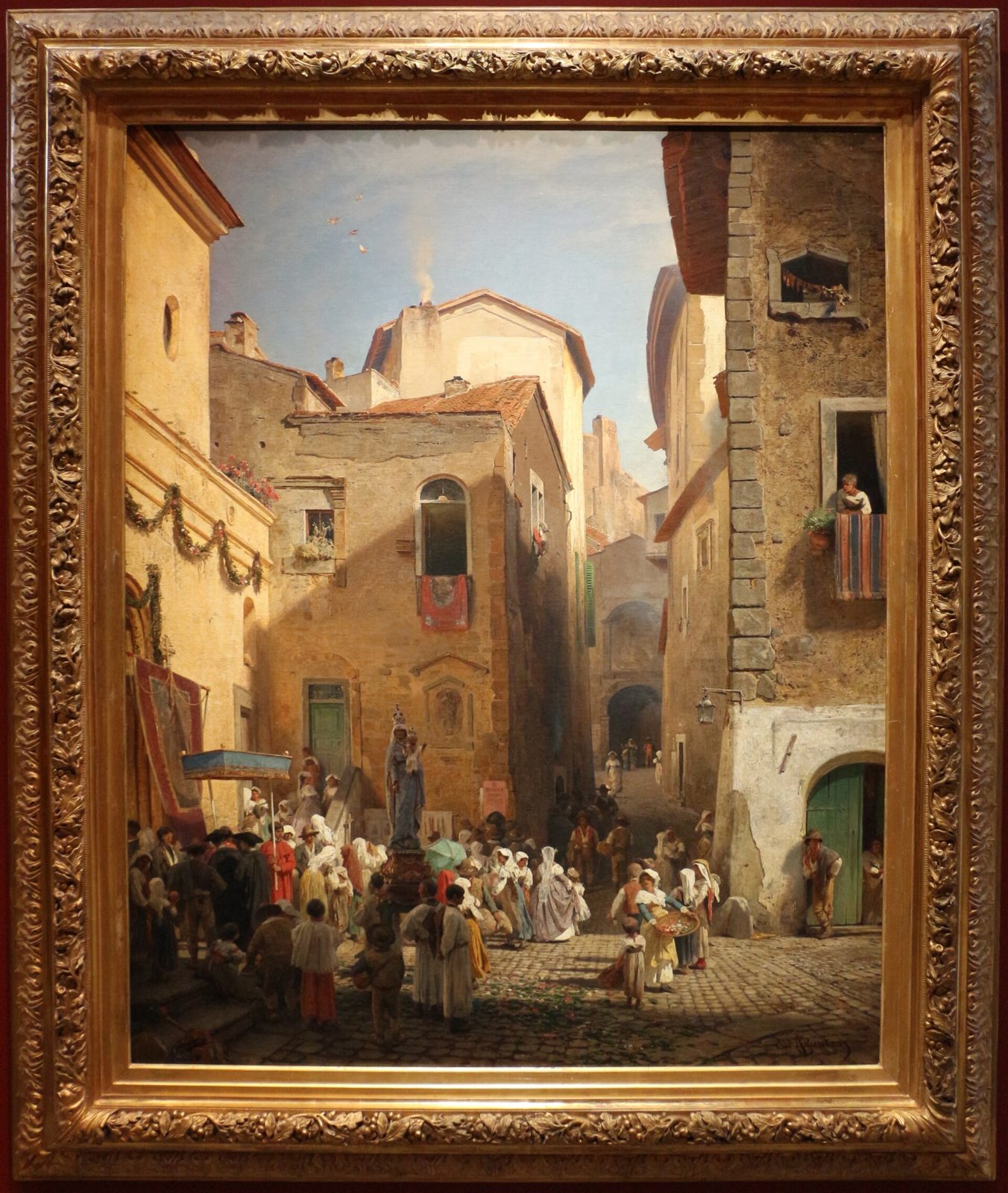
A Festival in Genazzano
🎧 This work has audio narration — listen in the appTake a moment to really absorb the vibrant scene before you in Oswald Achenbach's "A Festival in Genazzano." Notice how the lively procession draws your eyes into the heart of the painting, with figures dressed in colorful attire, celebrating beneath a bright Italian sky. Look closely at the statue of the Virgin and Child, standing majestically amid the festivities. These details aren’t just decorative; they encapsulate the spirit of a community coming together in joy and reverence. The statue symbolizes faith and tradition, grounding the exuberance of the festival in a deeper cultural context. Achenbach, known for his ability to blend landscapes with human activity, captures a moment where the sacred and the social intertwine, inviting you to feel the pulse of 19th-century Italian life. Created in 1865, this piece reflects Achenbach's fascination with Italy, a country he often depicted in his works. His vibrant brushwork and keen eye for detail not only showcase the beauty of the landscape but also the warmth of its people. As you stand here, consider: what stories might the figures in this painting tell if they could speak? What would it feel like to join them in their celebration? Let your imagination wander as you soak in this lively moment frozen in time.
Oswald Achenbach was a prominent German landscape painter born on February 2, 1827, in Düsseldorf, where he passed away on February 1, 1905. As a key figure of the Düsseldorf school of painting, he gained recognition for his vibrant depictions of Italian landscapes, particularly around Naples and Rome. Achenbach was the fifth of ten children in a family with modest means, yet he and his brother Andreas emerged as significant artists of the 19th century, humorously dubbed "the A and O of Landscapes."
Achenbach's artistic journey began early; he enrolled in the Kunstakademie Düsseldorf at just eight years old, defying age restrictions. His education there, though unconventional, laid the groundwork for his future success. He traveled extensively, studying nature and honing his craft, which led to a distinctive style characterized by lively scenes populated with small figures.
In addition to his painting, Achenbach was deeply involved in Düsseldorf's cultural life, co-founding the "Malkasten" association to support fellow artists. His works gained prominence in the newly established Eduard Schulte gallery, which showcased artists outside the rigid confines of the academy. Achenbach's legacy endures as a master of landscape painting, influencing generations of artists and contributing to the evolution of 19th-century art.
Oswald Achenbach's 'A Festival in Genazzano' was created in 1865 and first exhibited at the Salon des artistes français in Paris, where it was assigned the number 9. This was a significant moment for Achenbach, as the Salon was one of the most prestigious venues for artists in France, showcasing works that often defined careers. Over time, it has been included in various exhibitions, such as the Musée d'Orsay's catalog in 1990, which highlights its enduring relevance in the art world. Achenbach, a key figure in the Düsseldorf school of painting, was known for his vibrant landscapes and ability to capture the essence of Italian life, making this work a notable example of his artistic journey.
As you gaze at 'A Festival in Genazzano,' pay attention to Achenbach's dynamic brushwork. The way he applies oil paint creates a sense of movement, almost as if the figures are dancing across the canvas. Notice how the light interacts with the colors; the bright Italian sun casts a warm glow, enhancing the vibrancy of the festival. Achenbach's composition is carefully structured, drawing your eye into the scene with a diagonal flow that leads to the statue of the Virgin and Child. The scale of the figures, set against the expansive sky, emphasizes their connection to the landscape, grounding the celebration in a specific cultural context. Each stroke feels intentional, capturing not just the scene but the very spirit of the moment.
Interestingly, Achenbach was not only a painter but also a vibrant participant in the cultural life of Düsseldorf. He was a founding member of the 'Malkasten' association, where artists gathered to support each other through exhibitions and performances. This community spirit was crucial in an era when artists often struggled against the rigid structures of academic art. Achenbach's involvement in theater and music events showcases his multifaceted talents and deep commitment to the arts beyond just painting.
Achenbach enrolled in the Kunstakademie Düsseldorf at just eight years old, which was against the academy's rules requiring a minimum age of twelve. This early exposure to formal art education, despite its violation of guidelines, likely accelerated his artistic growth and skill development.
Achenbach was a founding member of the 'Malkasten' association, where he actively participated in theater and music events, showcasing his talents beyond painting. His involvement in these cultural activities highlights his commitment to the arts and the community of artists in Düsseldorf.