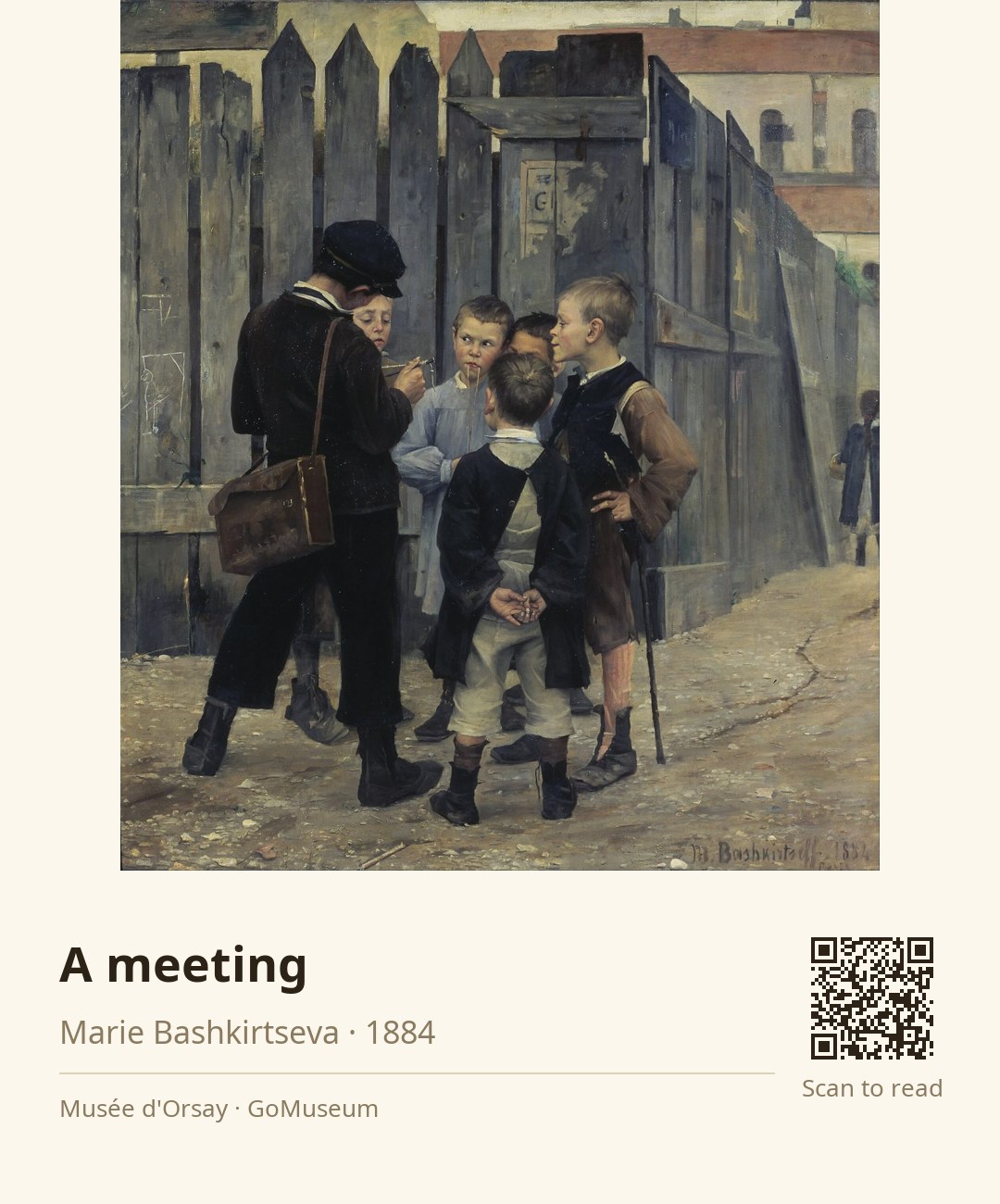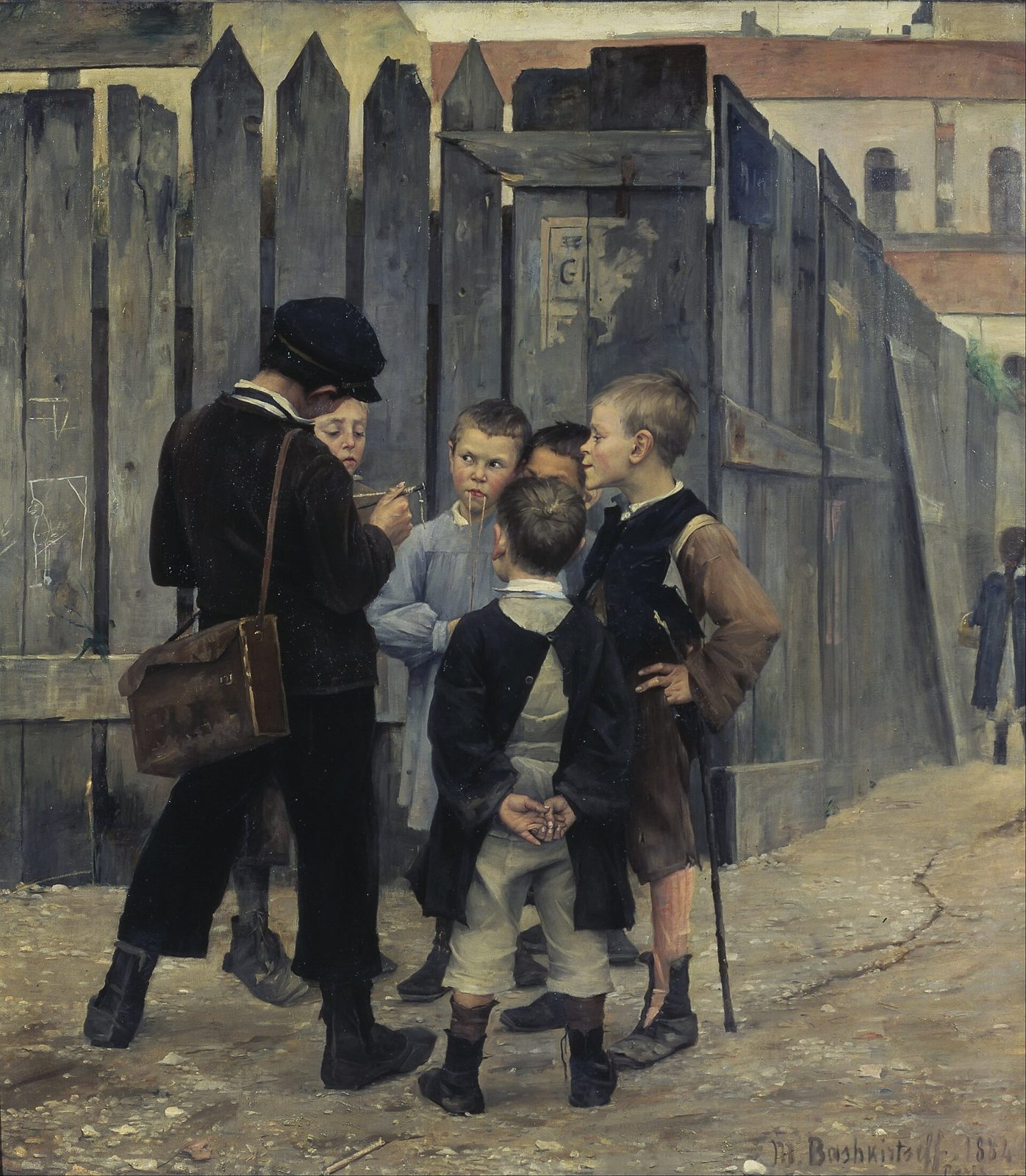
Take a moment to really look at "A Meeting" by Marie Bashkirtseva. Notice how the children are gathered together, their expressions a mix of curiosity and mischief. Look closely at the way their clothes hang loosely, hinting at their poverty, yet their faces radiate a sense of joy and camaraderie. These details are crucial because they capture a fleeting moment of innocence amidst hardship. Bashkirtseva, who herself faced significant struggles in life, was deeply empathetic to the plight of the less fortunate. By portraying these children with such warmth and vitality, she invites us to see their humanity, challenging the viewer to reflect on social issues of her time. Born into a noble family in Ukraine, Bashkirtseva moved to Paris, where she became a prominent figure in the art scene despite her short life, cut tragically short by tuberculosis at just 25. As you stand here, think about the stories these children might tell if they could speak. What dreams do you think they hold? Bashkirtseva’s brush brings them to life, asking us to remember and honor their existence.
Marie Bashkirtseff, born into a noble family in the Russian Empire in 1858, was a passionate artist and diarist who left a significant mark on the art world despite her brief life. After her parents' separation, she traveled extensively across Europe with her mother, eventually settling in Paris, where she pursued her artistic ambitions. Bashkirtseff studied at the Académie Julian, one of the few institutions that welcomed female students, and quickly established herself in the Parisian art scene.
Her works, characterized by realism and a focus on urban life, include notable pieces like "The Meeting," which portrays impoverished children in Paris, and "In the Studio," depicting her fellow artists. Bashkirtseff's talent was recognized at the Paris Salon, where she exhibited annually until her untimely death from tuberculosis at age 25.
Beyond her painting, she is celebrated for her candid journal, which offers a vivid psychological portrait of her ambitions and struggles, reflecting the complexities of a young woman in the late 19th century. Her writings, published posthumously, reveal her desire for fame and her keen observations of society. Bashkirtseff's legacy endures, as she is remembered not only for her art but also for her pioneering voice as a woman in a male-dominated field.
Marie Bashkirtseva's 'A Meeting' was created in 1884 and exhibited at the Salon des artistes français in Paris the same year, where it was assigned the number 116. This was a significant moment for Bashkirtseva, who had been striving to make her mark in the art world. The painting depicts a poignant scene of impoverished children, capturing their innocence and joy amidst hardship. Despite her short life, ending tragically at just 25 due to tuberculosis, Bashkirtseva's work resonated deeply with audiences, and 'A Meeting' remains one of her most celebrated pieces. The painting is now housed in the Musée d'Orsay, a testament to its lasting impact.
As you gaze at 'A Meeting', notice the vibrant brushwork that seems to dance across the canvas. Bashkirtseva employed a loose, expressive technique, allowing the oil paint to flow and blend, creating a sense of movement and life. The use of light is particularly striking; it bathes the children's faces in a warm glow, emphasizing their expressions of curiosity and mischief. The composition is thoughtfully structured, drawing your eye to the cluster of children while leaving the background somewhat undefined, which enhances the focus on their interactions. The scale of the painting, nearly two meters high, invites you to step closer, immersing you in their world. Each stroke feels deliberate, as if Bashkirtseva is inviting you to share in this fleeting moment of joy, despite the underlying themes of poverty and struggle.
One surprising aspect of Marie Bashkirtseva's life is that she was not only a talented painter but also a prolific writer. Her diary, which she began keeping at the age of 12, has been described as a strikingly modern psychological self-portrait. It offers a candid glimpse into her thoughts and feelings, revealing her ambitions and fears about her health and legacy.
Bashkirtseva studied at the Académie Julian in Paris, one of the few art schools that accepted female students at the time, which allowed her to connect with other aspiring women artists and develop her skills in a supportive environment.
Struggling with tuberculosis from a young age, Bashkirtseva's health issues not only influenced her sense of urgency in creating art but also shaped the themes of struggle and resilience in her work, as she often depicted the lives of the less fortunate.
Her diary, published posthumously, provides a candid and modern psychological portrait of her life, capturing her ambitions and fears, and has been recognized as an important feminist text, reflecting the struggles of women artists in the late 19th century.