Still Life: Japanese Vase with Roses and Anemones
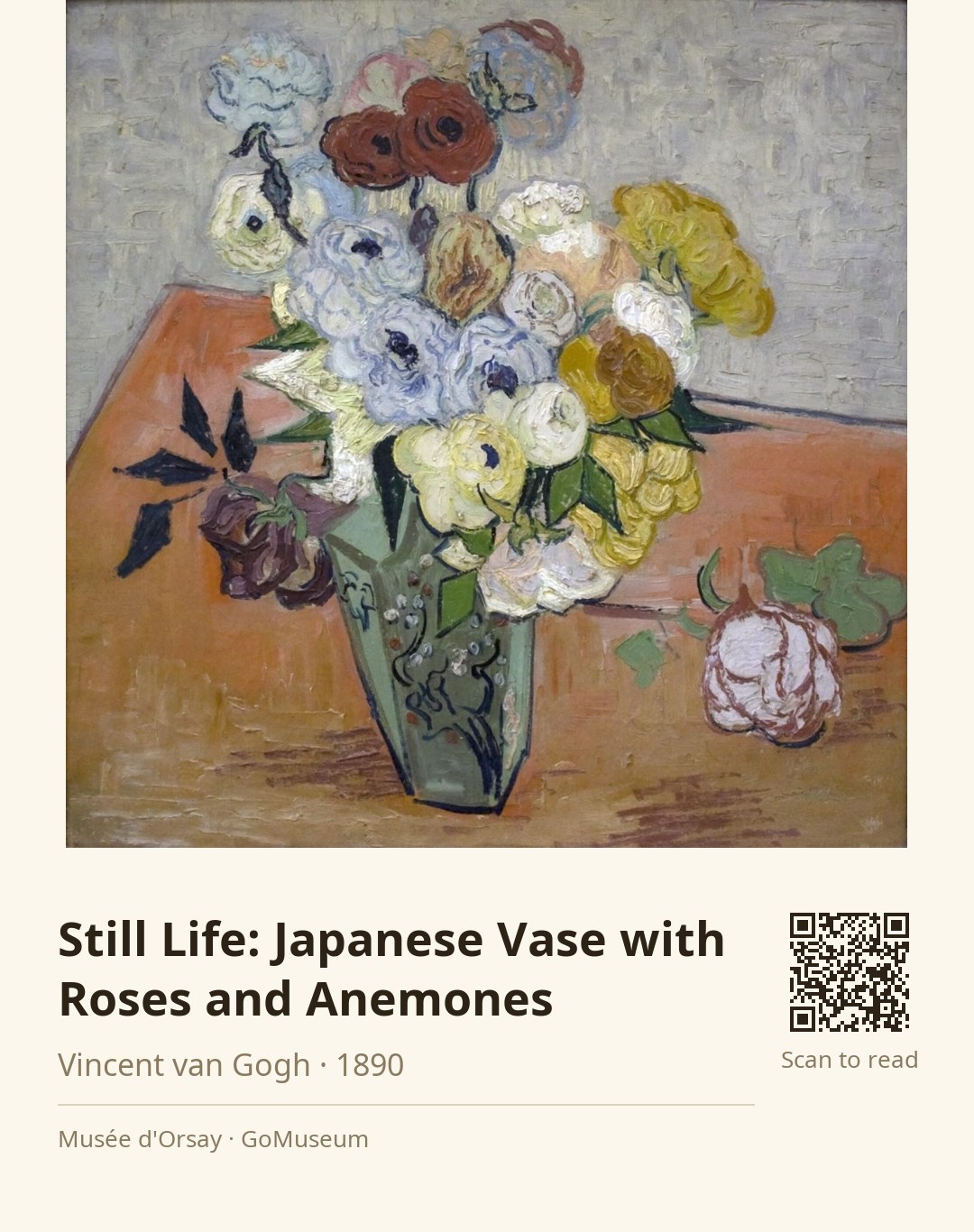
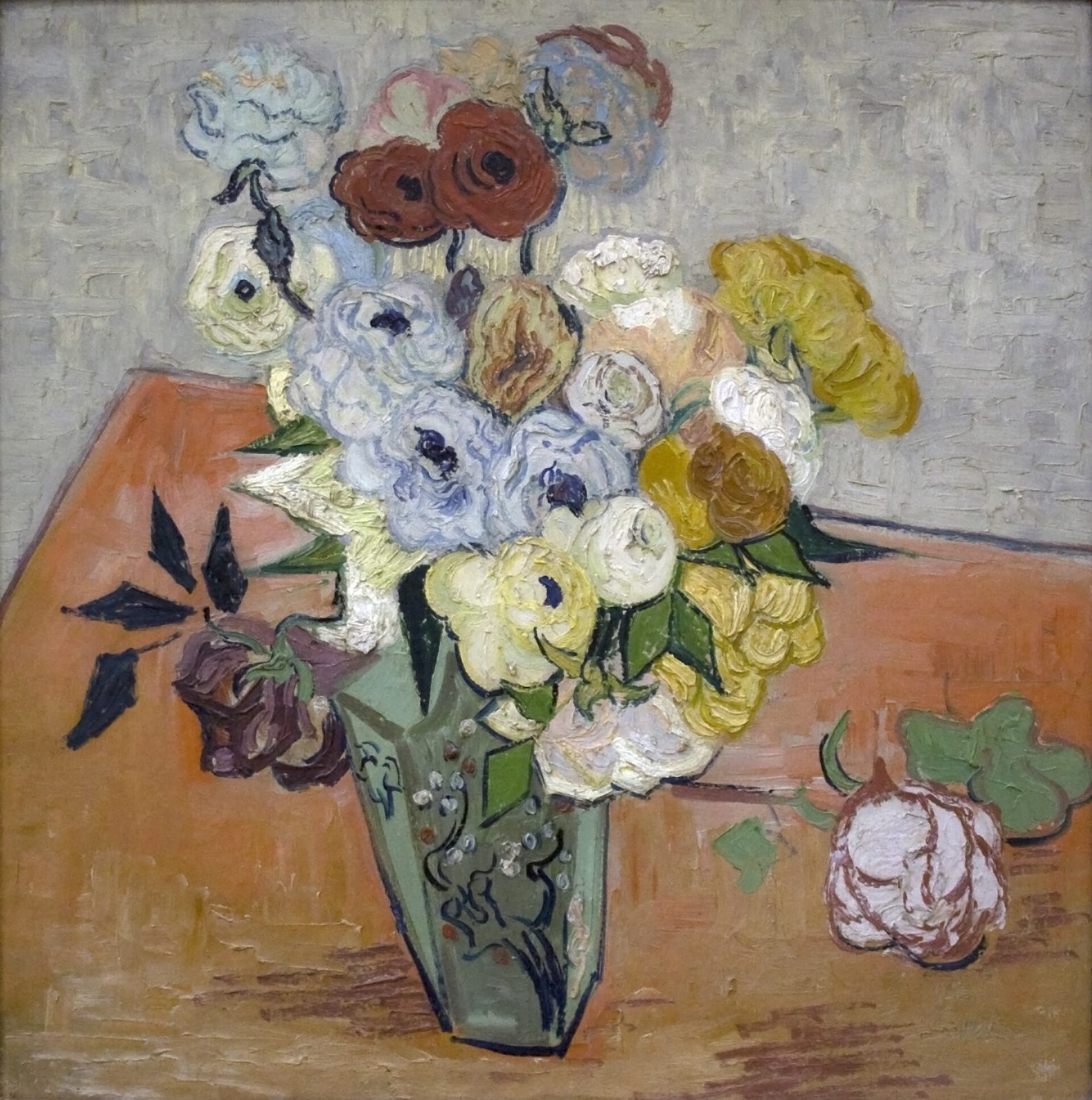
🎧 This work has audio narration — listen in the appThe vibrant bouquet in Vincent van Gogh's "Still Life: Japanese Vase with Roses and Anemones" bursts with colors that dance across the canvas. The delicate petals of the roses and anemones, rendered in shades of white, yellow, and blue, draw the eye, while the green vase, adorned with intricate patterns, anchors the composition. A single flower rests on the warm, earthy orange table, contrasting beautifully with the cooler tones of the blooms.
This interplay of colors and textures reveals Van Gogh's mastery of oil painting, where each brushstroke adds depth and emotion to the scene. The slightly off-center arrangement of the bouquet creates a dynamic visual interest, inviting viewers to explore the nuances of each flower. The muted gray background serves to elevate the vibrancy of the flowers, emphasizing their beauty and the artist's skill in capturing the essence of nature.
Created in 1890, this work reflects Van Gogh's evolving style during his final years, where he embraced bold colors and expressive brushwork. The painting is part of a broader exploration of still lifes that Van Gogh undertook, showcasing his fascination with the interplay of light and form. This piece, like many of his works, was influenced by his studies of Japanese art and aesthetics, which he admired greatly.
Vincent van Gogh was a Dutch Post-Impressionist painter born on March 30, 1853, in Zundert. He is renowned for his vibrant use of color and expressive brushwork, which laid the groundwork for modern art. Despite creating around 2,100 artworks in just over a decade, including 860 oil paintings, he struggled with mental illness and poverty throughout his life. His early career as an art dealer was marked by disillusionment, leading him to pursue painting in 1881.
Van Gogh's intense passion for art was evident in his correspondence with his brother Theo, who provided emotional and financial support. His works evolved significantly after moving to Paris in 1886, where he mingled with avant-garde artists. His time in Arles in 1888 marked a peak in his creativity, producing iconic series like sunflowers and wheat fields.
Tragically, van Gogh's life ended in suicide at 37, after years of battling his demons. Initially unrecognized, he gained fame posthumously, becoming a symbol of the tortured artist. His legacy influenced movements like Fauvism and Expressionism, securing his place as one of the most significant figures in art history.
In 'Still Life: Japanese Vase with Roses and Anemones', Van Gogh employs thick, expressive brushstrokes that create a palpable texture, inviting you to feel the petals' softness and the vase's coolness. The vibrant colors are not just for show; they are carefully chosen to evoke emotion and energy. The green vase, with its intricate patterns, stands out against the muted gray background, which serves to amplify the flowers' vivid hues. The slightly off-center arrangement of the bouquet adds a sense of movement, drawing your eye around the canvas. Van Gogh's technique of layering paint creates depth, making the flowers appear almost three-dimensional. This bold handling of oil paint showcases his mastery and his desire to capture the essence of nature in a way that transcends mere representation.
One surprising aspect of 'Still Life: Japanese Vase with Roses and Anemones' is that Van Gogh painted it while living in the Auberge Ravoux, a small inn in Auvers-sur-Oise, where he was under the care of Dr. Gachet. This inn was a place of both refuge and turmoil for Van Gogh, as he struggled with his mental health.