Faust and Marguerite in the Garden
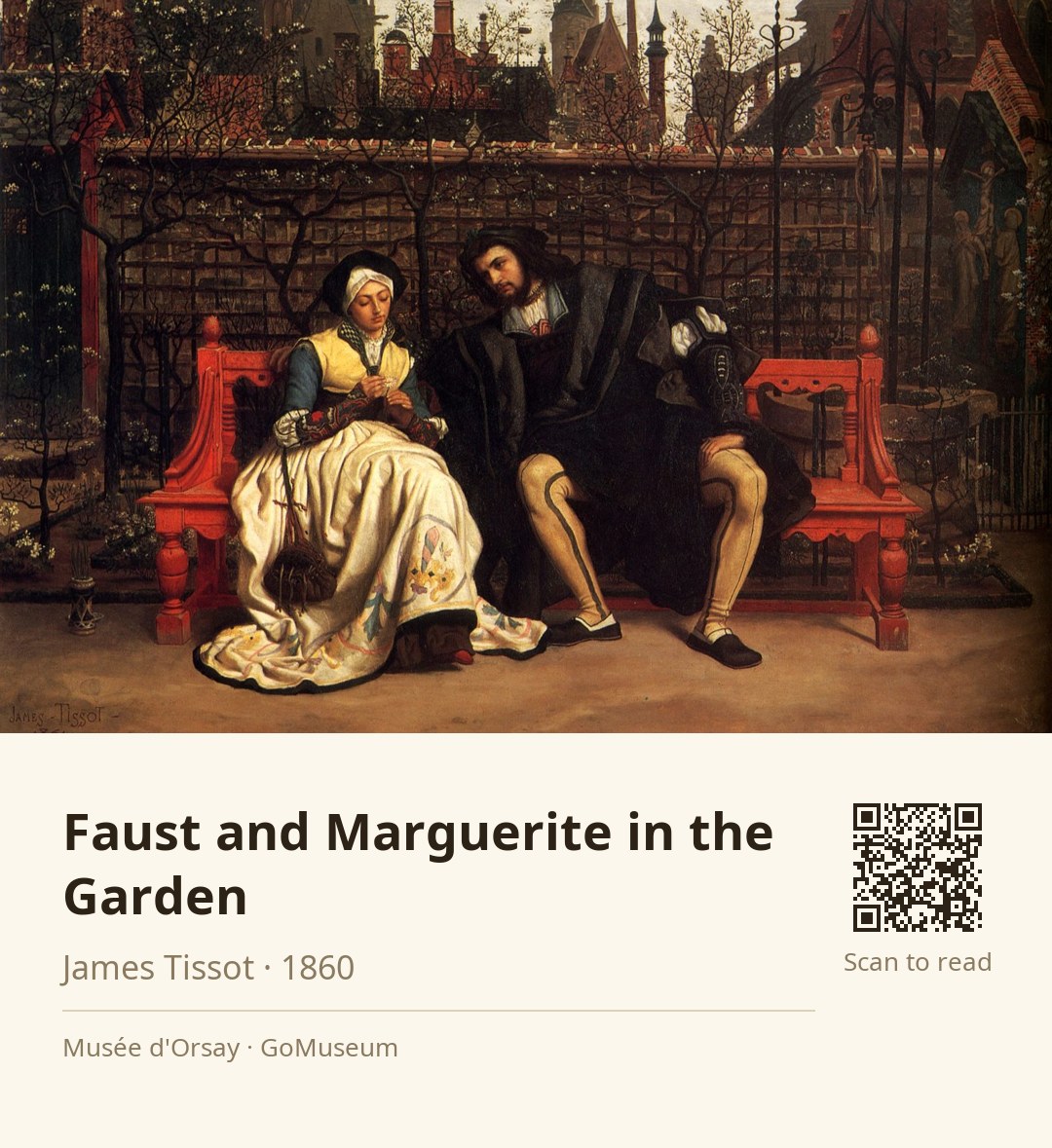
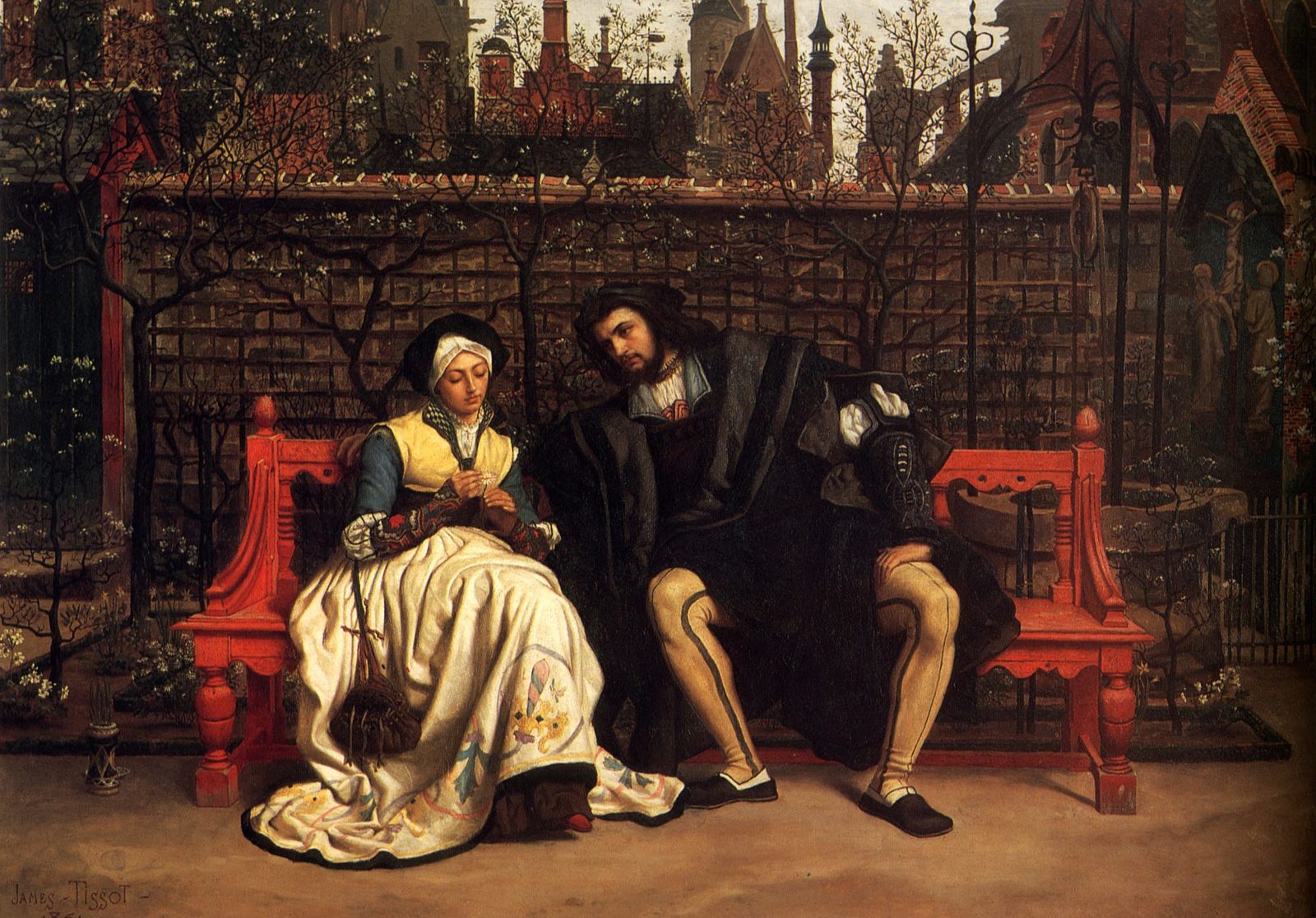
🎧 This work has audio narration — listen in the appFaust leans toward Marguerite, who is absorbed in her needlework on a vibrant red bench, surrounded by the lush greenery of a garden. The contrast between her blue and yellow dress and the dark, elaborate attire of Faust creates a striking visual dialogue, hinting at the tension between their worlds.
This moment captures the essence of their relationship, a blend of innocence and temptation, as Marguerite's focus on her craft suggests a life of domesticity, while Faust’s presence introduces an air of intrigue and desire. The brick wall and bare trees in the background hint at an urban setting, grounding their romantic encounter in a more complex reality, where societal expectations loom just beyond the garden's confines.
Tissot, influenced by Goethe’s "Faust," painted this scene in 1860, a time when he was transitioning from medieval themes to contemporary narratives. His meticulous attention to detail reflects his background in academic art, while the lush colors and textures reveal the emerging influence of Impressionism. The painting was exhibited at the Salon des artistes français in Paris in 1861, where it garnered significant attention and was acquired by the French government.
James Tissot, born Jacques Joseph Tissot in Nantes in 1836, was a French painter and illustrator renowned for his depictions of Victorian high society and women's fashion during the Belle Époque. Initially trained at the École des Beaux-Arts in Paris, he embraced realism and impressionistic techniques, capturing the nuances of contemporary life. Tissot's early works focused on medieval themes, but after moving to London in 1871, he shifted to genre paintings that resonated with British audiences, earning acclaim for his photorealistic style.
His tumultuous life included service in the Franco-Prussian War and a close relationship with Kathleen Newton, who inspired many of his works until her untimely death. Tissot's social circle included notable figures like Edgar Degas and James Whistler, reflecting his integration into the artistic elite. Later in life, he experienced a religious awakening, leading him to create biblical subjects that garnered significant recognition. Tissot's legacy endures as a pivotal figure in 19th-century art, bridging traditional techniques with modern themes, ultimately earning him a place in art history. He passed away in 1902, leaving behind a rich tapestry of works that continue to captivate audiences.
In 1860, James Tissot created 'Faust and Marguerite in the Garden,' a painting inspired by Goethe's 'Faust.' This piece was commissioned by the French government, reflecting Tissot's rising prominence in the art world. It was first exhibited at the Salon des artistes français in Paris in 1861, where it was assigned inventory number 2972 and quickly garnered attention. The painting's success marked a turning point in Tissot's career, as it showcased his transition from medieval themes to contemporary narratives. Following its exhibition, the painting was acquired by the French state, solidifying Tissot's reputation. Over the years, it has been included in various exhibitions, such as the Musée du Luxembourg in 1874 and the Grand Palais in 1974, further establishing its significance in art history.
The artist employs a meticulous brushwork style that captures the intricate textures of the clothing and the lushness of the garden. The vibrant colors, particularly the reds and blues, create a striking contrast that draws the viewer into the scene. The composition is carefully balanced, with Faust's dark attire juxtaposed against Marguerite's bright outfit, emphasizing the tension between their worlds. The background elements, like the brick wall and bare trees, are rendered with precision, grounding the romantic moment in a more complex urban reality. This attention to detail not only showcases Tissot's academic training but also hints at the emerging Impressionist influences in his work.
Tissot had significant relationships with key figures in the Impressionist movement, such as Whistler and Degas, which influenced his artistic development and exposure to new styles.
Growing up in a family involved in fashion likely inspired Tissot's meticulous attention to detail in depicting women's clothing and styles in his artwork.