Running deer in Plaisir-Fontaine creek
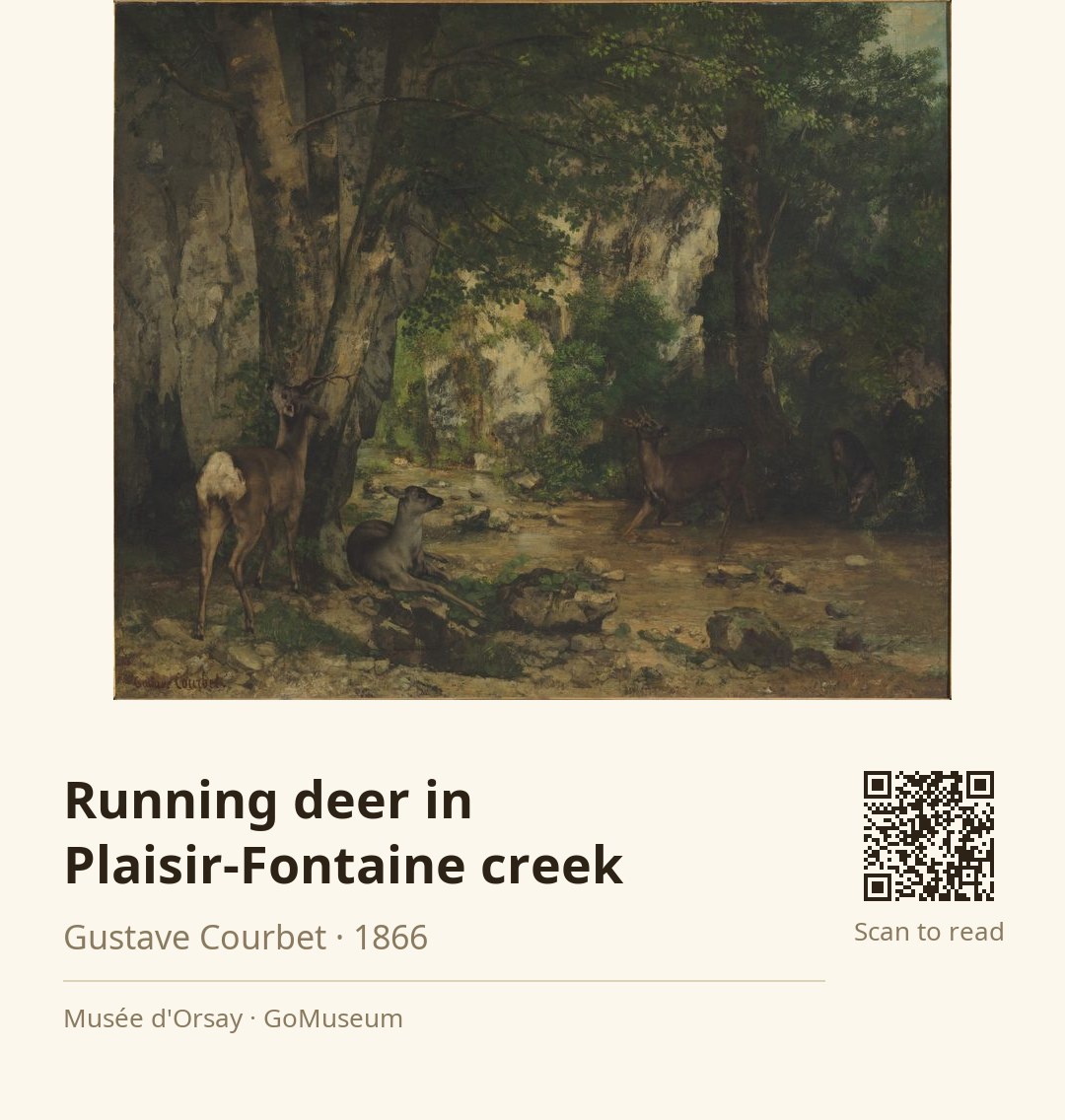
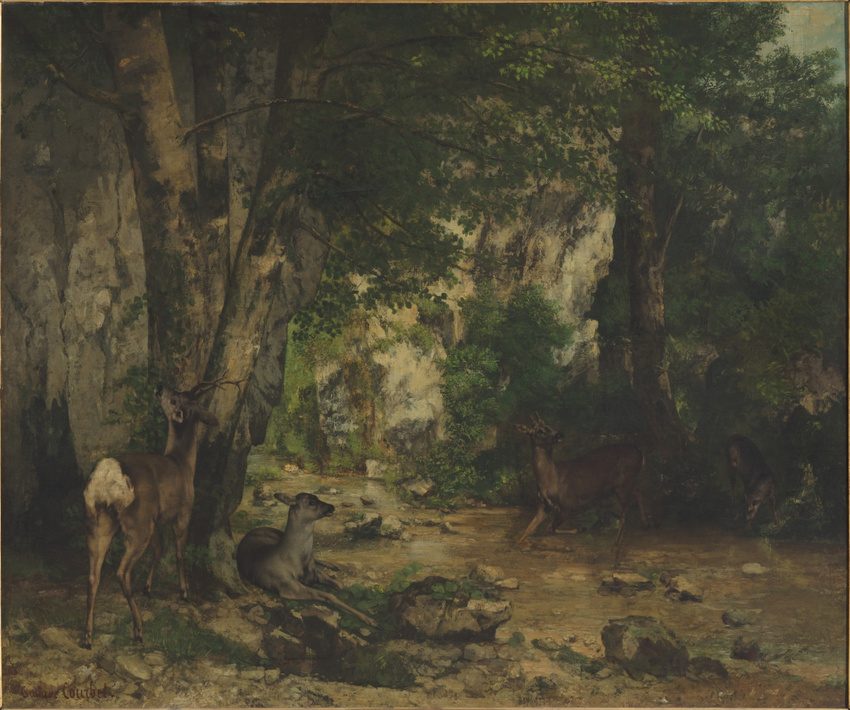
🎧 This work has audio narration — listen in the appA deer stands gracefully near a large tree in Gustave Courbet's "Running Deer in Plaisir-Fontaine Creek," painted in 1866. To its side, another deer rests comfortably on the forest floor, while a third deer, partially hidden in the shadows, adds a sense of intrigue to the scene. The rich, earthy browns and vibrant greens of the landscape create a serene atmosphere, with dappled sunlight filtering through the dense foliage, highlighting the intricate textures of the trees and the deer's fur.
Courbet's choice to depict these deer in their natural habitat reflects his commitment to realism, capturing the beauty of the animal world while immersing the viewer in the tranquility of the forest. The composition, with its balanced arrangement of deer and the surrounding environment, invites contemplation of nature's harmony.
Gustave Courbet, born on June 10, 1819, in Ornans, France, was a pioneering painter who championed the Realism movement in 19th-century art. Rejecting the conventions of academic painting and the idealism of Romanticism, he focused on depicting the world as he observed it, often portraying unidealized peasants and workers in monumental compositions. His early works gained recognition, notably "After Dinner at Ornans," which won him a gold medal at the Salon of 1849, allowing him to exhibit without jury approval.
Courbet's commitment to realism was revolutionary; he believed that art should stem from personal experience rather than historical or mythological themes. His bold approach often sparked controversy, challenging societal norms and addressing social issues, which resonated with later movements like Impressionism and Cubism. Despite facing criticism and imprisonment for his political involvement during the Paris Commune, Courbet continued to create until his death on December 31, 1877, in Switzerland.
His legacy endures as a transformative figure in art history, whose unflinching depictions of everyday life laid the groundwork for modern artistic expression. Today, Courbet is celebrated for his vigorous and uncompromising work, which continues to engage audiences with its raw honesty and depth.
Gustave Courbet's 'Running Deer in Plaisir-Fontaine Creek' was painted in 1866 and first exhibited at the Salon des Artistes français in Paris, where it was assigned the number 464. This painting, which showcases Courbet's deep connection to nature and realism, was later acquired by the Louvre in 1890 and has been housed at the Musée d'Orsay since 1986. Its provenance traces back to the Lepel-Cointet sale in Paris in 1881 and later to the Secrétan sale in 1889. The reception of the work was part of a broader movement where Courbet's commitment to depicting the natural world challenged the artistic conventions of his time, earning him both admiration and criticism from contemporaries.
The brushwork is meticulous, capturing the fine details of the deer’s fur and the textures of the surrounding foliage. The earthy palette of browns and greens not only reflects the natural environment but also evokes a sense of serenity. Courbet's handling of light is particularly striking; dappled sunlight filters through the dense canopy, creating a dynamic interplay of light and shadow that brings the scene to life. The composition is carefully balanced, with the deer positioned in a way that guides the viewer's eye through the painting, inviting them to explore the tranquil forest setting. This attention to detail and the naturalistic portrayal of the deer reflect Courbet's belief in painting from direct observation.
Interestingly, Courbet often used his own experiences and surroundings as inspiration for his paintings. He was known to spend time in the forests of his native Franche-Comté, observing the wildlife and landscapes, which fueled his passion for realism. This personal connection to nature not only informed his artistic choices but also reflected his broader philosophy of art being rooted in the artist's own experiences.
Courbet spent time in the forests of his native Franche-Comté, where he observed wildlife and landscapes that inspired his passion for realism in his artwork.
At its first exhibition, the painting was part of a broader movement that challenged artistic conventions, earning Courbet both admiration and criticism from his contemporaries.
Courbet's involvement with the Paris Commune led to his imprisonment and eventual exile in Switzerland, impacting his later years and artistic output.