 Image: Jean-Pierre Dalbéra from Paris, France
Evening Prayer in the Sahara
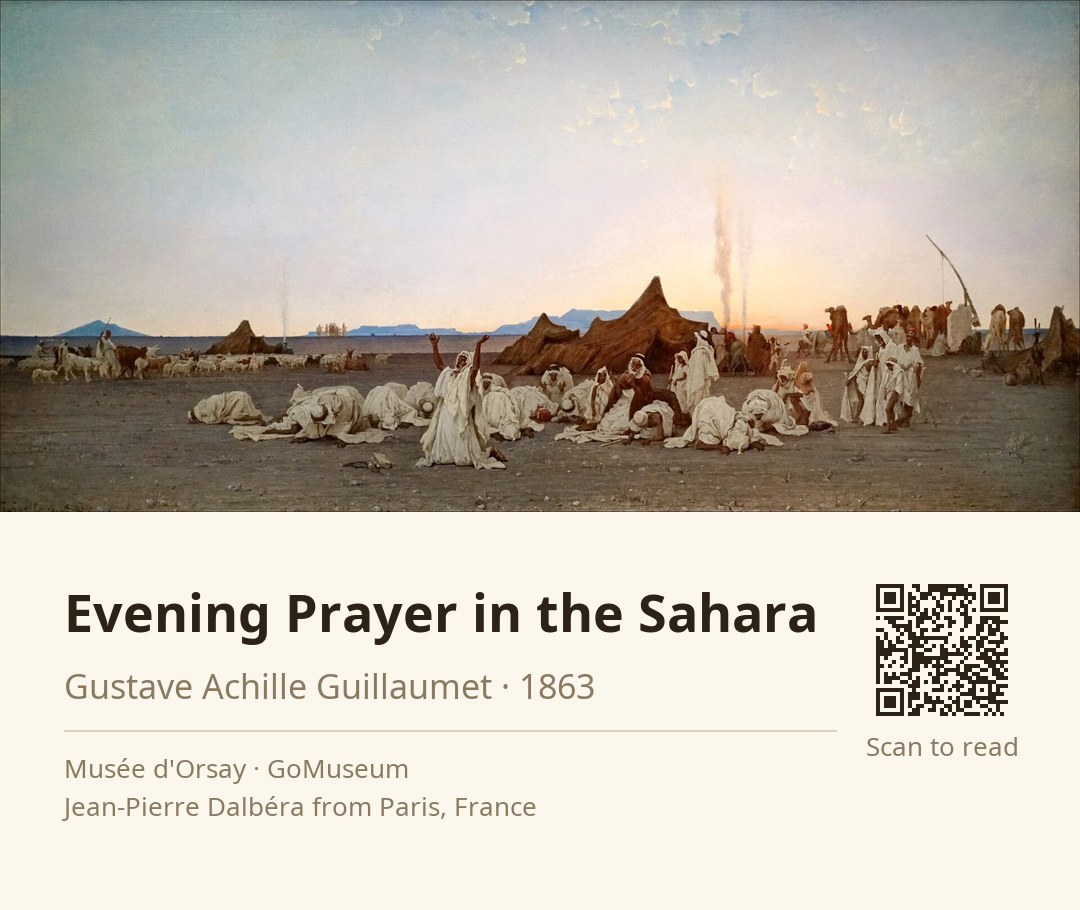
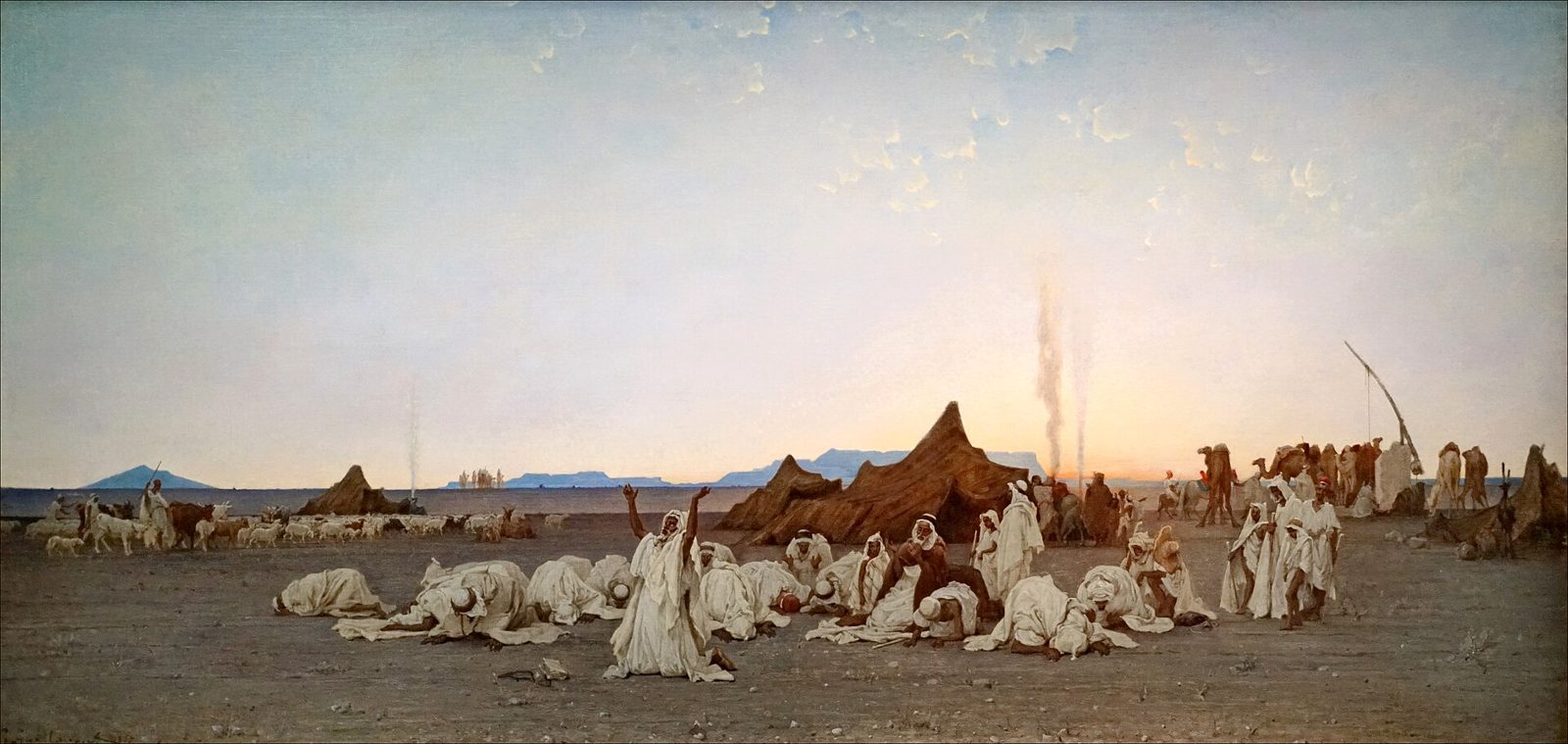
🎧 This work has audio narration — listen in the appA group of men in white robes kneels in the fading light of the Sahara, their bodies forming a solemn rhythm against the vast desert landscape. One figure stands apart, arms raised towards the sky, embodying a moment of spiritual connection as smoke curls from nearby campfires. The scene captures the essence of Maghrib prayer, a ritual of devotion set against the expansive backdrop of distant mountains and a sky painted with the warm hues of sunset.
This portrayal of prayer in the desert reflects not only the physical act of worship but also the profound solitude and serenity of the environment. Guillaumet’s choice to depict the men in various stages of prostration emphasizes the communal aspect of their faith, while the absence of women suggests a masculine interpretation of this sacred space. The calmness of the air, indicated by the gentle rise of smoke, enhances the sense of stillness and contemplation that permeates the scene.
Guillaumet, captivated by Algeria, made nine visits to the region, immersing himself in its culture and landscape during a time of colonial expansion. His works, including this painting, reveal a nuanced understanding of the harsh realities faced by the people living in the desert, contrasting the romanticized views often held by European artists. Completed in 1863, "Evening Prayer in the Sahara" was exhibited at the Salon that same year, where it garnered acclaim and was awarded a medal, marking a significant moment in Guillaumet's career.
Gustave Achille Guillaumet was a French painter born on March 26, 1840, in Puteaux, near Paris. His artistic journey began under the tutelage of notable instructors at the École nationale supérieure des Beaux-Arts, where he developed a keen interest in landscape painting. Guillaumet's career took a pivotal turn when he traveled to Algeria in 1861, seeking inspiration after failing to win a scholarship. This journey sparked a deep connection with North Africa, leading him to explore the region ten times over the next few years.
His works stand out for their raw and honest depiction of desert life, contrasting with the romanticized portrayals typical of Orientalism. Notable pieces like "The Sahara" and "Evening Prayer in the Sahara" reflect the harsh realities of the environment and its inhabitants. Guillaumet's commitment to authenticity earned him recognition, culminating in his appointment as a Knight of the Legion of Honour in 1878.
Despite his artistic success, Guillaumet's personal life was tumultuous. He died in Paris on March 14, 1887, under tragic circumstances, leaving behind a legacy that continues to influence the portrayal of North African landscapes in art. His posthumous publication, "Tableaux Algériens," further solidified his place in art history as a pioneer of realistic representation in a genre often marred by fantasy. Guillaumet is remembered not only for his artistic contributions but also for his unflinching gaze at the complexities of colonial life.
Gustave Achille Guillaumet's 'Evening Prayer in the Sahara' was completed in 1863, during a time when Algeria was under French colonial rule. Guillaumet, captivated by the region, made nine visits to Algeria, immersing himself in its culture and landscapes. The work was exhibited at the Salon in 1863, where it received a warm reception, winning a medal and being purchased by the state. Over the years, it has been part of several prestigious collections, including the Musée du Luxembourg and the Louvre, before finding its home in the Musée d’Orsay in 1982. Its journey through various exhibitions, including the Exposition Universelle, highlights its significance in the art world and the evolving perception of North African landscapes in European art.
In 'Evening Prayer in the Sahara,' Guillaumet employs oil on canvas to create a vast, immersive landscape that captures the essence of the desert. The scale of the painting, measuring over three meters wide, invites viewers into the expansive scene, emphasizing the isolation and serenity of the setting. Guillaumet's brushwork is deliberate yet fluid, allowing the warm hues of the sunset to blend seamlessly into the cool blues of the fading day. The figures, dressed in white robes, are rendered with a careful attention to detail, showcasing their various postures in prayer. The central figure, arms raised, draws the eye, creating a focal point that contrasts with the kneeling men. The smoke rising from the campfires adds a layer of atmosphere, enhancing the sense of calm and spirituality. Guillaumet’s technique strips away unnecessary distractions, focusing on the interplay between the figures and the vastness of the desert, evoking a profound sense of place and moment.
Guillaumet's work is pivotal in the context of Orientalist art, marking a shift towards a more nuanced representation of North African life. Unlike many of his contemporaries, who often romanticized the region, Guillaumet's paintings reflect the harsh realities faced by the people living in the desert. His focus on the spiritual aspect of daily life, particularly through the lens of prayer, offers a counter-narrative to the prevailing stereotypes of the time. This painting not only influenced future artists exploring similar themes but also contributed to a broader understanding of the complexities of colonial encounters, making it a significant piece in the evolution of modern art.
Interestingly, while 'Evening Prayer in the Sahara' is celebrated for its depiction of a spiritual moment, it contains inaccuracies regarding Islamic prayer poses, particularly the stance of the central figure. This discrepancy highlights Guillaumet's artistic interpretation rather than a strict adherence to religious practices, revealing the complexities of representing cultures through an outsider's lens.
The painting inaccurately represents Islamic prayer poses, especially in the stance of the central figure, which is not recognized in actual Islamic prayer.
Guillaumet visited Algeria nine times after his first stay in 1862, where he contracted malaria and spent three months in a military hospital.
Guillaumet lamented the loss of the unique and evocative culture of Algiers, attributing it to the detrimental effects of modern progress and economic exploitation.