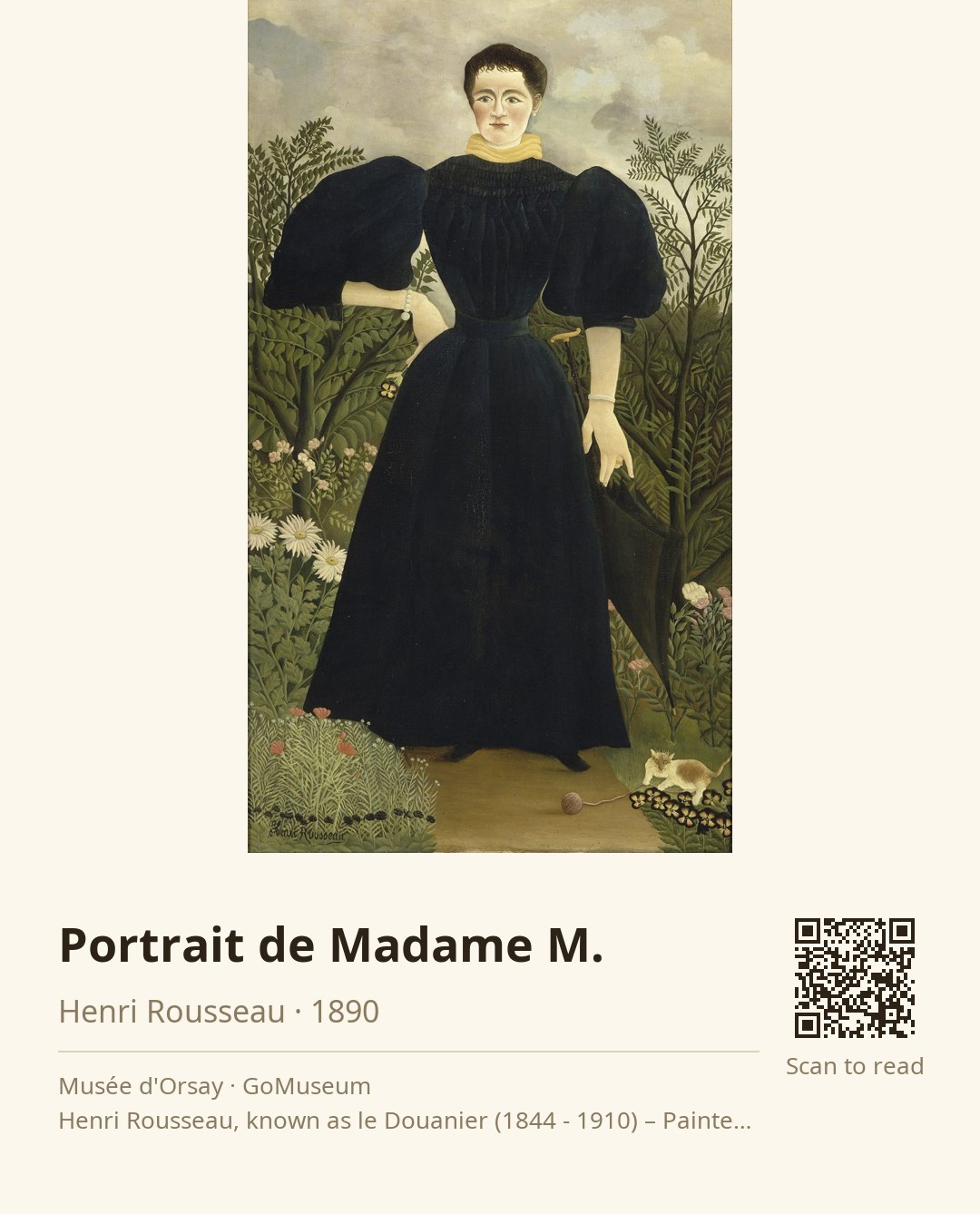
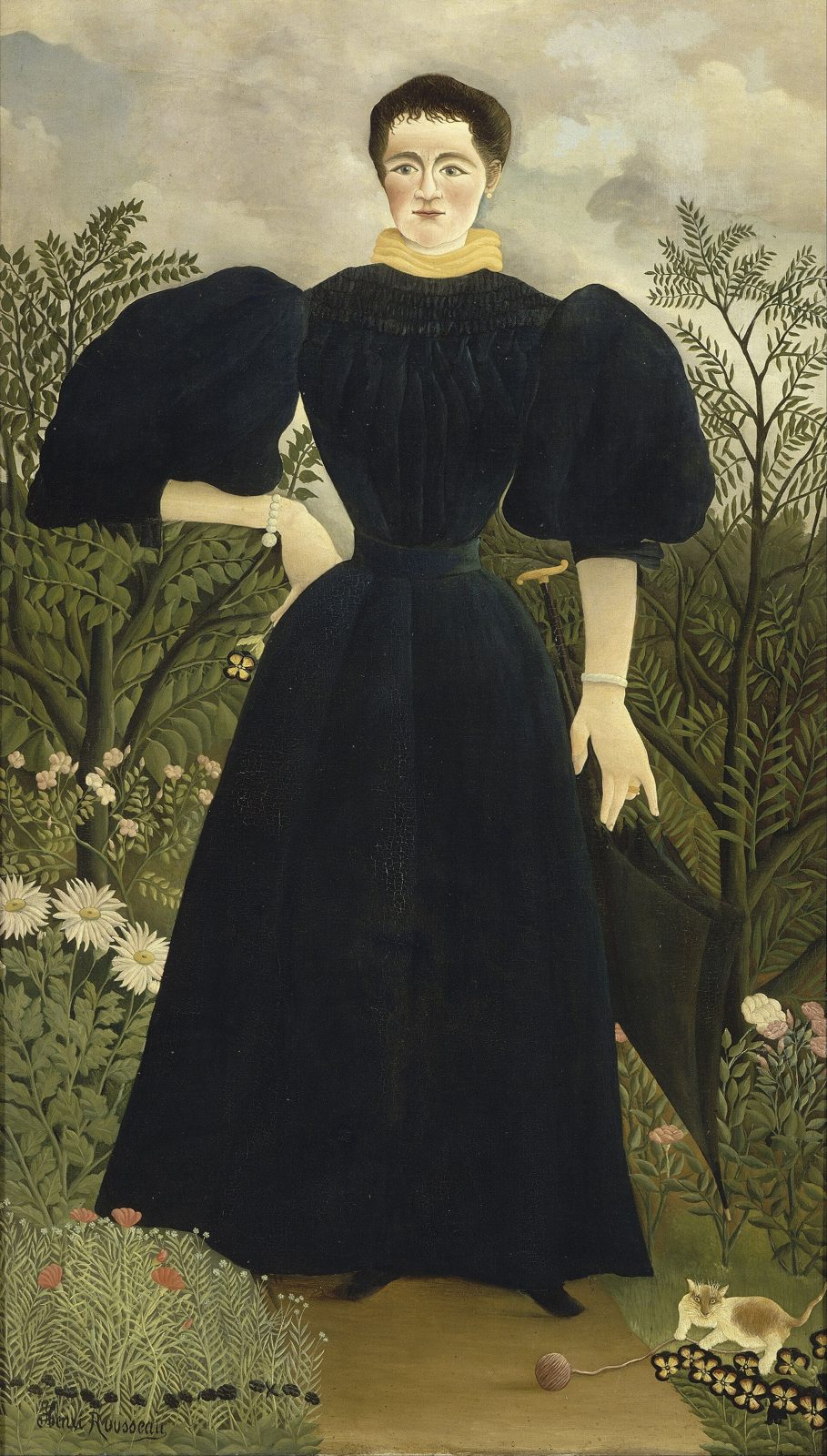
 Image: Henri Rousseau, known as le Douanier (1844 - 1910) – Painter (French) Born in Laval. Died in Paris. Details on Google Art Project
Portrait de Madame M.
🎧 This work has audio narration — listen in the appTake a moment to really look at "Portrait de Madame M." by Henri Rousseau. Notice how the woman stands confidently in her dark dress, an umbrella in hand, surrounded by lush greenery. The way the leaves seem to almost cradle her adds a sense of intimacy, doesn’t it? These details matter because they reveal Rousseau's unique style—his naive approach transforms a simple portrait into a vibrant moment of life. The garden setting isn’t just a backdrop; it’s a world of its own, hinting at the tranquility and perhaps the complexity of the subject's life. Rousseau, often dismissed in his time, was a self-taught artist who painted from his imagination, drawing inspiration from the botanical gardens of Paris rather than exotic jungles. As you stand here, think about the contrast between Rousseau’s humble beginnings as a customs officer and the way he captured the essence of his subjects with such warmth and vibrancy.
Henri Rousseau, born on May 21, 1844, in Laval, France, was a self-taught painter who became a pivotal figure in the Naïve art movement. Known as "Le Douanier" due to his job as a customs officer, he began painting seriously in his forties after a modest life marked by early hardship and family responsibilities. Despite facing ridicule from critics during his lifetime, Rousseau's unique style, characterized by vivid colors and dreamlike jungle scenes, garnered a devoted following.
His works, inspired by visits to the Natural History Museum and botanical gardens in Paris, often depicted fantastical landscapes, despite his never having traveled outside France. He exhibited regularly at the Salon des indépendants, where his painting "Surprised!" received acclaim from fellow artists, including Félix Vallotton. By the end of his life, Rousseau was celebrated by avant-garde figures like Pablo Picasso, who recognized his genius and honored him with a banquet in 1908.
Rousseau's influence on modern art is profound, impacting generations of artists, including the Surrealists and the Fauves. His legacy endures as a testament to the power of imagination and the beauty of simplicity in art. He passed away on September 2, 1910, in Paris, leaving behind a body of work that continues to inspire and captivate audiences worldwide.
The painting was later exhibited at the Grand Palais in Paris in 1984, where it was recognized as a significant work within Rousseau's oeuvre. Its provenance traces back through notable collectors, including Suermondt and the Gourgaud family, which adds layers to its history. Despite being ridiculed during his lifetime, Rousseau's work began to receive more serious attention as the years passed, hinting at the shifting tides of art appreciation that would eventually elevate him to a celebrated status.
As you gaze at 'Portrait de Madame M.', pay attention to Rousseau's distinctive brushwork. His technique combines bold strokes with a meticulous layering of paint, creating a texture that feels almost alive. The colors he chose are rich yet harmonious, with deep greens enveloping the subject, giving a sense of depth and intimacy. Notice how the light filters through the foliage, casting gentle shadows that enhance the three-dimensionality of the figure. stands confidently in the foreground, her dark dress contrasting beautifully against the vibrant garden behind her. This juxtaposition draws your eye directly to her, making her the undeniable focal point. Rousseau’s choice to depict her with an umbrella suggests a playful interaction with the environment, inviting you to ponder the relationship between the subject and her lush surroundings.
This painting, with its vivid colors and childlike simplicity, challenged the established norms of realism and academic painting. Rousseau, often ridiculed during his lifetime, ultimately influenced a wave of avant-garde artists, including the likes of Picasso and the Fauves. They saw in his work a raw, unfiltered vision of the world, one that resonated with their own explorations of color and form. Remember, this painting is not just a portrait; it's a bridge to a new artistic language that celebrates imagination over technical precision.
Did you know that Henri Rousseau, often called 'Le Douanier' because of his job as a customs officer, didn't start painting seriously until he was in his forties? It's a fascinating twist that this self-taught artist, who faced ridicule for his naive style, eventually became a major influence on avant-garde artists like Picasso. His journey from a tax collector to a celebrated painter is a testament to the power of passion and perseverance.
Rousseau's use of color and light is particularly notable; he employed a technique of layering paint that creates a vivid, almost glowing effect, which is sometimes missed in the overall composition.
Many viewers might not notice the small cat playing with a ball of yarn in the garden, which adds a playful element to the scene and hints at the subject's domestic life.