 Image: Sailko
portraif ofa Russian Girl
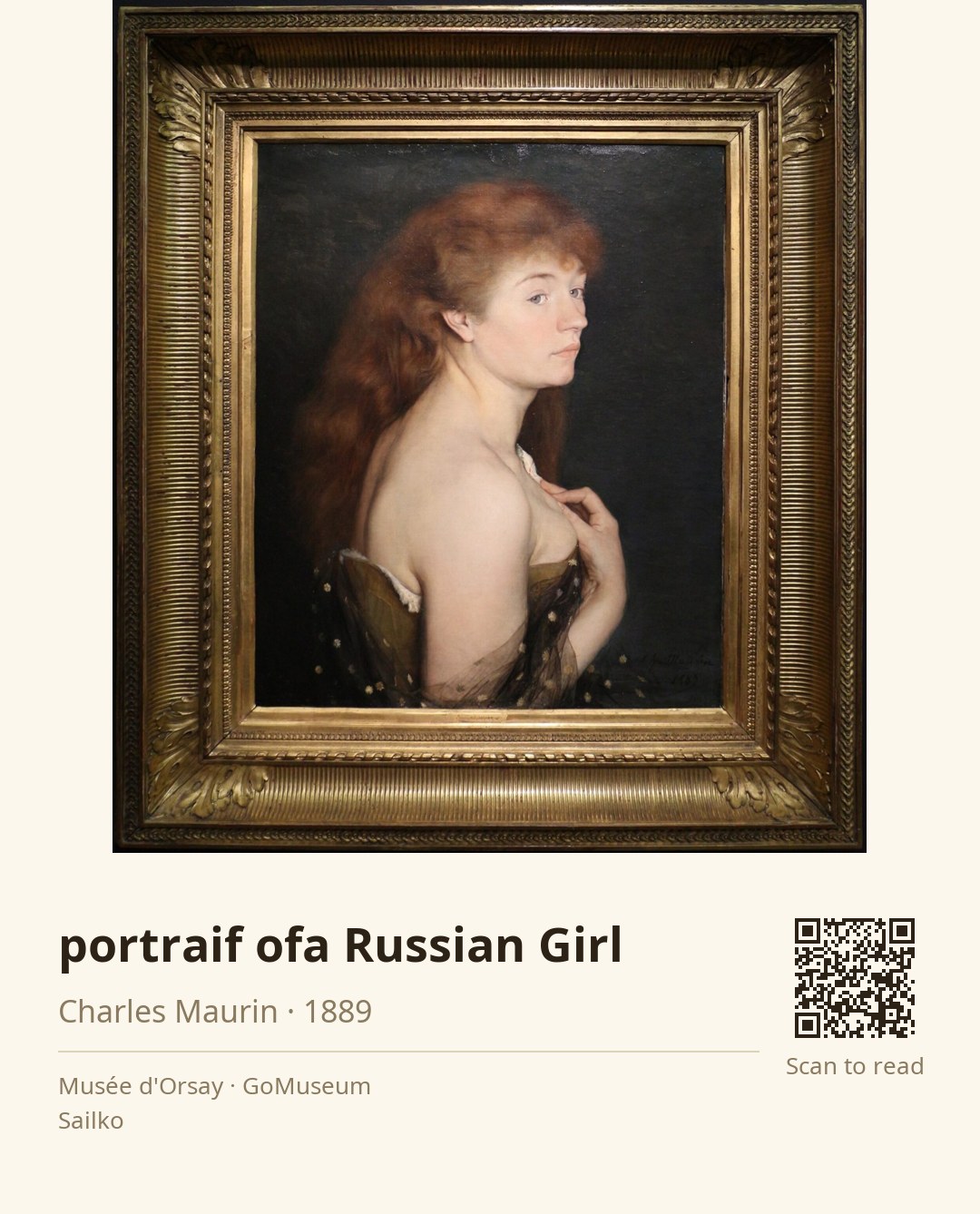
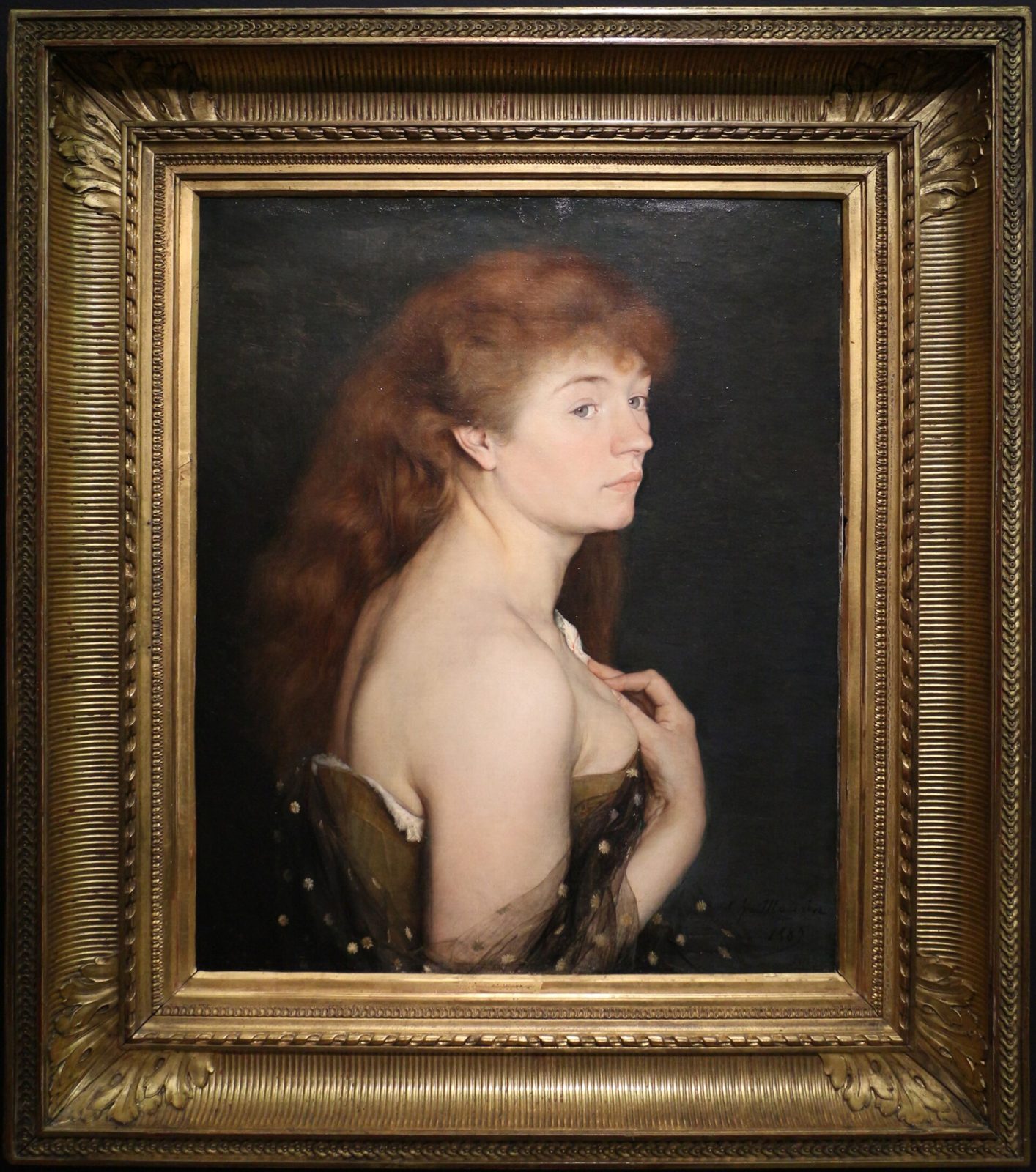
🎧 This work has audio narration — listen in the appThe woman in Charles Maurin's "Portrait of a Russian Girl" captivates with her three-quarter pose, her long reddish-brown hair cascading down her back, and her pale skin glowing against the deep black background. The strapless dress, adorned with delicate light-colored dots, adds an intriguing texture that contrasts beautifully with her complexion. Her right hand, gently placed near her chest, holds the fabric, drawing attention to her elegance and grace.
This intimate portrayal invites a closer connection with the subject, emphasizing her serene expression and the softness of her features. The smooth brushwork enhances the delicate nature of her skin and hair, creating a sense of depth and warmth that draws the viewer in. The stark black backdrop serves not only to highlight her beauty but also to evoke a sense of mystery, suggesting a narrative that remains just out of reach.
Maurin, a French painter and engraver, was influenced by various artistic movements and was known for his innovative techniques, including a patented method of color printing. He was active in the late 19th century, exhibiting at the Salon of French artists and becoming a member of the Society of French Artists in 1883. "Portrait of a Russian Girl," created in 1889, reflects his mastery of portraiture and his ability to convey emotion through the subtleties of color and form.
Charles Maurin was a French painter and engraver born on April 1, 1856, in Le Puy-en-Velay. His artistic journey began with the Prix Crozatier in 1875, allowing him to study at the École des Beaux-Arts under Jules Lefebvre. He later taught at the Académie Julian and became a member of the Society of French Artists in 1883. Maurin's friendships with notable figures like Toulouse-Lautrec and Félix Vallotton shaped his career and artistic vision.
A versatile artist, Maurin explored various styles, notably symbolist themes, as seen in his work "Maternity," which reflects on motherhood. He was influenced by Japanese art, revolutionizing etching techniques and patenting a method for color printing in 1891. His political beliefs aligned with anarchism, leading him to collaborate with publications like La Revue Blanche and Les Temps nouveaux. His woodcut of the anarchist Ravachol, depicting him before the guillotine, showcases his unique perspective and has been noted for its iconic quality.
Maurin's contributions to art and his engagement with social issues position him as a significant figure in late 19th-century French art. He passed away on July 22, 1914, in Grasse, leaving behind a legacy that intertwines artistic innovation with a commitment to social change.
Charles Maurin's 'Portrait of a Russian Girl' was created in 1889. The painting is part of Maurin's broader body of work, which he exhibited at the Salon of French artists.
In this painting, the woman is depicted in a three-quarter pose, her long reddish-brown hair flowing down her back. The strapless dress features a dark, sheer fabric with small, light-colored dots, adding a unique texture. Her pale skin stands out against the deep black background, creating a striking contrast. The smooth brushwork enhances the softness of her features, while the intimate composition draws the viewer's attention directly to her serene expression and the delicate placement of her right hand near her chest.
Interestingly, Maurin patented a method of color printing in 1891, which was a significant advancement in the field of printmaking.
Charles Maurin was both a friend and mentor to the painter Félix Vallotton, influencing his artistic development.
In 1893, Maurin created a commemorative woodcut depicting the anarchist Ravachol in front of the guillotine, which showcased his engagement with political themes.