Portrait de femme, dit de Mme Georges Hartmann
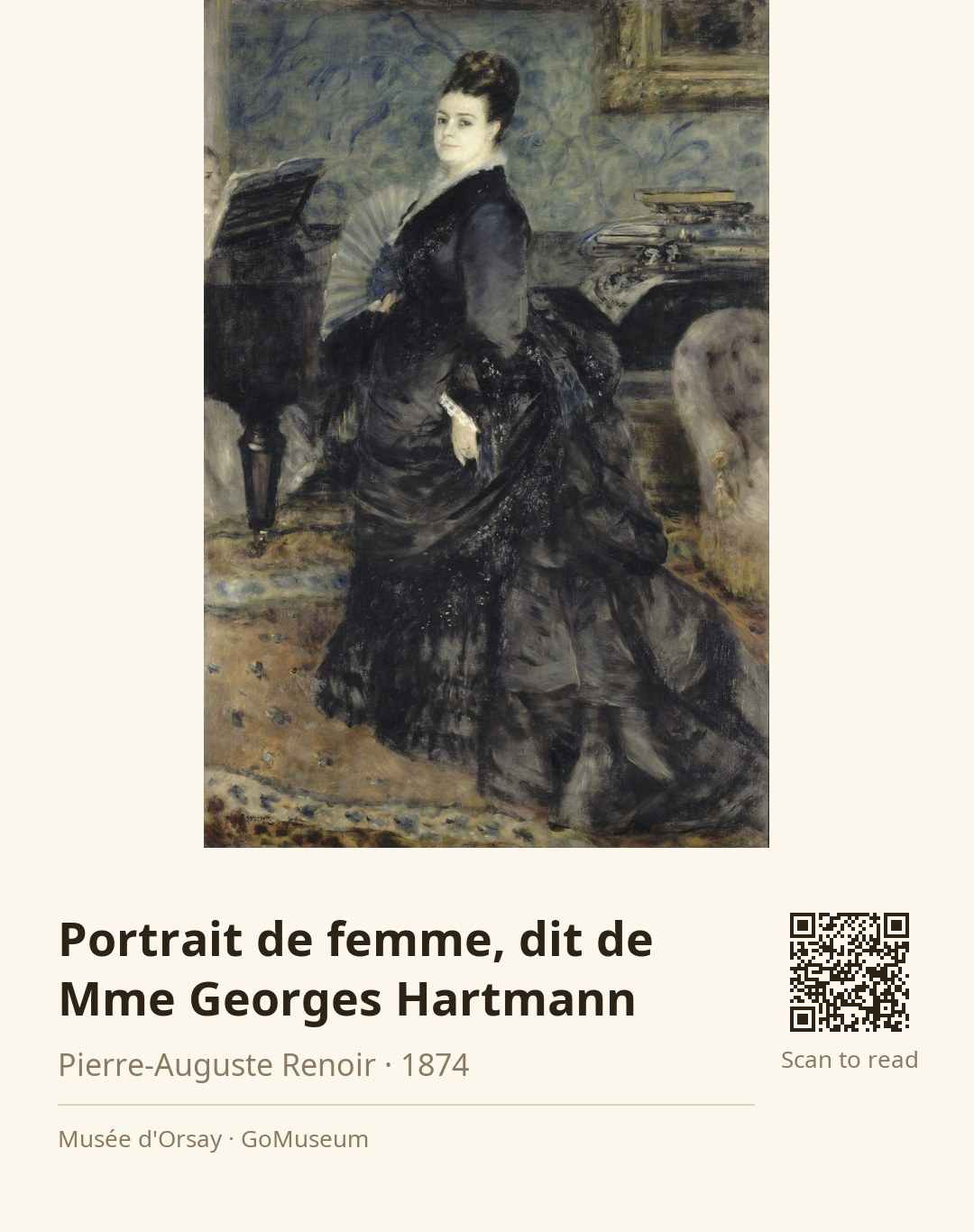
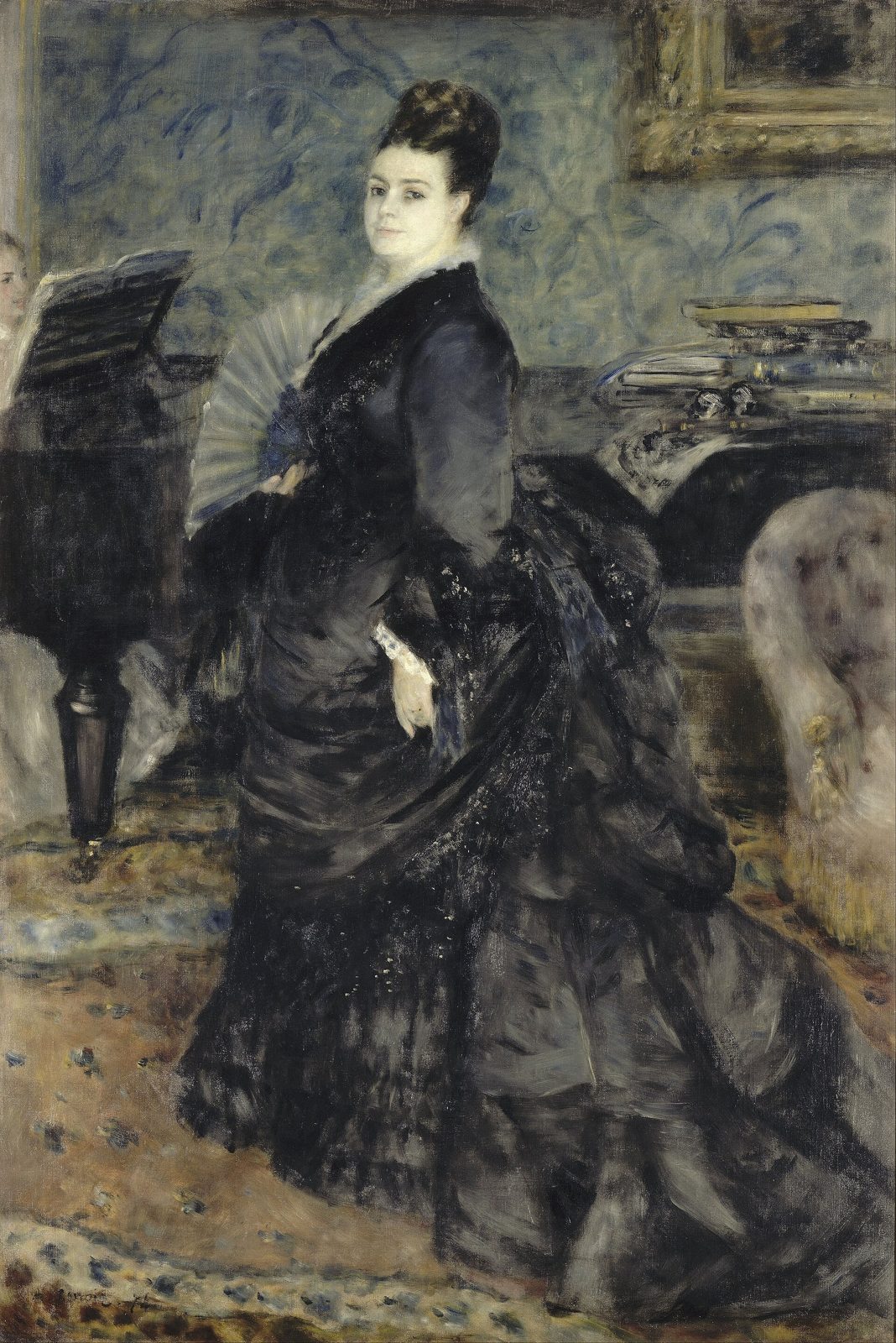
🎧 This work has audio narration — listen in the appThe woman in the painting stands poised in a richly decorated interior, her dark gown flowing elegantly around her. The intricate detailing of her dress, combined with the fan she holds delicately in her right hand, captures a moment of refined grace. Behind her, the patterned blue wall and the piano adorned with sheet music hint at a cultured atmosphere, suggesting she is part of a sophisticated social circle.
Renoir's loose brushwork and soft color blending breathe life into her figure, creating a sense of movement that contrasts with the stillness of the room. The subtle highlights on her face and gown draw the viewer's eye, emphasizing her beauty and the careful attention to detail that Renoir is known for. This portrait, created in 1874, reflects the artist's deep interest in feminine beauty and the intimate settings that frame it, showcasing his mastery of capturing the essence of his subjects.
During this period, Renoir was establishing himself as a prominent figure in the Impressionist movement, a group that sought to break away from traditional artistic conventions. "Portrait de femme, dit de Mme Georges Hartmann" is one of the works that exemplifies his evolving style, blending realism with the emerging Impressionist techniques that would define his later career.
Pierre-Auguste Renoir, born on February 25, 1841, in Limoges, France, emerged as a pivotal figure in the Impressionist movement. His early life in a modest family led him to Paris, where he honed his artistic skills amidst the masterpieces of the Louvre. Initially apprenticed in a porcelain factory, Renoir's passion for painting flourished, particularly after studying under Charles Gleyre, where he befriended fellow artists like Monet and Sisley.
Renoir's work celebrated feminine beauty and vibrant social scenes, exemplified in iconic pieces like "Dance at Le Moulin de la Galette." Despite facing criticism early on, he gained recognition, especially after participating in the first Impressionist exhibition in 1874. His style evolved over the years, transitioning towards realism influenced by classical masters like Raphael.
Throughout his life, Renoir balanced personal struggles, including health issues, with a prolific output, reportedly creating around four thousand works. He became a beloved figure in art history, known for his warm palette and expressive brushwork. Renoir passed away on December 3, 1919, leaving a legacy that continues to inspire artists and art lovers alike.
The loose brushwork creates a sense of fluidity, allowing the viewer to feel the fabric of the woman's gown almost as if it were tangible. The dark palette, punctuated by subtle highlights, draws attention to her face and the intricate details of her attire. Renoir's choice to position the figure slightly off-center not only balances the composition but also invites the viewer to engage with the surrounding elements, like the piano and patterned wall. This approach enhances the sense of intimacy and movement, making the viewer feel as though they are part of the scene, rather than just an observer.
By placing the figure slightly off-center, Renoir creates a balanced composition that encourages viewers to interact with the surrounding elements in the painting, such as the piano and patterned wall.
While painting by the Seine during the Paris Commune, Renoir was nearly thrown into the river by Communards who suspected him of being a spy, but was saved when Raoul Rigault recognized him.
Renoir's early career faced challenges in gaining recognition due to the disruptions caused by the Franco-Prussian War, which affected the art scene and his opportunities for exposure.