Berthe Morisot with a Fan
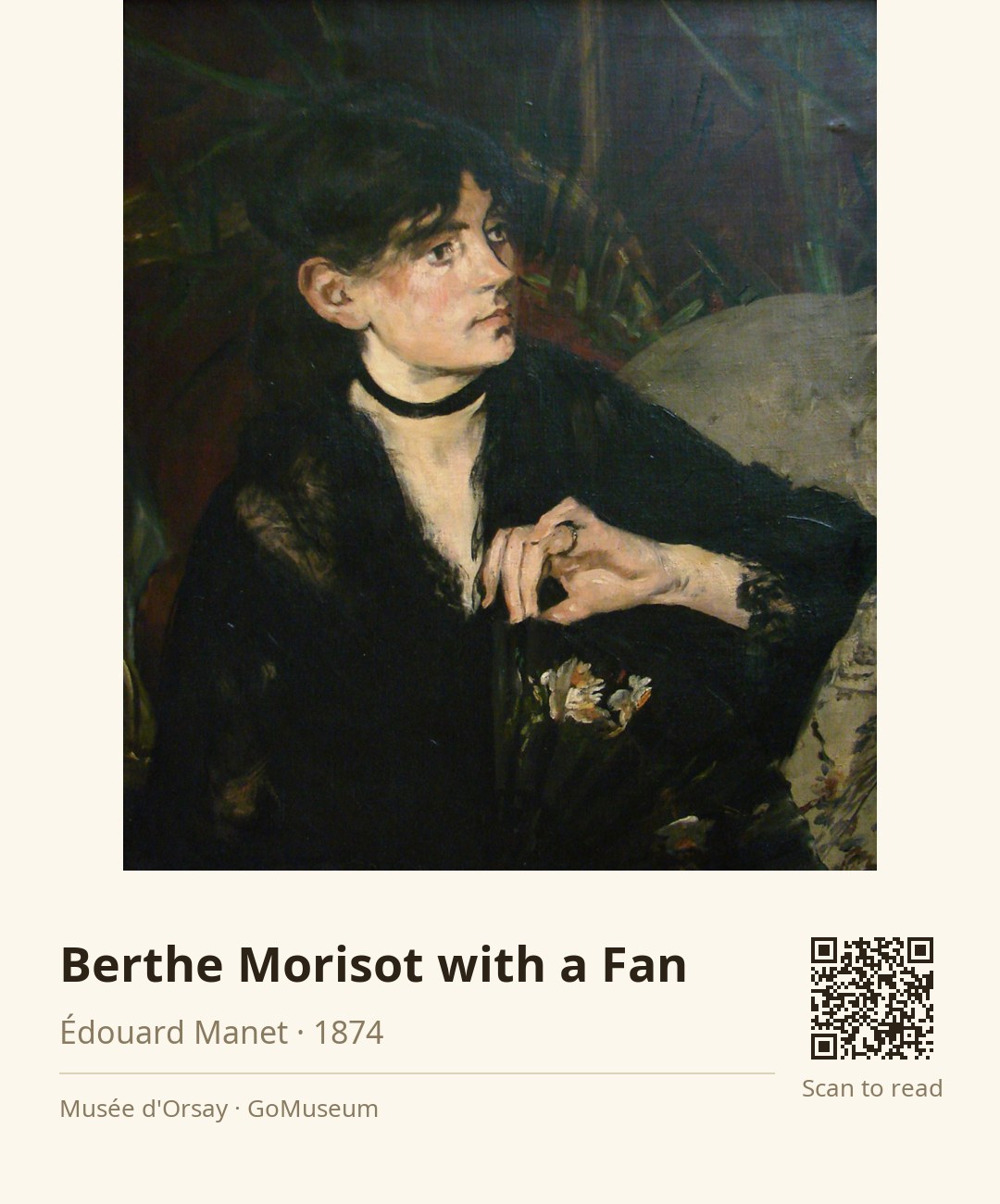
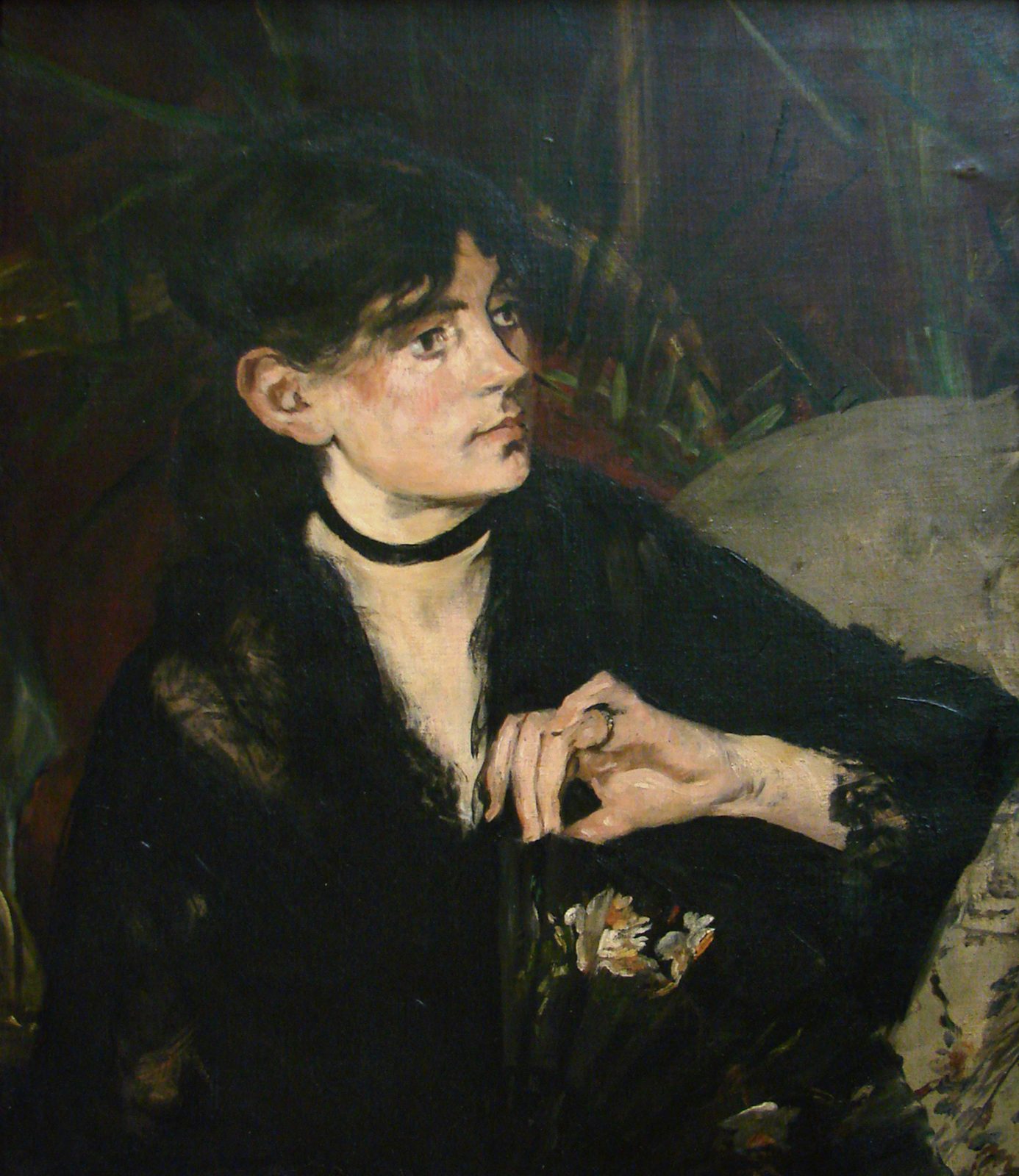
🎧 This work has audio narration — listen in the appTake a moment to really look at "Berthe Morisot with a Fan." Notice how the delicate fan in her hand is adorned with flowers, a striking contrast to the somber black of her dress. This detail isn’t just decorative; it symbolizes the duality of her life at this moment—mourning her father's death while stepping into a new chapter of marriage.
Morisot’s expression is distant, almost as if she’s saying goodbye, which is poignant considering this was one of the last portraits Manet painted of her before she married his brother. The velvet ribbon around her neck and the lace on her dress add a layer of texture that draws your eye, highlighting her elegance amidst the sadness.
Manet was deeply influenced by Spanish masters like Velázquez, and you can see that in the way he captures her likeness with such intimacy and depth. This painting, created in 1874, marks a significant transition for both artist and subject, as Morisot would soon step away from the canvas to embrace her new life.
As you stand here, think about the emotions wrapped up in this moment. What do you feel when you see her gaze turned away? Is it a reflection of her inner turmoil, or perhaps a hint of the freedom she was about to embrace?
Édouard Manet, born on January 23, 1832, in Paris, emerged as a pivotal figure in 19th-century art, bridging Realism and Impressionism. From an affluent family, he initially faced pressure to pursue a naval career but instead dedicated himself to painting, influenced by his uncle and the Old Masters. His early works, including "The Luncheon on the Grass" and "Olympia," sparked controversy and challenged traditional artistic norms, marking him as a revolutionary force.
Manet's style, characterized by loose brushwork and a focus on contemporary life, diverged from the meticulous techniques of his predecessors. He often depicted modern Parisian scenes, capturing the essence of leisure and social dynamics. Despite initial rejection from the art establishment, he gained recognition among progressive artists and became a mentor to the Impressionists.
Throughout his life, Manet formed connections with influential figures like Baudelaire and Zola, who defended him against critics. His later works, such as "A Bar at the Folies-Bergère," showcased his evolving style and mastery of color. Manet's contributions to art history are profound; he is celebrated not only for his innovative techniques but also for elevating still life and modern subjects to the forefront of artistic expression. He passed away on April 30, 1883, leaving behind a legacy that continues to inspire artists today.
The painting 'Berthe Morisot with a Fan' was created by Édouard Manet in 1874, marking the end of a significant chapter in both the artist's and the subject's lives. This piece is the twelfth and final portrait of Berthe Morisot that Manet painted between 1868 and 1874. It was commissioned during a poignant time, shortly after Morisot's father's death and just before her marriage to Manet's brother, Eugène. This transition meant that Morisot would no longer pose for Manet, making this work a bittersweet farewell. The painting was first exhibited in 1884 at the Exposition des oeuvres de Edouard Manet in Paris. Over the years, it has traveled through various collections, including Morisot's own, before being accepted by the French state in 1999.
As you gaze at 'Berthe Morisot with a Fan,' pay attention to the way Manet's brushwork captures both the texture of Morisot's attire and the delicate fan she holds. The painting is rich with contrasts—the somber black of her dress juxtaposed against the vibrant floral patterns on the fan. Manet's use of light is particularly striking; it dances across her pale skin and the lace of her dress, creating a luminous quality that draws you in. Notice how the composition is structured; Morisot's turned gaze and the slight tilt of her head suggest a moment of introspection, almost as if she's caught between two worlds. The background, with its plant motifs, hints at the influence of Japanese art, a trend that captivated many artists of the time, adding layers of cultural depth to the piece. This careful handling of color and form not only highlights Morisot's elegance but also evokes the emotional complexity of her situation.
Painted in 1874, it marks the end of Manet's twelve portraits of Morisot, a fellow artist and his sister-in-law, showcasing a deep personal connection. This work not only reflects the emotional weight of Morisot's mourning but also signals a shift in how women were portrayed in art—moving from mere subjects to complex individuals with their own narratives. Manet's innovative use of color and composition influenced future generations, paving the way for Impressionists and beyond, as he challenged conventions and invited viewers to see the humanity behind the canvas.
Did you know that this painting, 'Berthe Morisot with a Fan', is the last of twelve portraits that Édouard Manet created of his favorite model, Berthe Morisot? It was painted just after her marriage to Manet's brother, Eugène. This moment was bittersweet, as it marked the end of their artistic collaboration. Berthe, dressed in black due to her father's recent passing, holds a fan adorned with flowers, symbolizing both mourning and new beginnings. The engagement ring on her finger hints at her new life, while the way she gazes away from Manet adds a layer of emotional complexity to this farewell portrait.
In the painting, Morisot's eyes are depicted as black, although they were actually green, showcasing Manet's artistic license in portraying her likeness.
This portrait marked the end of Morisot's time as Manet's model, as she would soon marry his brother and step away from her artistic pursuits, making the painting a bittersweet farewell.
The background features plant motifs that hint at the influence of Japanese art, which was a popular trend among artists during the time Manet created this work.