 Image: Sailko
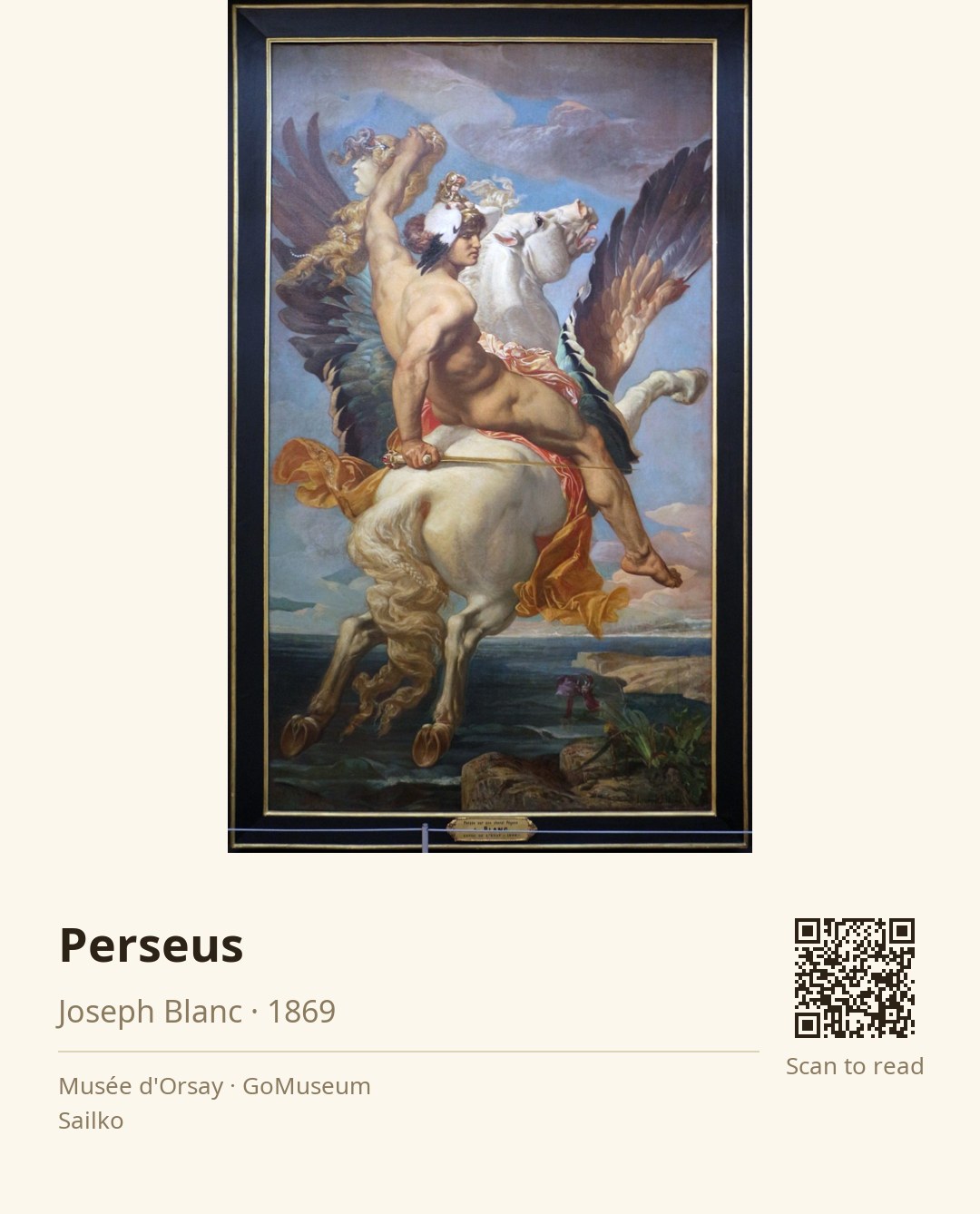
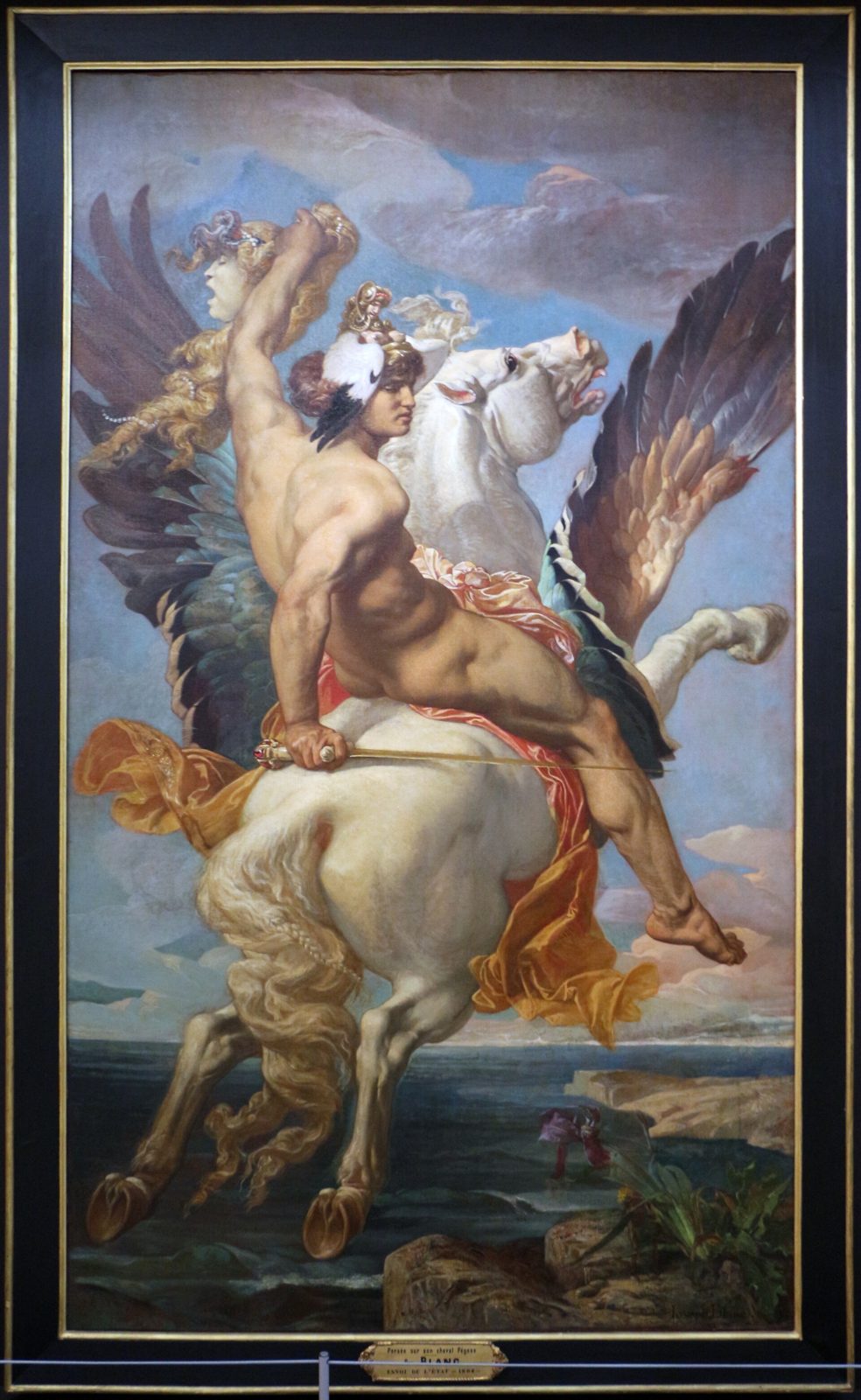
Take a moment to really look at "Perseus" by Joseph Blanc. Notice how the hero, with his flowing hair and powerful stance, holds the severed head of Medusa high above him. The intricate details of Medusa’s hair, adorned with pearls, contrast sharply with the fierce expression frozen on her face. These details matter because they capture the essence of triumph and the complexity of the myth. Blanc's choice to depict Perseus in this moment of victory not only showcases his technical skill but also immerses you in the drama of Greek mythology. The way Perseus rides Pegasus, with its wings poised in an almost theatrical manner, adds to the grandeur of the scene, making it feel alive. Created in 1869 during Blanc's time at the Académie de France in Rome, this painting reflects the influence of both the Florentine Mannerism and Baroque styles, blending classical themes with a modern touch. As you stand here, think about the story behind this artwork. What does it mean to you to see a hero in such a powerful moment? How does this image of victory resonate with your own experiences?
Paul-Joseph Blanc was a French painter born on January 25, 1846, in Paris, where he also passed away on July 5, 1904. He studied at the École des Beaux Arts under notable artists Émile Bin and Alexandre Cabanel. Blanc gained recognition early in his career, winning the Prix de Rome in 1867 for his painting "The Murder of Laius by Œdipus." His artistic focus revolved around ancient history and mythology, but he also created numerous portraits of prominent politicians like Georges Clemenceau and Léon Gambetta.
In 1889, he became a professor at the École des Beaux Arts, sharing his expertise with aspiring artists in his Montmartre studio, which also functioned as an art school. Blanc contributed to the decoration of significant Parisian landmarks, including the Panthéon, where he depicted the legendary figure of Clovis in a series of works. His decorative style extended to the Opéra-Comique and the Hôtel de Ville. Additionally, he designed a series of postage stamps featuring Marianne, which were widely used and became known as "Blancs."
Blanc's legacy is marked by his blend of historical and mythological themes, his role in shaping future artists, and his contributions to public art in France. His works remain a testament to the rich narrative tradition of 19th-century French painting.
Joseph Blanc's 'Perseus' was created in 1869 during his time at the Académie de France in Rome. This period was crucial for Blanc, as he was required to produce a life-sized human figure painting. He chose the iconic moment of Perseus triumphantly holding Medusa's head while riding Pegasus. The painting was initially inspired by Benvenuto Cellini's sculpture of the same subject. After its completion, 'Perseus' was sent back to France, where it was acquired by the state during the 1870 Salon and first exhibited at the Musée du Luxembourg. It later moved to the Louvre in 1882 and finally found its home at the Musée d'Orsay in 1986. Notably, it will be featured in the upcoming 2024 exhibition 'Cheval en majesté' at the Château de Versailles, showcasing its enduring relevance in art history.
As you gaze at 'Perseus,' take a moment to appreciate Blanc's masterful brushwork. The painting is a vivid blend of Florentine Mannerism and Baroque styles, evident in the dynamic poses and intricate details. Notice how the musculature of Perseus is rendered with an almost palpable tension, showcasing Blanc's deep understanding of human anatomy. The rich colors, particularly the striking reds of Medusa's hair adorned with pearls, create a dramatic contrast against the more subdued tones of Perseus and Pegasus. The composition is carefully structured, drawing your eye to the central figure while the wings of Pegasus seem to burst forth, adding a sense of movement and grandeur. This painting is not just a static image; it feels alive, capturing a moment of mythological triumph.
Joseph Blanc's 'Perseus' is a striking example of how mythological themes were reinterpreted in the 19th century, bridging classical inspiration with contemporary artistic expression. This painting not only showcases Blanc's technical prowess but also reflects the competitive spirit of his time, as he sought to outshine his peers like Henri Regnault. Its influence can be seen in the way it revived interest in heroic narratives, paving the way for future artists to explore similar themes. The dramatic portrayal of Perseus, Medusa, and Pegasus invites viewers to engage with ancient myths in a fresh, dynamic way, making it a significant piece in the evolution of historical and mythological painting.
One intriguing detail about 'Perseus' is that while the painting is celebrated for its depiction of the heroic moment, the portrayal of Pegasus has been critiqued for its less convincing anatomy. The disproportionate relationship between the horse's croup and neck adds an unexpected twist to the artwork, inviting viewers to ponder the balance between idealism and realism in mythological representations.