Flowers in a Crystal Vase
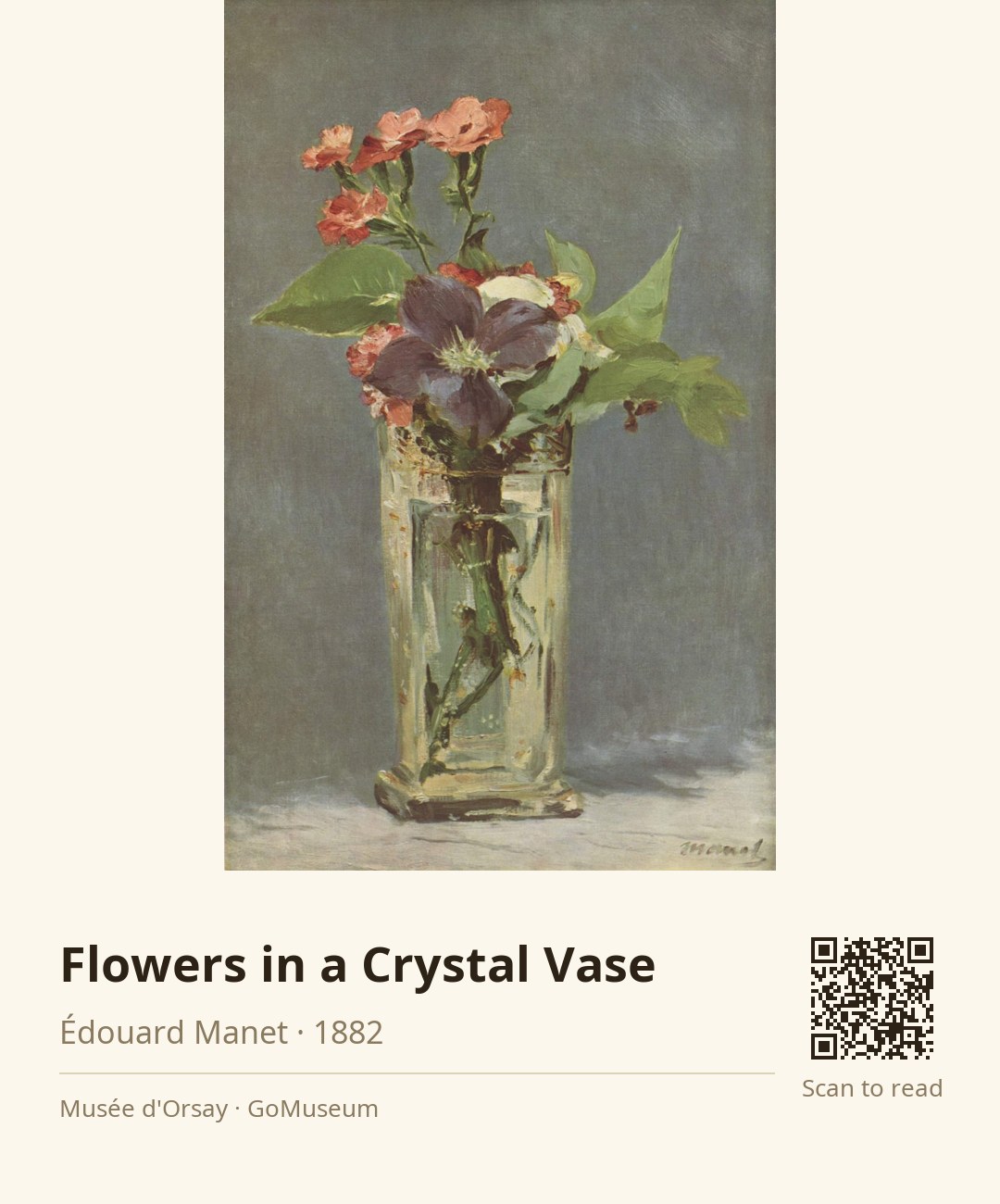
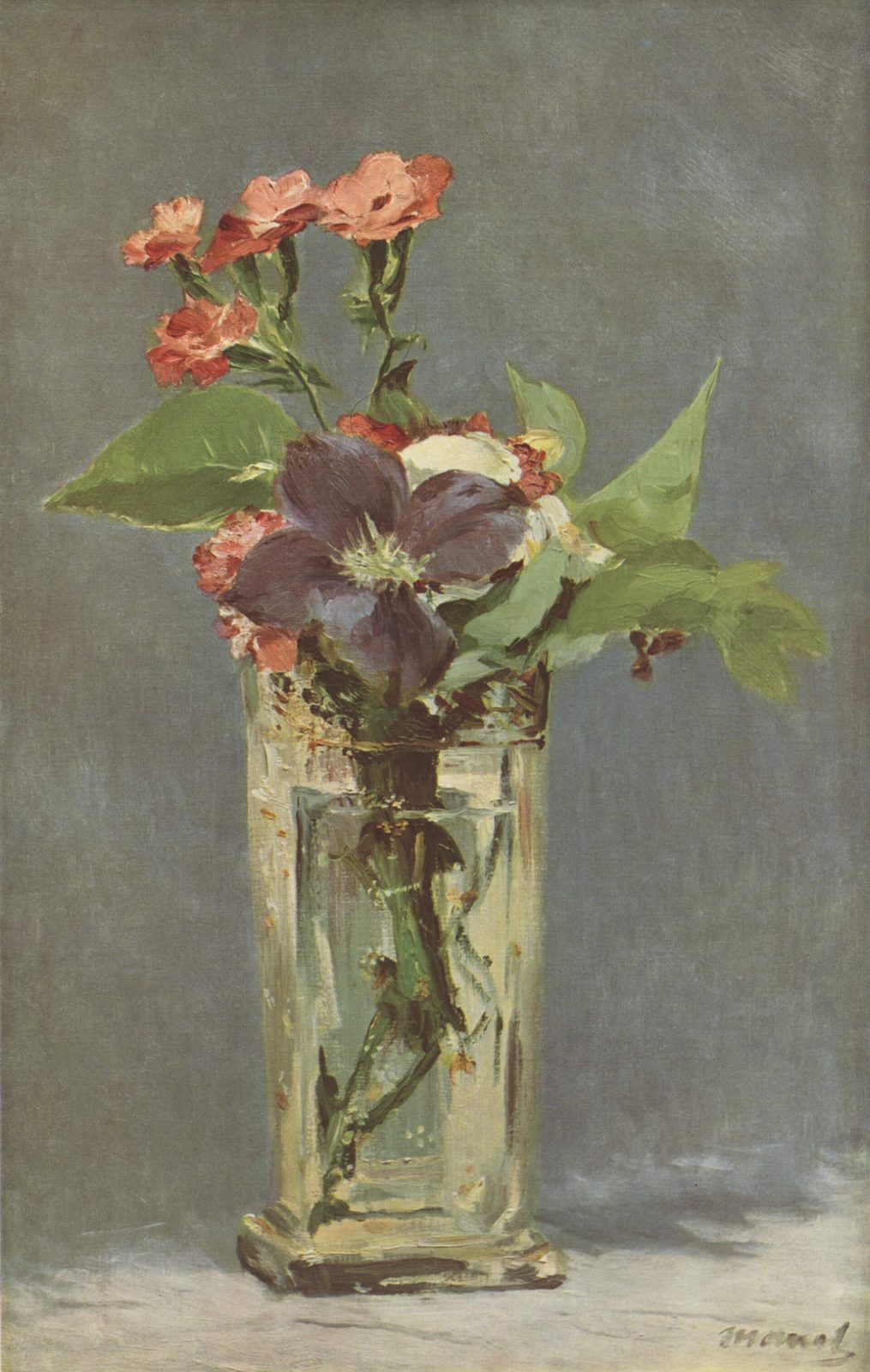
🎧 This work has audio narration — listen in the appTake a moment to really look at "Flowers in a Crystal Vase." Notice how the vibrant clematis and delicate 'oeillets' seem to dance in the light, their colors almost pulsating against the cool clarity of the crystal vase. The way Manet captures the texture of the petals and the transparency of the glass is nothing short of magical.
These details matter because they reveal Manet's mastery of still life, a genre he elevated from mere decoration to a profound exploration of beauty and transience. Painted in 1882, just a year before his death, this work reflects a deep sensitivity, perhaps even a sense of urgency, as he confronted his own mortality.
Manet, a pivotal figure in the transition from realism to impressionism, had a knack for capturing modern life, and this painting is a testament to his evolving style. It’s part of a series of floral still lifes he created at the end of his life, showcasing his ability to find joy and vibrancy even in the face of illness.
As you stand here, think about the fleeting nature of flowers and how they symbolize both beauty and impermanence. What emotions does this evoke for you?
Édouard Manet, born on January 23, 1832, in Paris, emerged as a pivotal figure in 19th-century art, bridging Realism and Impressionism. From an affluent family, he initially faced pressure to pursue a naval career but instead dedicated himself to painting, influenced by his uncle and the Old Masters. His early works, including "The Luncheon on the Grass" and "Olympia," sparked controversy and challenged traditional artistic norms, marking him as a revolutionary force.
Manet's style, characterized by loose brushwork and a focus on contemporary life, diverged from the meticulous techniques of his predecessors. He often depicted modern Parisian scenes, capturing the essence of leisure and social dynamics. Despite initial rejection from the art establishment, he gained recognition among progressive artists and became a mentor to the Impressionists.
Throughout his life, Manet formed connections with influential figures like Baudelaire and Zola, who defended him against critics. His later works, such as "A Bar at the Folies-Bergère," showcased his evolving style and mastery of color. Manet's contributions to art history are profound; he is celebrated not only for his innovative techniques but also for elevating still life and modern subjects to the forefront of artistic expression. He passed away on April 30, 1883, leaving behind a legacy that continues to inspire artists today.
This work was part of a series of floral still lifes that he created as he faced the decline of his health. It found its home in the Musée d'Orsay in Paris in 1986, but its journey didn't start there. After World War II, the painting was recovered and entrusted to the care of the French national museums in 1951. It was classified as part of the 'Musées Nationaux Récupération' collection, a testament to the tumultuous history of art during that period. Before its current residence, it was housed at the Louvre, showcasing the changing tides of art curation and appreciation over the decades.
When you look closely at 'Flowers in a Crystal Vase,' notice how Manet's brushwork feels both deliberate and spontaneous. He employs a technique that captures the essence of the flowers with a few swift strokes, allowing the vibrant colors to leap off the canvas. The interplay of light and shadow is masterful; the way the light refracts through the crystal vase creates a sense of depth that draws you in. The composition is carefully structured, with the flowers arranged to lead your eye through the piece, creating a rhythm that feels almost musical. This is not just a still life; it's a dance of color and form, where each petal and leaf seems to have its own story, reflecting Manet's emotional state as he faced his mortality.
This painting, created in 1882, reflects Manet's evolution as an artist, transitioning from the bold, controversial works that sparked debates in the art world to a more introspective exploration of beauty and detail. By elevating floral subjects, Manet challenged the traditional view of still life as mere decoration, asserting its place in the realm of serious art. His innovative approach influenced future generations, paving the way for artists to embrace everyday subjects with the same reverence as historical or mythological themes. Remember, this isn't just a painting of flowers; it's a statement about the value of the ordinary in art history.
One intriguing aspect of 'Flowers in a Crystal Vase' is that it was painted during a time when Manet was grappling with his declining health. Despite his struggles with illness, he managed to produce this vibrant work, showcasing his relentless spirit and dedication to his craft. This painting, along with others from this period, reveals how he sought solace and joy in the beauty of flowers, perhaps as a way to confront the impermanence of life.
The clematis and 'oeillets' are not just decorative; they were chosen for their contrasting textures and colors, which highlight Manet's skill in capturing the essence of each flower, adding depth to the composition.
During the time he painted 'Flowers in a Crystal Vase,' Manet was dealing with significant health issues, which may have intensified his appreciation for the fleeting beauty of flowers, reflecting a poignant connection between his art and his personal struggles.