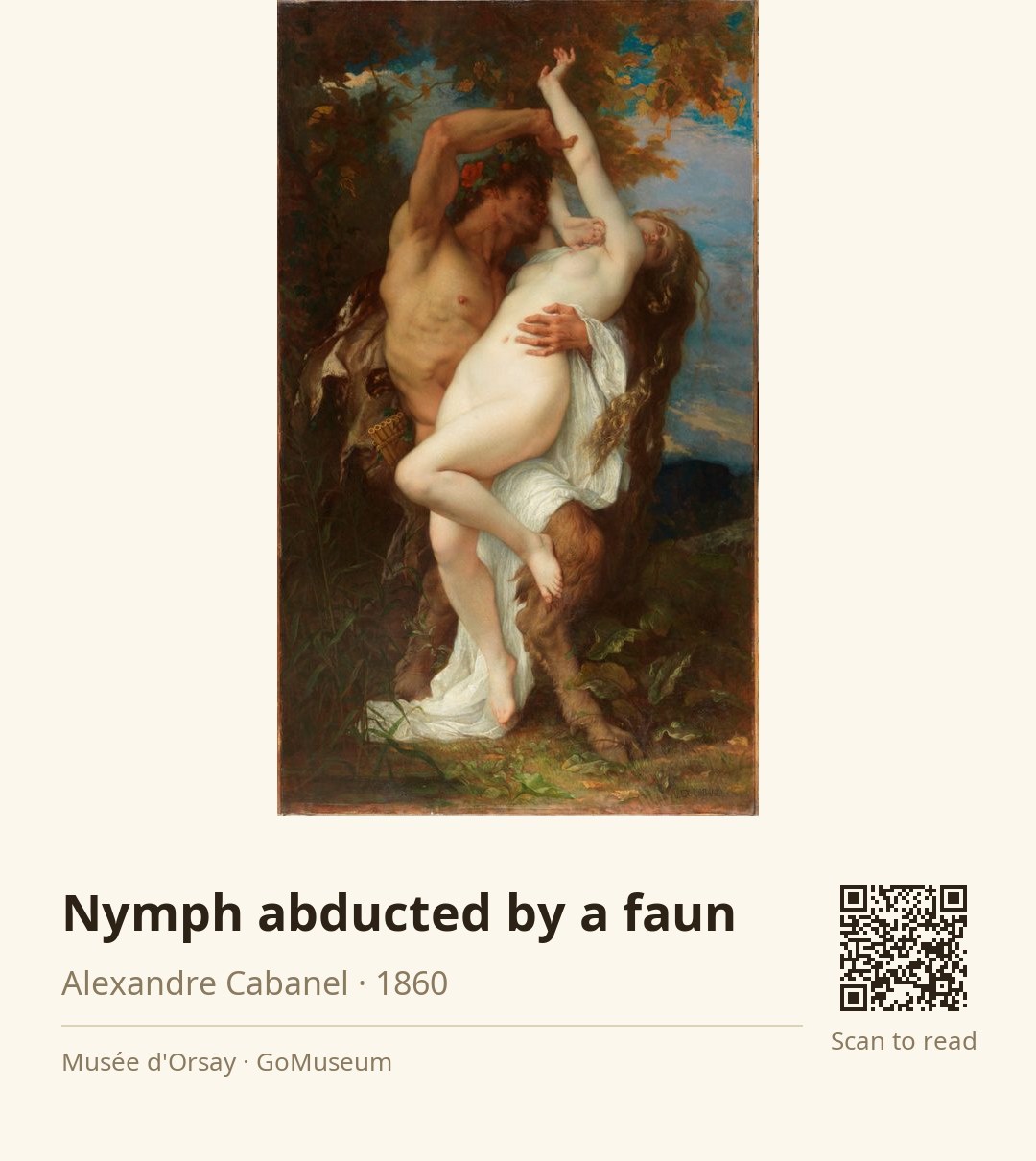
Nymph abducted by a faun
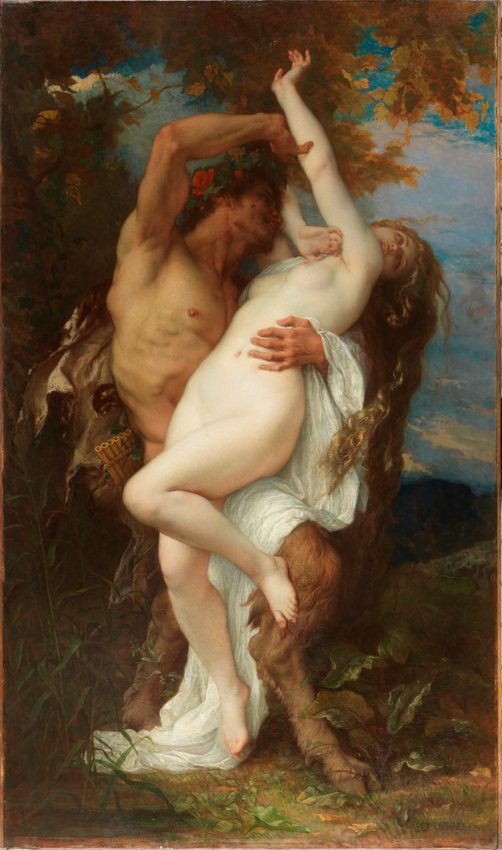
🎧 This work has audio narration — listen in the appTake a moment to really look at "Nymph Abducted by a Faun" by Alexandre Cabanel. Notice how the nymph's pale skin almost glows against the lush greenery surrounding her. Her expression is a captivating mix of ecstasy and distress, leaving you to wonder: is she resisting or surrendering to the faun's embrace?
This tension is crucial. It reflects the duality of desire and danger, a common theme in mythological art. The faun, with his goat legs and playful demeanor, embodies wildness and instinct, while the nymph represents purity and beauty. Their interaction captures a moment that feels both intimate and unsettling, inviting you to question the nature of their relationship.
Cabanel painted this scene in 1860, a time when classical mythology was all the rage among artists. He was known for his ability to blend realism with romanticism, making his subjects feel alive and relatable. This painting, with its soft brushwork and delicate details, showcases his mastery of the oil medium.
As you stand here, think about the stories we tell ourselves about love and desire. What do you see in their expressions? Is it a moment of passion, or something darker?
Alexandre Cabanel was a prominent French painter born on September 28, 1823, in Montpellier. He emerged from humble beginnings as the son of a carpenter, beginning his artistic journey at the Montpellier School of Fine Arts before moving to Paris in 1839. There, he studied at the École des Beaux-Arts under François-Édouard Picot. Cabanel's career flourished as he became known for his historical, classical, and religious subjects, as well as his exquisite portraiture. His most famous work, "The Birth of Venus," showcased his mastery of the academic style and was acquired by Napoleon III, solidifying his status as a leading artist of the Second Empire.
Cabanel was deeply involved in the art community, serving as a member of the Salon jury and later as a professor at the École des Beaux-Arts. His influence shaped the direction of French painting during the belle époque. Despite facing criticism from modernists like Émile Zola and Joris-Karl Huysmans, he defended innovative works, showcasing his commitment to the evolving art scene. Cabanel passed away on January 23, 1889, leaving behind a legacy marked by both admiration and controversy, and his contributions continue to be celebrated in art history.
In 1860, Alexandre Cabanel created 'Nymph Abducted by a Faun', a painting that would soon capture the attention of the art world. It was first exhibited at the Salon des artistes français in Paris in 1861, where it was met with acclaim. The painting was so impressive that Emperor Napoleon III, upon visiting the Salon, decided to purchase it for a staggering 15,000 francs. This acquisition placed the work in the private collection of the French royal family for many years. Its journey reflects not only the tastes of the elite but also the cultural fascination with mythological themes during the Second Empire in France.
The soft brushwork creates a sense of fluidity, particularly in the nymph's skin, which almost seems to glow against the deep greens of the background. Notice how he uses light to highlight her figure, drawing your eye to the tension in her expression. The composition is structured to lead your gaze from the nymph's face, filled with an ambiguous mix of emotions, down to the faun's playful yet predatory grasp. The scale of the painting, towering at 245 cm high and 142 cm wide, envelops you, making the scene feel larger than life. Cabanel's choice of colors, rich and vibrant, enhances the emotional weight of the moment, inviting you to linger in the complexity of desire and danger.
Interestingly, Cabanel's painting style was not universally embraced. While he was celebrated by many, he faced criticism from emerging movements like Impressionism. Notably, he was part of the Salon jury that famously rejected Édouard Manet's 'Le Déjeuner sur l'herbe', a decision that led to the establishment of the Salon des Refusés. This tension between traditional academic art and modernist impulses highlights the shifting landscape of art during Cabanel's time.
The nymph's complexion and elegance closely resemble the Venus depicted in Cabanel's renowned painting 'The Birth of Venus', showcasing his consistent portrayal of idealized beauty.
As a prominent member of the Salon jury, Cabanel played a significant role in shaping the acceptance of academic art, often rejecting modernist works, which led to the establishment of the Salon des Refusés, a platform for artists like Manet.
After being purchased by Emperor Napoleon III, the painting remained in the private collection of the French royal family for many years, reflecting its significance in the cultural landscape of the Second Empire.