Death of Francesca da Rimini and of Paolo Malatesta
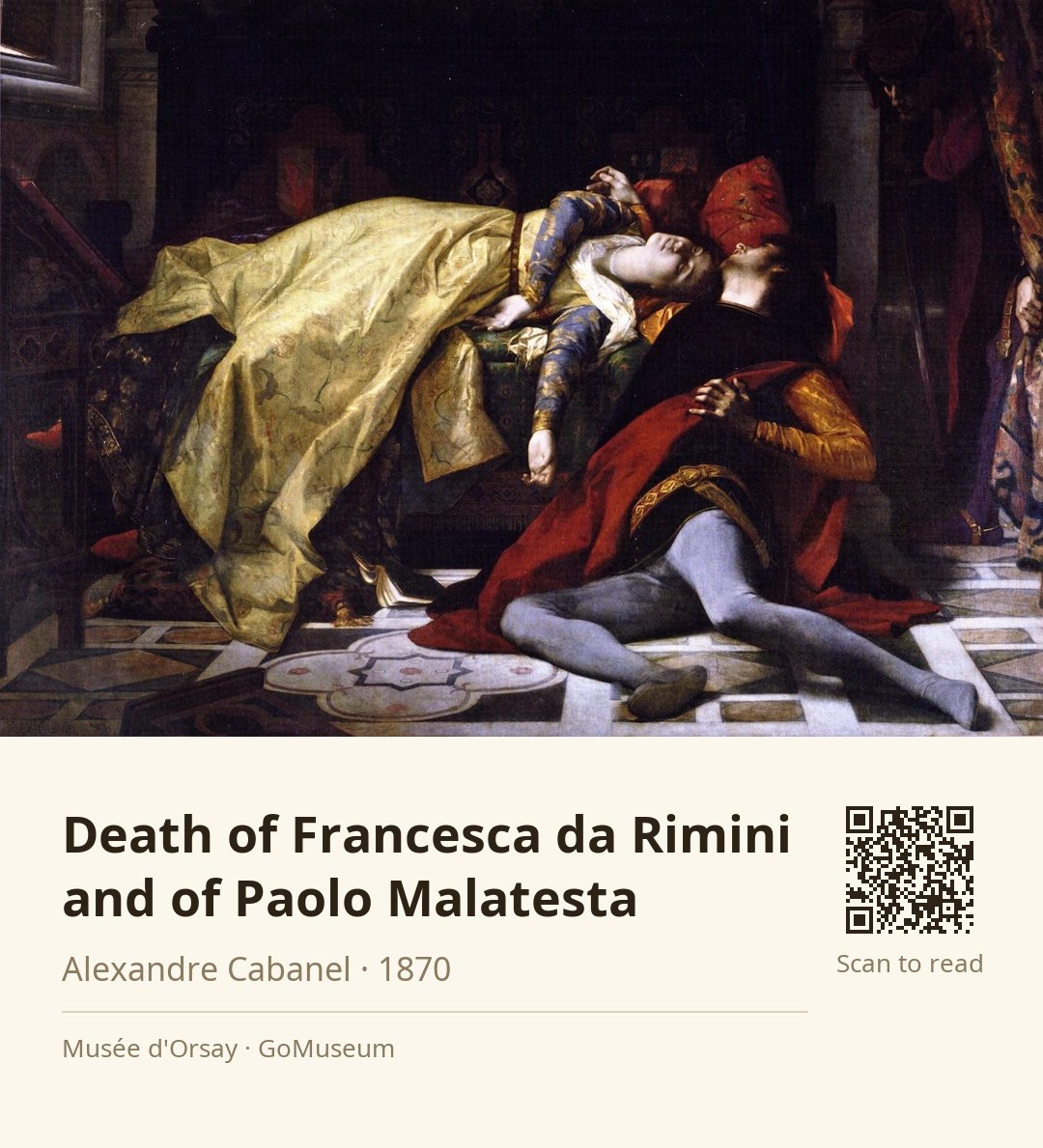
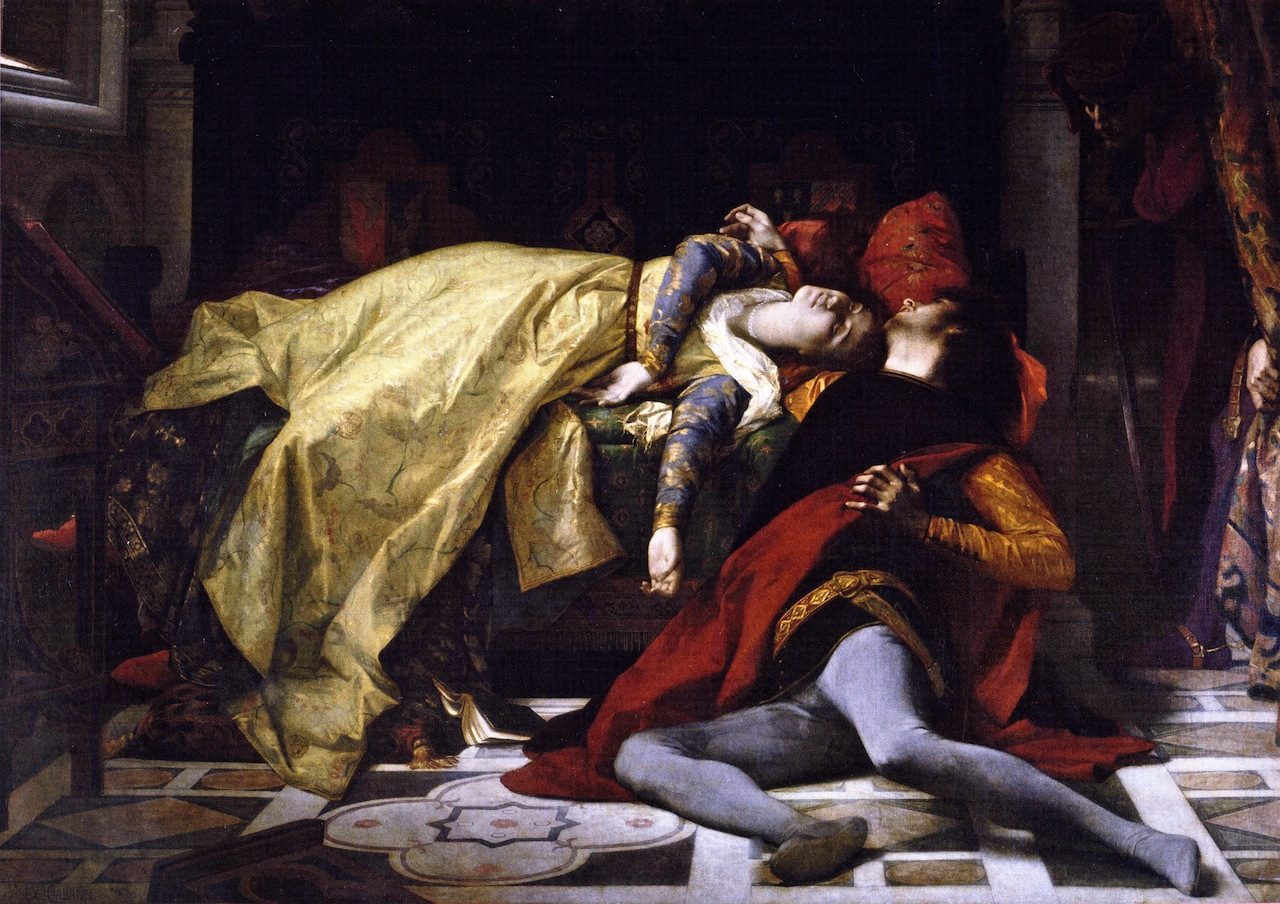
🎧 This work has audio narration — listen in the appFrancesca da Rimini lies draped in a sumptuous golden gown, her head tilted back and eyes closed, while Paolo Malatesta slumps beside her, his hand clutching his chest. The opulent interior, with its ornate furnishings and a shadowy figure lurking in the background, heightens the dramatic tension of this tragic scene.
The richness of the colors—deep reds and shimmering golds—intensifies the emotional weight of their final moments together. Cabanel captures not just their physical forms but the essence of their doomed love, echoing the themes of desire and betrayal found in Dante’s "Inferno." The figures are positioned in a way that suggests both intimacy and despair, inviting viewers to contemplate the depth of their tragic fate.
Cabanel, a prominent figure in the academic art movement, was known for his historical and romantic themes, and this painting exemplifies his mastery of the genre. His work often reflects the ideals of beauty and emotion that defined the Second Empire period in France, where he was celebrated as one of the leading artists. In 1870, he created this poignant piece, which remains a powerful exploration of love and loss.
Alexandre Cabanel was a prominent French painter born on September 28, 1823, in Montpellier. He emerged from humble beginnings as the son of a carpenter, beginning his artistic journey at the Montpellier School of Fine Arts before moving to Paris in 1839. There, he studied at the École des Beaux-Arts under François-Édouard Picot. Cabanel's career flourished as he became known for his historical, classical, and religious subjects, as well as his exquisite portraiture. His most famous work, "The Birth of Venus," showcased his mastery of the academic style and was acquired by Napoleon III, solidifying his status as a leading artist of the Second Empire.
Cabanel was deeply involved in the art community, serving as a member of the Salon jury and later as a professor at the École des Beaux-Arts. His influence shaped the direction of French painting during the belle époque. Despite facing criticism from modernists like Émile Zola and Joris-Karl Huysmans, he defended innovative works, showcasing his commitment to the evolving art scene. Cabanel passed away on January 23, 1889, leaving behind a legacy marked by both admiration and controversy, and his contributions continue to be celebrated in art history.
Interestingly, Cabanel was not just a celebrated painter; he also played a significant role in the art community as a juror at the Salon. His influence was so profound that he was instrumental in the establishment of the Salon des Refusés, a response to the exclusion of innovative artists like Édouard Manet.
Cabanel came from a humble background as the son of a carpenter and started his artistic training at the Montpellier School of Fine Arts.
In 1855, Cabanel was awarded the title of knight of the Legion of Honor, marking a significant recognition of his contributions to art.