Misia à sa coiffeuse
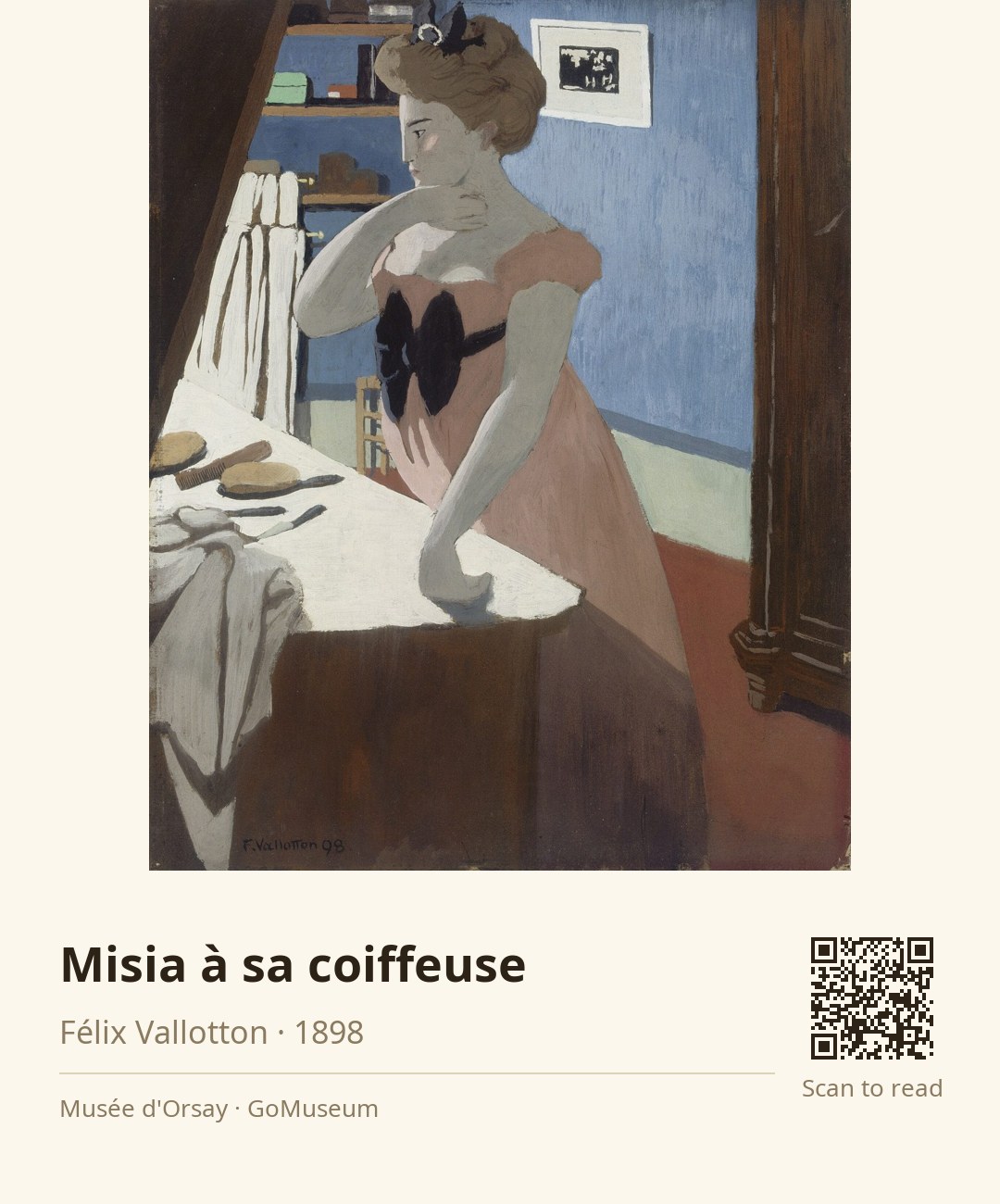
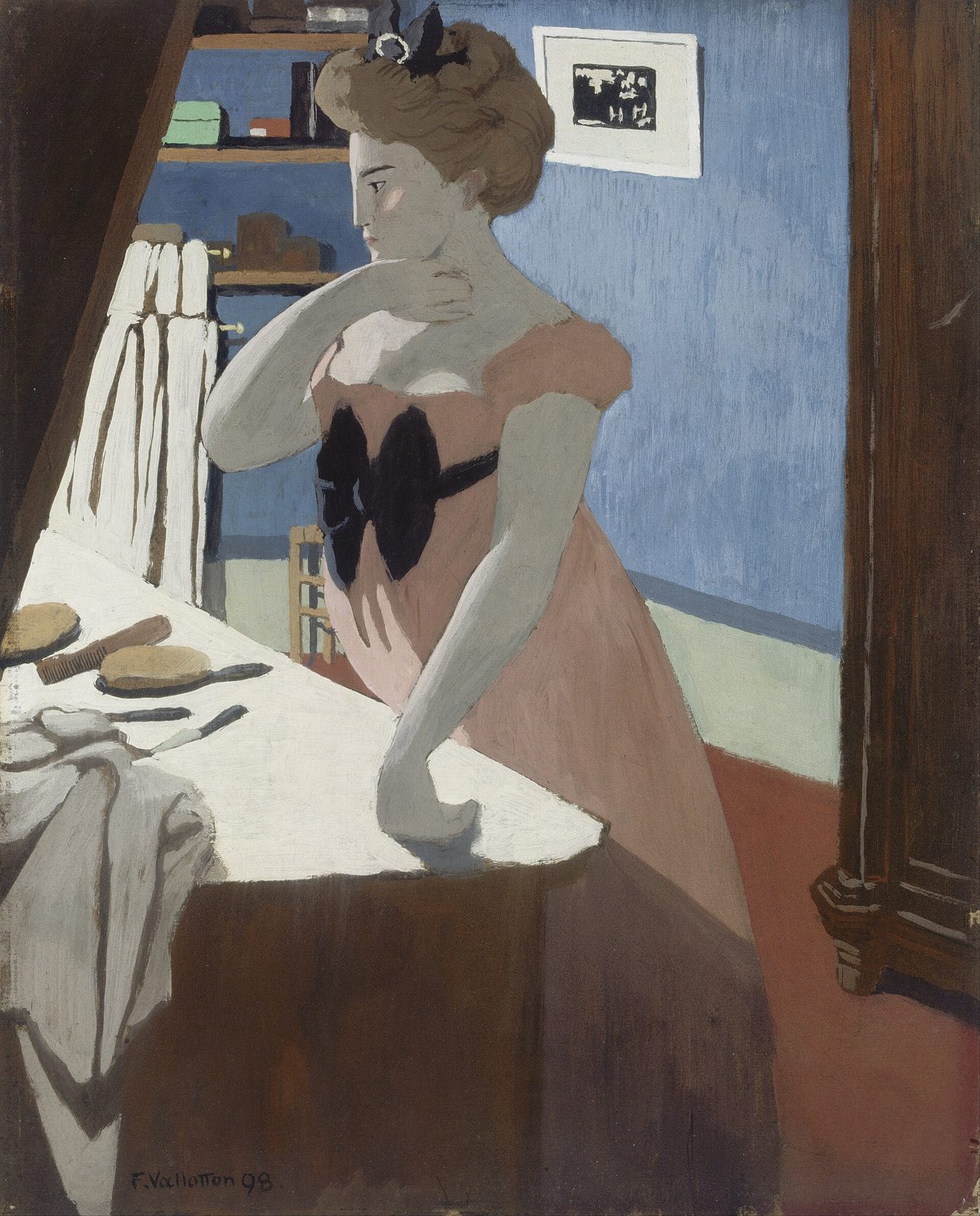
🎧 This work has audio narration — listen in the appTake a moment to really look at "Misia à sa coiffeuse." Notice how the light dances across Misia's face, illuminating her features while casting soft shadows around her. The way she gazes into the mirror, lost in thought, creates an intimate connection between her and the viewer.
These details matter because they capture a fleeting moment of reflection and self-examination, a theme that resonates deeply in Vallotton's work. He was known for his ability to convey emotion through simple yet powerful compositions, and here, he invites us into a private world, making us feel like silent observers of a personal ritual.
Painted in 1898, this piece showcases Vallotton's unique style, influenced by the Nabis movement, which sought to explore the emotional depth of everyday life. Misia Godebska, the subject, was not just a model; she was a muse to many artists of the time, embodying the spirit of the Belle Époque.
As you stand here, think about the stories that unfold in moments like these. What do you see in Misia's expression?
Félix Vallotton, born in Lausanne in 1865, emerged as a significant figure in the art world, particularly within the Les Nabis group. His early life in a strict Protestant family shaped his disciplined approach to art. After moving to Paris in 1882, he honed his skills at the Académie Julian, influenced by masters like Ingres and Holbein. Vallotton's work, initially realistic, evolved into a distinctive style characterized by bold contrasts in his woodcuts, which gained him international acclaim.
His woodcuts, especially the series "Intimités," explored intimate domestic scenes, revealing complex human interactions. Although he shifted focus to painting after 1901, his later works maintained a keen observation of reality, often infused with dark humor. Vallotton's artistic journey was marked by personal struggles, including health issues and the impact of World War I, which inspired his later works. He also contributed to art criticism and literature, showcasing his multifaceted talent.
Vallotton's legacy lies in his innovative approach to woodcut techniques and his candid portrayal of life, earning him a respected place in modern art history. He passed away in 1925, leaving behind a rich body of work that continues to resonate.
In 1898, Félix Vallotton painted 'Misia à sa coiffeuse,' a striking portrait that captures Misia Godebska in a moment of intimate reflection at her vanity. This work was created during a vibrant period in Vallotton's career, as he was gaining recognition within the avant-garde circles of Paris. The painting is now housed at the Musée d'Orsay in Paris, a testament to its enduring significance. Vallotton, originally from Switzerland, had moved to Paris to study art and quickly became involved with the Nabis, a group of artists known for their bold colors and innovative techniques. This piece exemplifies his transition from the realism of his early works to a more expressive style. The reception of Vallotton's work was mixed at the time, with some critics praising his unique approach while others found it challenging. However, over time, 'Misia à sa coiffeuse' has come to be appreciated for its psychological depth and the way it encapsulates the essence of its subject.
In 'Misia à sa coiffeuse,' Vallotton employs a meticulous technique that draws you into the scene. Notice how the brushwork feels both deliberate and fluid, creating a sense of intimacy. The light is masterfully handled, casting soft shadows that enhance Misia's features, making her appear almost ethereal. The color palette is rich yet restrained, with warm tones that evoke a sense of comfort and familiarity. The composition is structured around Misia's reflection in the mirror, creating a dynamic interplay between reality and perception. This clever use of reflection invites you to ponder not just what Misia sees, but what she feels. Vallotton's choice to depict this moment in a close-up format amplifies the emotional weight, making you feel like a silent observer in a private ritual.
One intriguing aspect of Vallotton's life is that he kept a detailed notebook throughout his career, documenting every painting, drawing, and print he created. This meticulous log, known as his 'Livre de Raison,' contained over 1,700 works by the time of his death, showcasing not only his prolific output but also his dedication to his craft. This practice was quite rare for artists of his time and provides invaluable insight into his artistic journey.
Growing up in a strict, middle-class family in Switzerland, Vallotton developed a keen sense of observation and realism, which he honed during his studies at the Académie Julian in Paris, shaping his unique approach to painting.