Madeleine Brohan
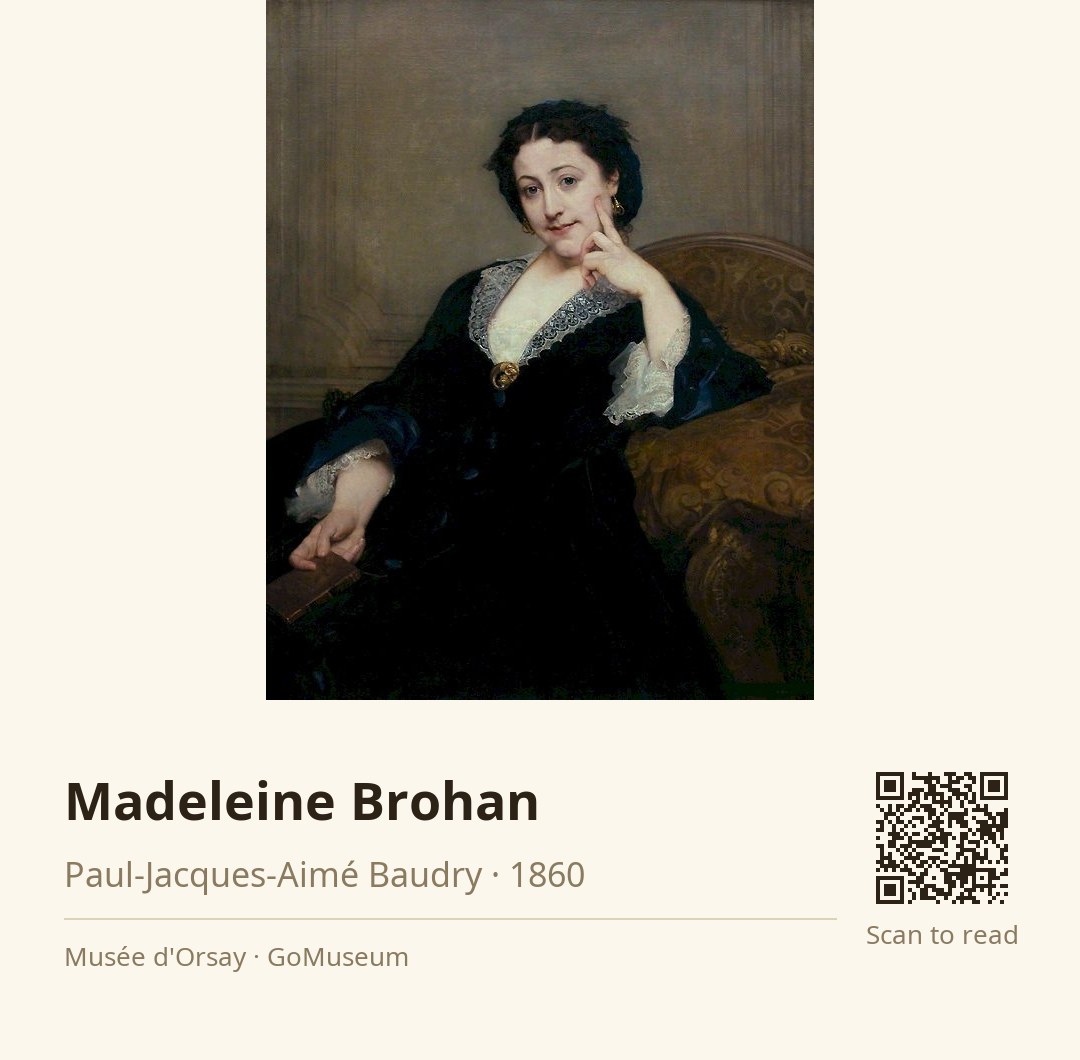
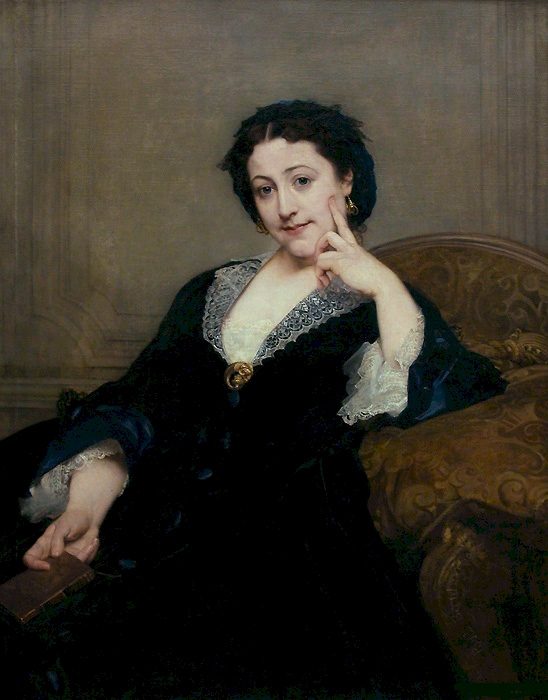
🎧 This work has audio narration — listen in the appMadeleine Brohan, a celebrated actress of the Comédie-Française, exudes an air of elegance and introspection in this portrait by Paul-Jacques-Aimé Baudry. Seated gracefully, she rests her head on her right hand, her dark, lace-trimmed dress contrasting beautifully with her soft skin tones. The closed book in her left hand hints at a moment of quiet reflection, while the ornate chair adds a touch of sophistication to the scene.
Baudry’s smooth brushwork captures the textures of her attire and the gentle softness of her expression, inviting viewers to connect with her serene demeanor. The muted background emphasizes her presence, allowing the viewer to focus on the subtleties of her character. This painting reflects Baudry’s academic style, which, while often critiqued for its lack of originality, showcases a refined elegance that was highly regarded in his time.
Born in 1828, Baudry became known for his mural decorations and portraits, with his work on the Opéra Garnier being one of his most notable achievements. He created "Madeleine Brohan" in 1860, a year that marked a significant period in his career as he transitioned from historical subjects to capturing the likenesses of prominent figures in French society.
Paul-Jacques-Aimé Baudry was a notable French painter born on November 7, 1828, in La Roche-sur-Yon. He studied under Michel Martin Drolling at the École des Beaux-Arts, where he demonstrated a talent for academic painting characterized by elegance and grace. Winning the Prix de Rome in 1850, Baudry's early works, such as "The Martyrdom of a Vestal Virgin," showcased his ability to blend classical themes with a refined style influenced by Italian masters like Correggio.
Throughout his career, Baudry gravitated towards mythological and fanciful subjects, creating notable pieces like "The Pearl and the Wave." His most significant contributions to art were his mural decorations, particularly the grand foyer of the Opéra Garnier, which he dedicated ten years to complete. His work there, along with frescoes in various prestigious locations, solidified his reputation as a leading figure in academic art during the Second Empire.
Baudry was elected to the Académie des beaux-arts in 1870 and continued to receive accolades throughout his life. He passed away on January 17, 1886, in Paris, leaving behind a legacy celebrated for its imaginative use of color and composition. His burial in Père Lachaise Cemetery features a striking monument, a testament to his impact on the art world.
Baudry's technique in 'Madeleine Brohan' is a masterclass in smooth brushwork and careful paint handling. The artist employs a refined palette dominated by dark blues and blacks, which not only enhances the elegance of Brohan's attire but also serves to create a striking contrast with her soft skin tones. The lace trim of her dress is rendered with meticulous detail, showcasing Baudry's skill in capturing texture. The composition is intimate, with Brohan's relaxed pose inviting the viewer into her world. The muted background, devoid of distractions, allows her serene expression to take center stage, drawing the eye directly to her thoughtful demeanor. This careful orchestration of elements not only highlights Baudry's academic style but also evokes a sense of connection between the viewer and the subject.
Interestingly, Baudry's artistic journey was marked by a significant achievement early on when he won the Prix de Rome in 1850 for his painting of Zenobia found on the banks of the Araxes. This prestigious award allowed him to study in Italy, where he drew inspiration from the works of the Italian masters, particularly the mannerism of Correggio.
Baudry won the Prix de Rome in 1850 for his painting of Zenobia found on the banks of the Araxes.
Baudry is known for his mural decorations, including frescoes in the Paris Court of Cassation and at the château de Chantilly, showcasing his imagination and color skills.