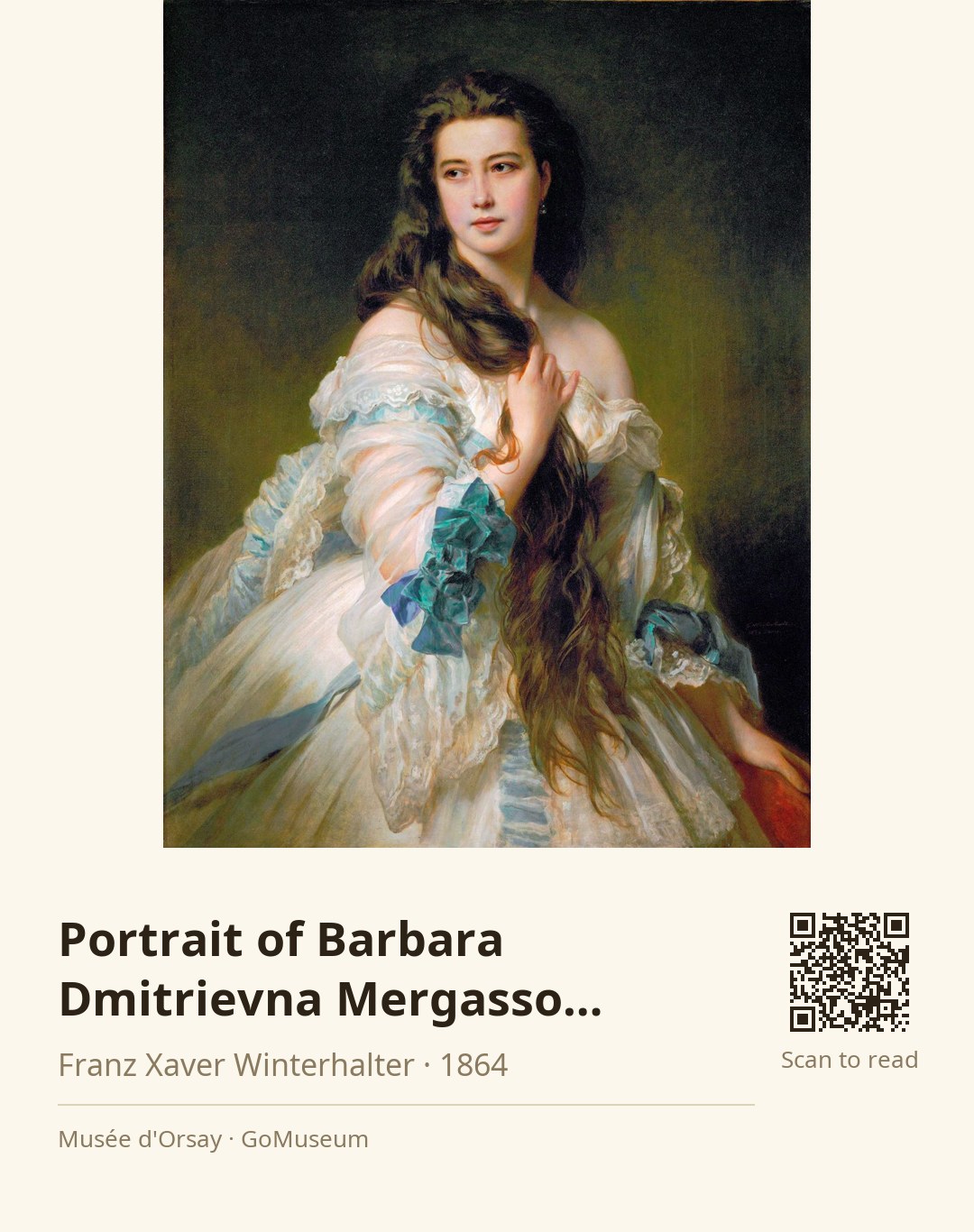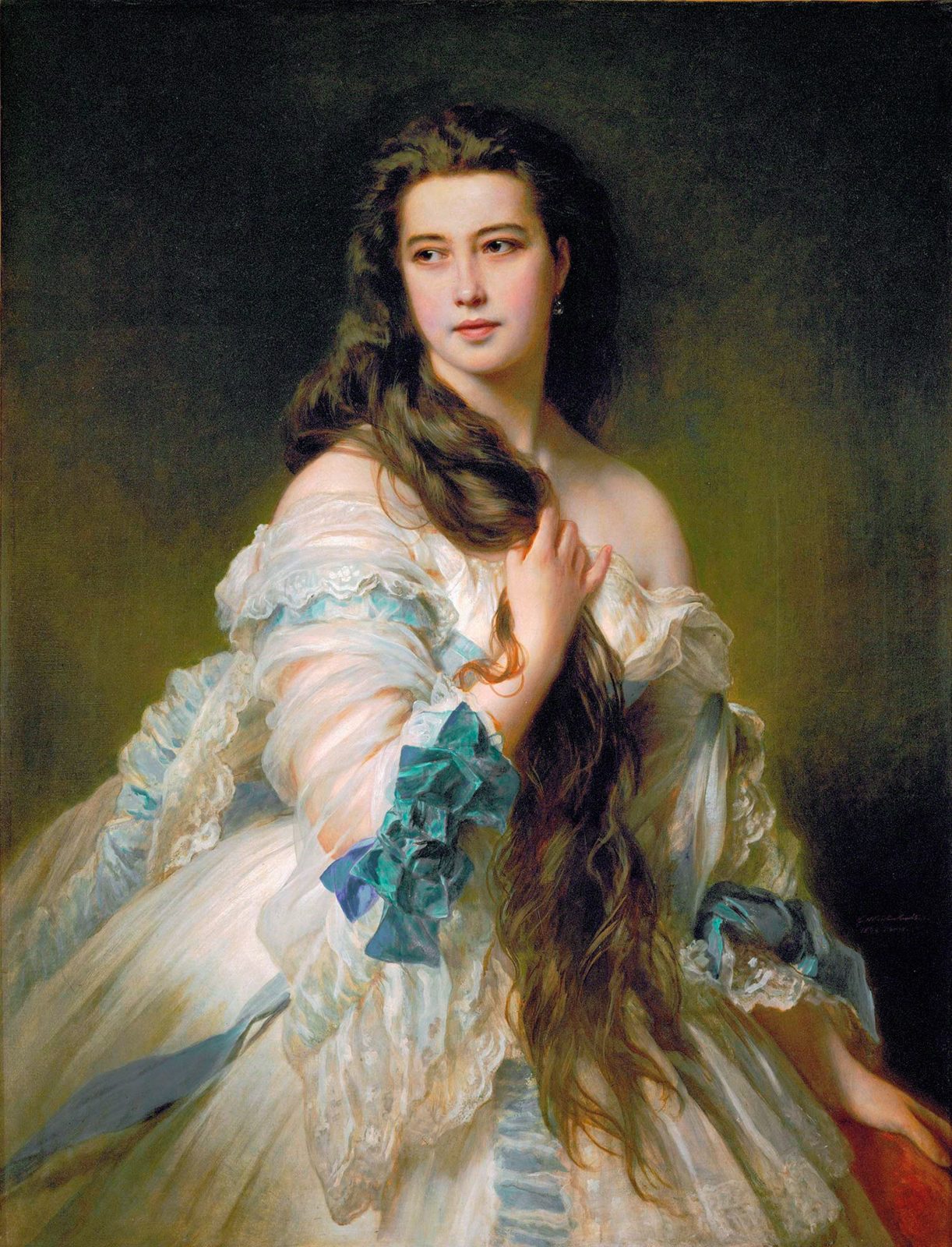
Portrait of Barbara Dmitrievna Mergassov Rimsky-Korsakova
🎧 This work has audio narration — listen in the appBarbara Dmitrievna Mergassov Rimsky-Korsakova stands elegantly in this 1864 portrait, her long, dark hair cascading down as she holds it delicately with one hand. Dressed in an exquisite off-the-shoulder gown, adorned with intricate lace and soft blue ribbons, she gazes thoughtfully to her left, her serene expression contrasting beautifully with the muted dark background that frames her.
The softness of the fabric, captured through smooth brushwork, enhances the luxurious quality of her attire, drawing the viewer's eye to the graceful lines of her pose. This attention to detail not only highlights her aristocratic elegance but also reflects the mid-19th century fascination with fashion and beauty, particularly among the upper classes. Winterhalter's ability to convey texture and lightness in the fabric of her dress and the gentle fall of her hair speaks to his mastery as a portraitist, making the viewer feel the softness and delicacy of the scene.
Franz Xaver Winterhalter was a prominent German painter and lithographer, born on April 20, 1805, in Menzenschwand, Germany. He became renowned for his flattering portraits of royalty and the upper class in the mid-19th century, establishing a reputation for fashionable court portraiture. His works, including "Empress Eugénie Surrounded by her Ladies in Waiting" and portraits of Empress Elisabeth of Austria, exemplify his skill in blending likeness with flattery.
Winterhalter's artistic journey began at a young age, influenced by his family and early education in drawing and engraving. He trained under notable artists and gained recognition in Germany before moving to France, where he quickly became a sought-after portraitist. Appointed court painter to Louis-Philippe of France, he executed numerous commissions for the royal family, solidifying his status in the art world. Despite facing criticism from some artistic circles, his success made him an international celebrity, with royal patrons across Europe, including Queen Victoria.
Winterhalter's legacy lies in his ability to capture the essence of his subjects while embodying the elegance of his time, making him a significant figure in the history of portrait painting. He passed away on July 8, 1873, leaving behind a rich collection of works that continue to resonate in art history.
Winterhalter, already a celebrated portraitist, was known for capturing the essence of high society, and this work was no exception. The portrait was gifted to the Louvre by her sons in 1879, shortly after her passing, marking its entry into one of the world's most prestigious art collections. By 1883, it was physically housed in the Louvre, but in 1986, it was transferred to the Musée d'Orsay, where it continues to be admired.
The smooth brushwork creates a soft, almost ethereal quality to the fabric of Barbara's gown, enhancing the luxuriousness of her attire. Each stroke seems to caress the canvas, bringing out the delicate lace and the translucent nature of the fabric, which flows elegantly around her. The muted dark background serves a dual purpose: it not only contrasts with the lightness of her dress and skin but also draws the viewer's focus squarely onto her serene expression and graceful pose. The vertical format of the painting emphasizes her stature and elegance, while the careful composition, centered on her upper body, allows for an intimate connection between the subject and the viewer. The play of light across her features and the gentle fall of her hair further accentuates the softness of the scene, inviting admiration for both the subject and the artist's skill.
The painting showcases Winterhalter's mastery in conveying texture and lightness, particularly in the fabric of the dress and the hair, highlighting his skill as a portraitist.
Winterhalter's established reputation for capturing high society is reflected in this portrait, as it exemplifies his style and focus on aristocratic elegance.