Madame Pasca
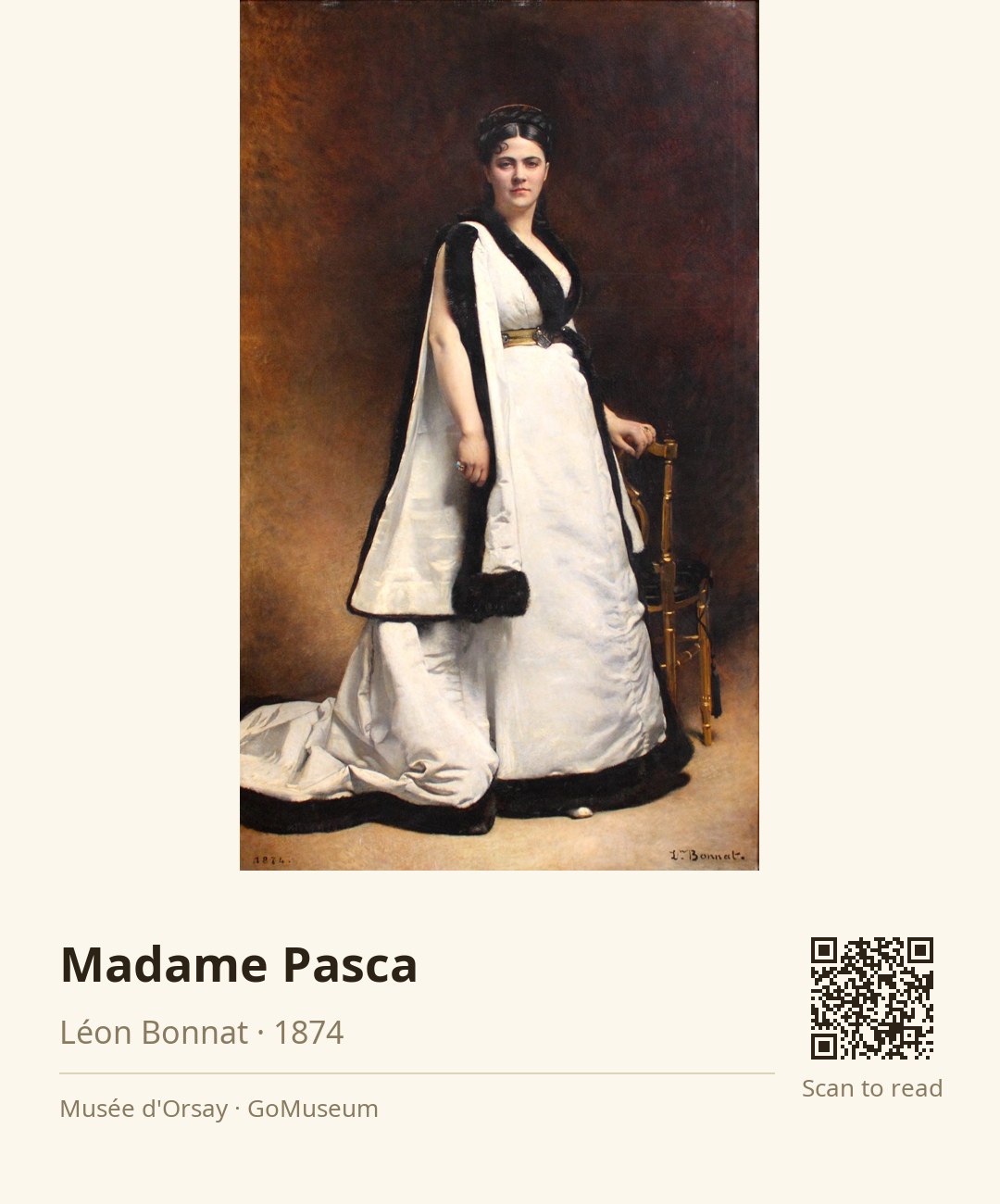
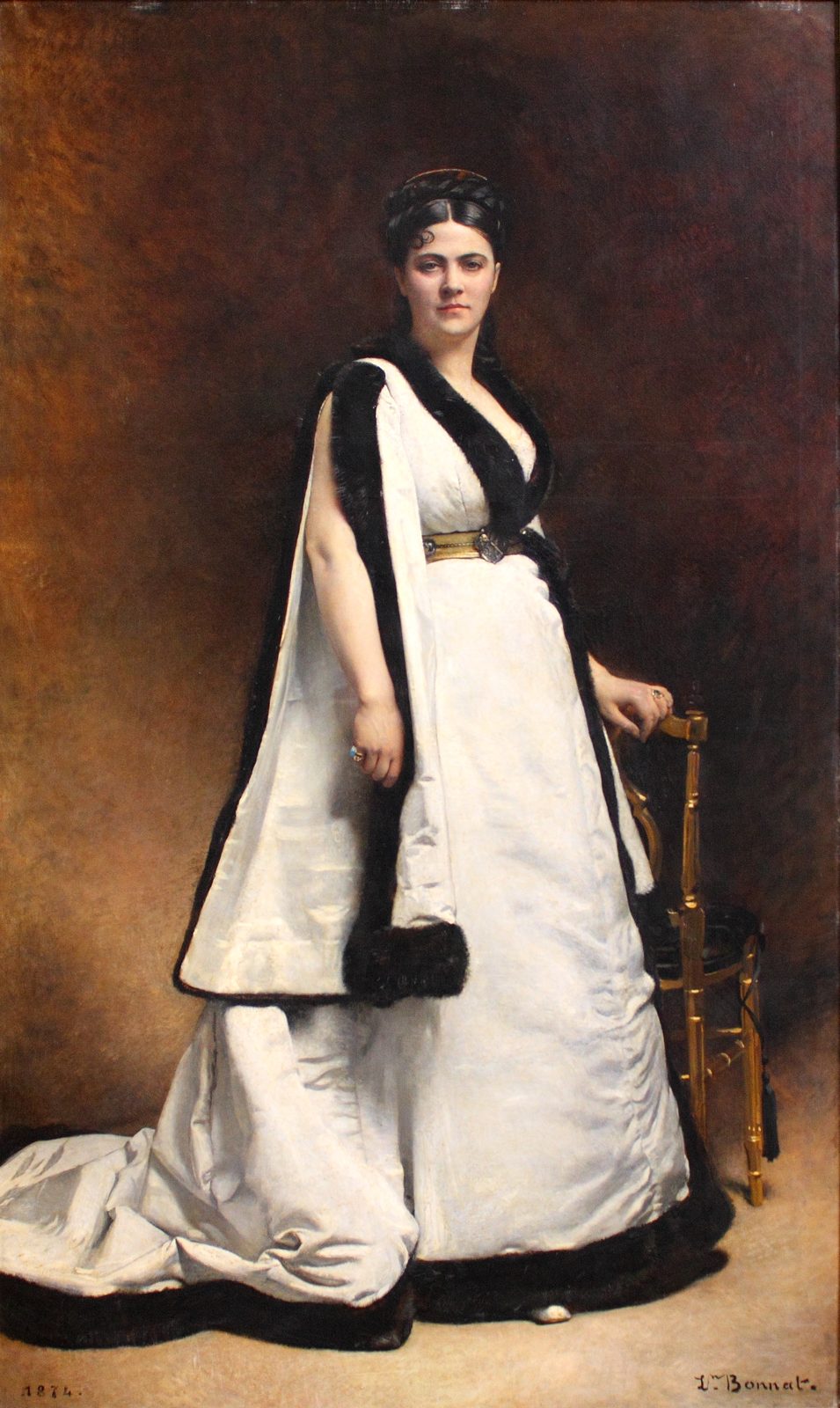
🎧 This work has audio narration — listen in the appMadame Pasca stands confidently in her luxurious white gown, the black fur trim framing her figure elegantly. The gold belt cinches her waist, while her dark hair is styled with meticulous care, drawing your eye to her direct gaze that seems to connect with you across time. Her left hand rests gracefully on a gold chair, a subtle detail that hints at her status, while the warm brown background enhances the richness of her attire.
This portrait, painted by Léon Bonnat in 1874, encapsulates the essence of academic art, showcasing not just the subject's beauty but also the artist's skill in capturing texture and form. The smooth brushwork reflects Bonnat's dedication to realism, allowing the viewer to appreciate the delicate interplay of fabric and fur. The choice of a full-length pose and the three-quarter turn adds depth, inviting a sense of intimacy with the viewer.
Bonnat, a prominent portraitist of his time, created this work for the Salon des Artistes français in 1875, where it garnered attention for its striking representation of contemporary elegance. The painting later featured at the Exposition Universelle in Paris in 1900, further solidifying its place in the artistic landscape of the 19th century.
Léon Joseph Florentin Bonnat, born on June 20, 1833, in Bayonne, was a prominent French painter and art educator known for his vivid portraits and powerful religious works. His early years in Madrid, where he honed his skills under José de Madrazo, ignited his passion for art, leading him to Paris, where he became a leading portraitist by the 1850s. Influenced by Spanish masters and the Old Masters, Bonnat's style combined rigorous drawing with a focus on overall effect, positioning him between academic painters and the emerging Impressionists.
Bonnat's career flourished as he won numerous accolades, including the Grand Officer of the Légion d'honneur and a professorship at the École des Beaux-Arts, where he inspired many notable artists, including Henri de Toulouse-Lautrec and John Singer Sargent. His portraits of contemporary figures, alongside significant religious paintings like "Christ on the Cross," showcased his ability to blend realism with emotional depth.
Despite facing criticism, Bonnat was recognized for his contributions to art, becoming an honorary member of the National Academy of Design in 1917. He passed away on September 8, 1922, leaving behind a rich legacy and a substantial collection of art that continues to influence the field.
This portrait, titled 'Madame Pasca,' was painted by Léon Bonnat in 1874. It was exhibited at the Salon des Artistes français in Paris in 1875, where it was assigned the number 239. Later, it featured at the Exposition Universelle in Paris in 1900, marked as number 46. The painting's provenance traces back to Madame Carnette-Pasca, the daughter of the model. It is cataloged in the Musée d'Orsay's illustrated summary of paintings published in 1990, on page 66.
In this striking portrait, the woman stands in a full-length pose, slightly turned to her left, exuding confidence. Her luxurious white gown, adorned with black fur trim, is cinched at the waist with a gold belt, emphasizing her elegance. The warm brown background contrasts beautifully with her attire, enhancing the richness of the scene. Her dark hair is styled with meticulous care, and her direct gaze connects with the viewer, drawing them into her world. The smooth brushwork captures the textures of the fabric and fur with precision, showcasing Bonnat's skill in realism.
The painting exemplifies academic art, showcasing Bonnat's mastery in portraiture. It stands as a notable representation of contemporary elegance during its time, reflecting the artist's ability to capture not just beauty but also the essence of his subjects.
Léon Bonnat spent part of his early life in Madrid, where he lived from 1846 to 1853.
Léon Bonnat was quite popular among American students in Paris, likely due to his ability to speak multiple languages.
Notable supporters of Léon Bonnat included writers Émile Zola and Théophile Gautier.