Madame Hector France
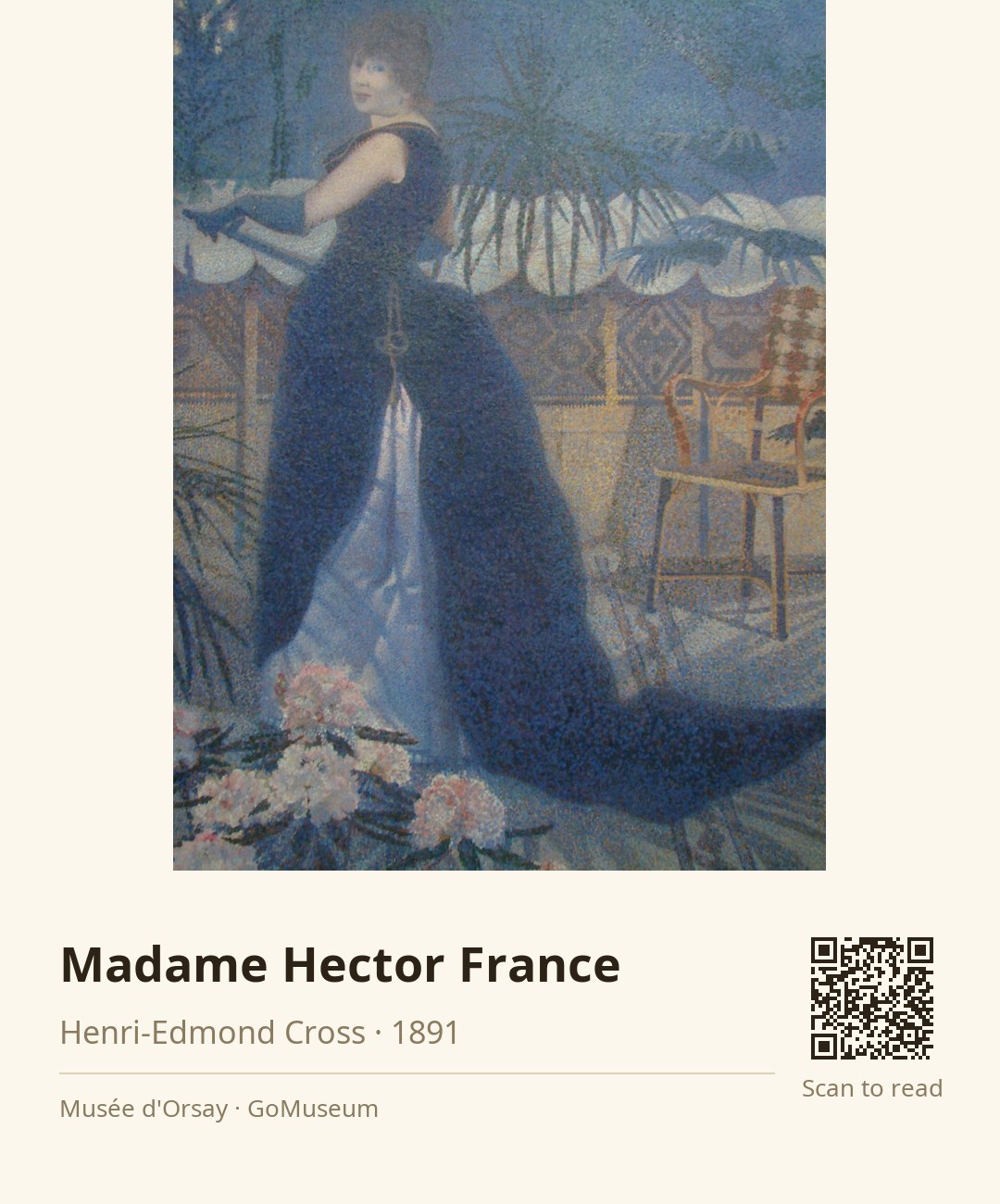
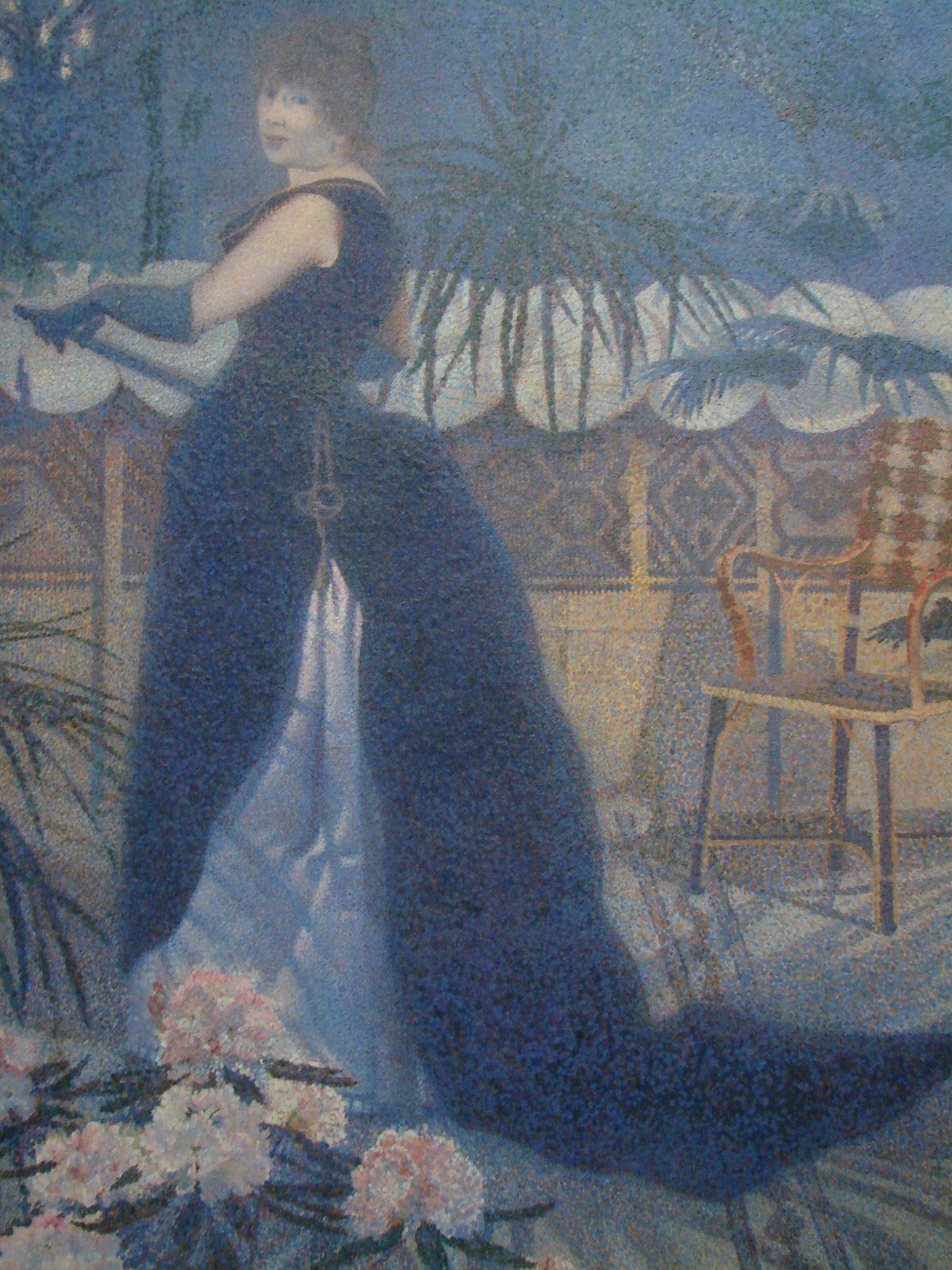
🎧 This work has audio narration — listen in the appThe striking figure of a woman in a dark blue dress with a flowing train stands gracefully in this vibrant garden scene, her gaze turned over her shoulder as she holds a delicate fan. The lush greenery surrounding her, dotted with clusters of pink flowers and palm-like plants, creates an inviting atmosphere, while a decorative fence adds a touch of elegance to the backdrop.
This portrait of Madame Hector France, painted in 1891, showcases Henri-Edmond Cross's mastery of the Neo-Impressionist technique, employing small dots of color that come together to form a textured and luminous surface. The choice of a rich blue palette against the soft pinks and greens not only highlights the subject's beauty but also reflects the artist's evolving style, moving away from the darker tones of his earlier works. The meticulous attention to detail in her attire, from the long gloves to the intricate patterns in the background, emphasizes the sophistication of the era and the intimate connection between the artist and his subject, whom he would later marry.
Cross's transition to this divisionist style marked a significant moment in his career, coinciding with his full-time move to the south of France, where he found inspiration in the Mediterranean light. This painting was exhibited in an Indépendants show, signaling his commitment to the Neo-Impressionist movement and his desire to capture the essence of his surroundings and the people within them. In 1893, he married Irma Clare, the woman depicted here, who was previously married to the writer Hector France.
Henri-Edmond Cross, born on May 20, 1856, in Douai, France, was a pivotal figure in Neo-Impressionism and a precursor to Fauvism. Initially trained in Realism, he evolved his style under the influence of artists like Paul Signac and Georges Seurat, adopting a lighter palette and divisionist techniques. His early works, characterized by dark tones, transitioned to vibrant landscapes inspired by the Mediterranean light after he moved to southern France in 1891.
Cross's artistic journey was marked by a commitment to anarchist ideals, which shaped his subject matter, often depicting utopian scenes. He co-founded the Société des Artistes Indépendants, promoting unjuried exhibitions that fostered artistic freedom. His marriage to Irma Clare in 1893 further enriched his life and work, as she became a frequent subject of his paintings.
Cross's influence extended to notable artists like Henri Matisse, cementing his place in art history. His legacy is preserved in major collections worldwide, where his vibrant landscapes and innovative techniques continue to inspire. He passed away on May 16, 1910, leaving behind a rich body of work that reflects both his artistic evolution and his philosophical convictions.
Henri-Edmond Cross painted 'Madame Hector France' in 1891, a pivotal year in his artistic journey. This portrait was not just a commission; it marked his full embrace of the Neo-Impressionist style, a technique he had been gradually adopting. The painting was first showcased at an Indépendants exhibition, a platform for artists seeking to break free from the constraints of the traditional Salon. Cross's relationship with the subject, Irma Clare, adds a layer of intimacy to the work; they would marry just two years later. The painting's provenance traces back to Cross himself, indicating its significance in his personal and professional life.
In 'Madame Hector France', Cross employs a pointillist technique, meticulously applying tiny dots of color to create a vibrant, textured surface. This method not only enhances the luminosity of the scene but also invites viewers to experience the painting from different distances. Up close, the dots appear chaotic, yet they coalesce into a harmonious image from afar. The rich blue of the dress contrasts beautifully with the surrounding greens and pinks, drawing the eye to the figure while simultaneously integrating her into the lush garden. The composition is dynamic; the woman's slight turn and her gaze over the shoulder create a sense of movement and engagement, as if she's inviting you into her world. Cross's choice of a larger scale—208 by 149 centimeters—further amplifies the impact, allowing for intricate details that celebrate both the subject and the surrounding beauty.
Cross shared anarchist principles with fellow Neo-Impressionists, which influenced his choice of subjects and the themes he explored in his artwork.
Initially, Cross's paintings featured dark colors typical of Realism, but he later transitioned to a lighter palette and embraced the vibrant colors of Impressionism and Neo-Impressionism.