 Image: Didier Descouens
Madame de Loynes
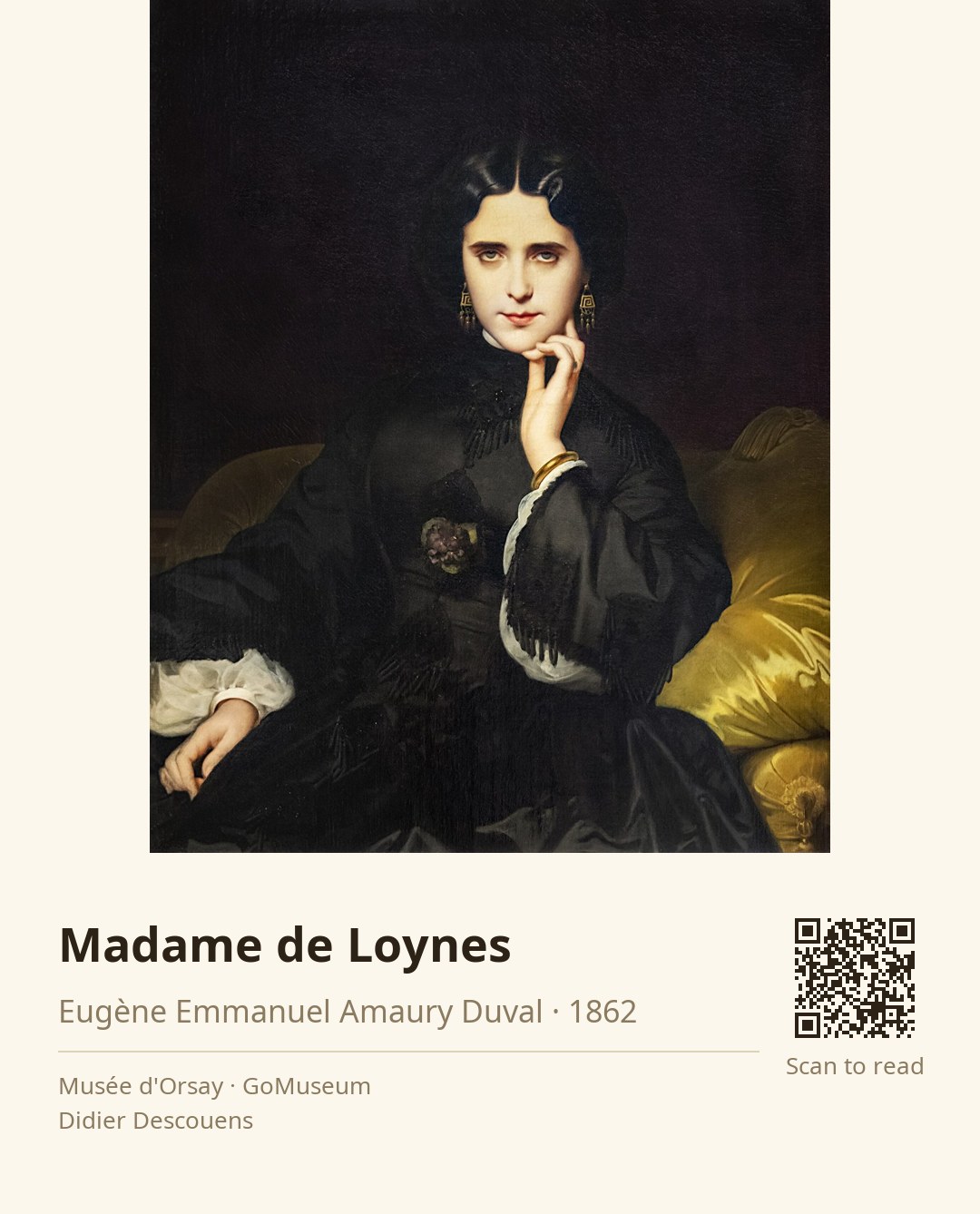
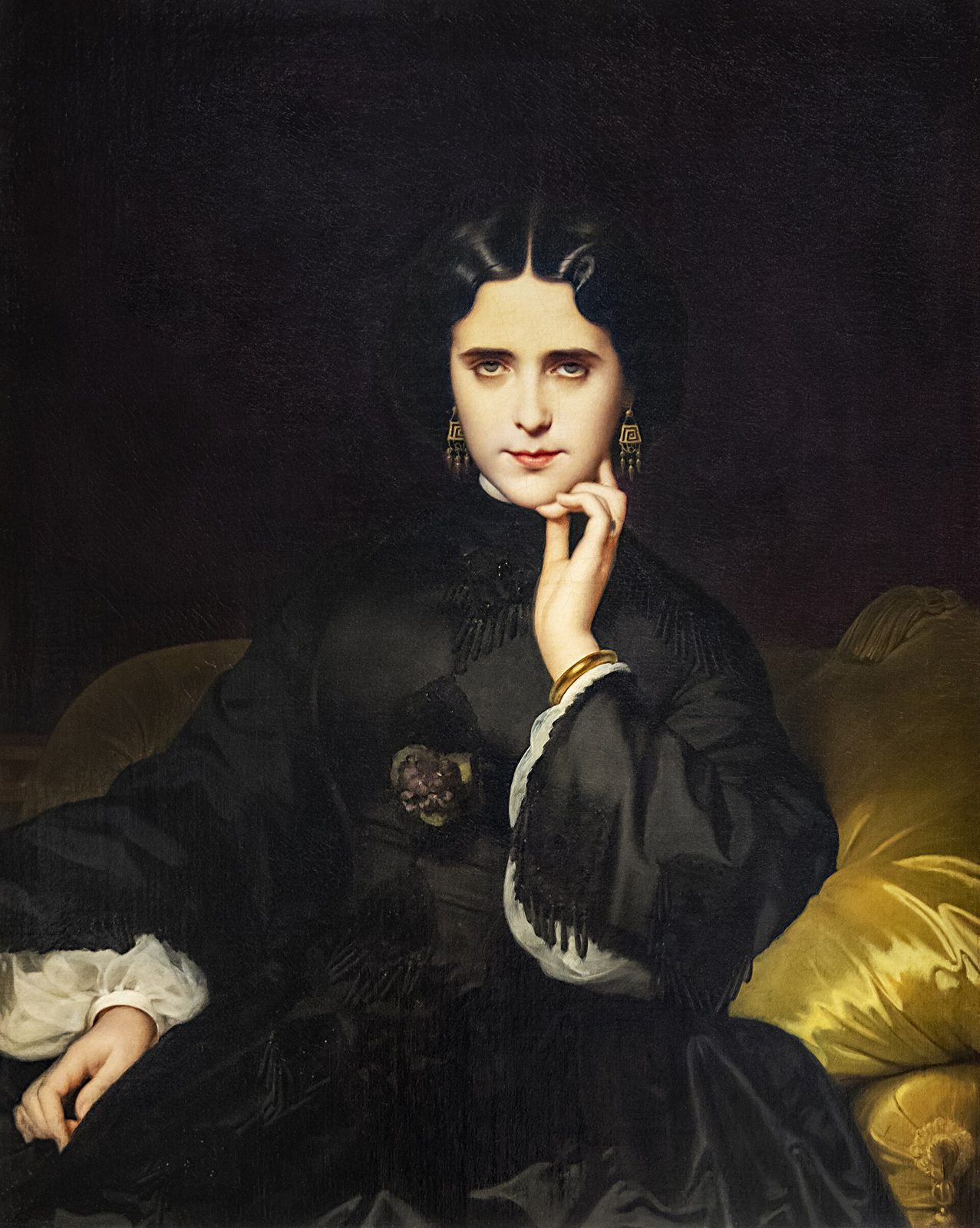
🎧 This work has audio narration — listen in the appThe contemplative gaze of Madame de Loynes draws you in, her right hand resting thoughtfully against her chin. Seated on a plush, golden-yellow cushion, she wears a dark gown adorned with intricate lace cuffs, while her smooth, dark waves frame her face, accentuating the elegance of her ornate earrings. The rich brown background enhances the softness of her skin and the vibrant cushion, creating a striking contrast that highlights her poised demeanor.
This portrait, painted by Eugène Emmanuel Amaury Duval in 1862, captures not just a moment but the essence of a woman immersed in thought. The smooth brushwork emphasizes the textures of her gown and the delicate features of her face, showcasing Duval's skill in portraying both fabric and emotion. The artist, a student of the renowned Jean-Auguste-Dominique Ingres, was known for his ability to blend classical influences with a personal touch, and here, he presents a subject that embodies both grace and introspection.
Duval exhibited this work at the Salon des Artistes français in Paris in 1863, where it was noted for its refined execution and the artist's distinctive style. Madame de Loynes, also known as Jeanne Détourbay, remains a testament to Duval's dedication to portraiture, reflecting the social and artistic currents of 19th-century France.
Eugène Emmanuel Amaury Pineux Duval, known as Amaury-Duval, was a French painter born on April 16, 1808, in Montrouge. He was the son of a diplomat and the nephew of playwright Alexandre-Vincent Pineux Duval. A prominent student of Jean Auguste Dominique Ingres, his artistic journey began early, participating in the 1829 Morea Expedition to Greece to create archaeological drawings. His first exhibition at the Paris Salon in 1833 showcased his talent in portraiture, including a notable self-portrait.
Duval's travels to Italy from 1834 to 1836 deepened his appreciation for Renaissance art, influencing his later works. He became known for his ecclesiastical commissions under Louis-Philippe and Napoleon III, decorating several churches with his murals. Despite his technical skill, critics like Baudelaire found his work pretentious, highlighting a tension between his refined style and emotional depth. Duval's legacy includes 76 known works and a reputation as a French Pre-Raphaelite, celebrated for his delicate modeling and composition. He passed away in Paris on December 25, 1885, leaving behind a rich artistic heritage.
Eugène Emmanuel Amaury Duval painted 'Madame de Loynes' in 1862, a time when portraiture was a prestigious art form in France. The painting made its debut at the Salon des Artistes français in Paris in 1863, where it garnered attention for its refined execution and the artist's unique style. Critics noted Duval's ability to capture not just the likeness but the essence of his subjects.
Duval's technique in 'Madame de Loynes' showcases a mastery of oil painting that brings the subject to life. The smooth brushwork creates a velvety texture, particularly evident in the intricate lace cuffs of the gown and the soft contours of Madame de Loynes' face. This attention to detail not only highlights the fabric but also enhances the emotional depth of her contemplative expression. The rich brown background serves a dual purpose: it not only contrasts beautifully with the lighter tones of her skin and the vibrant cushion but also draws the viewer's focus directly to her. The composition is centered, with Madame de Loynes' gaze directed outward, inviting you into her world of thought.
Duval was part of the Morea Expedition in 1829, which was commissioned by Charles X of France to create archaeological drawings in Greece.
Yes, Duval published his memoirs, providing insights into his life and artistic journey.
Contemporary critic Charles Baudelaire harshly criticized Duval and the Ingres school, noting their portraits often displayed pretentiousness and affectedness.