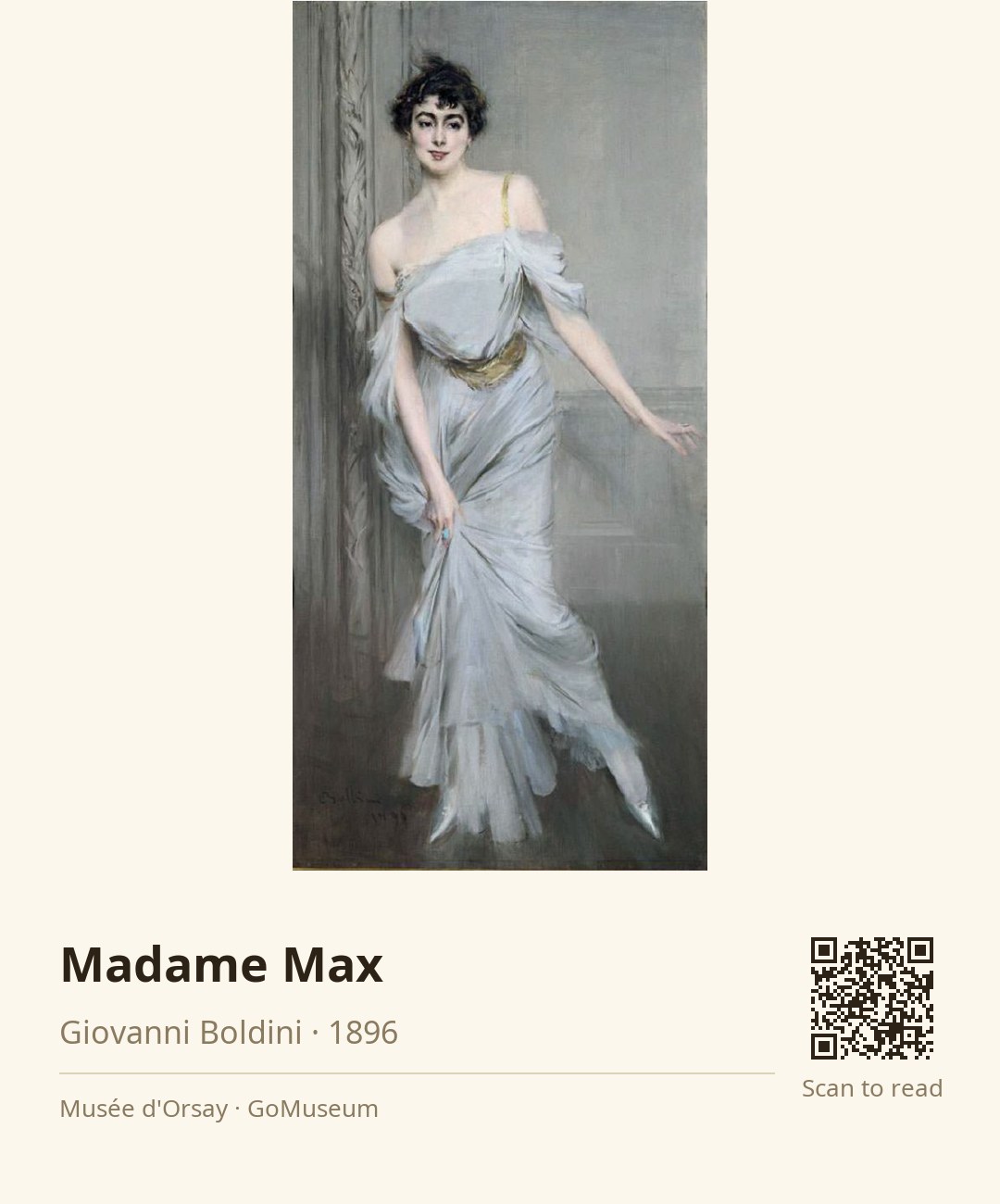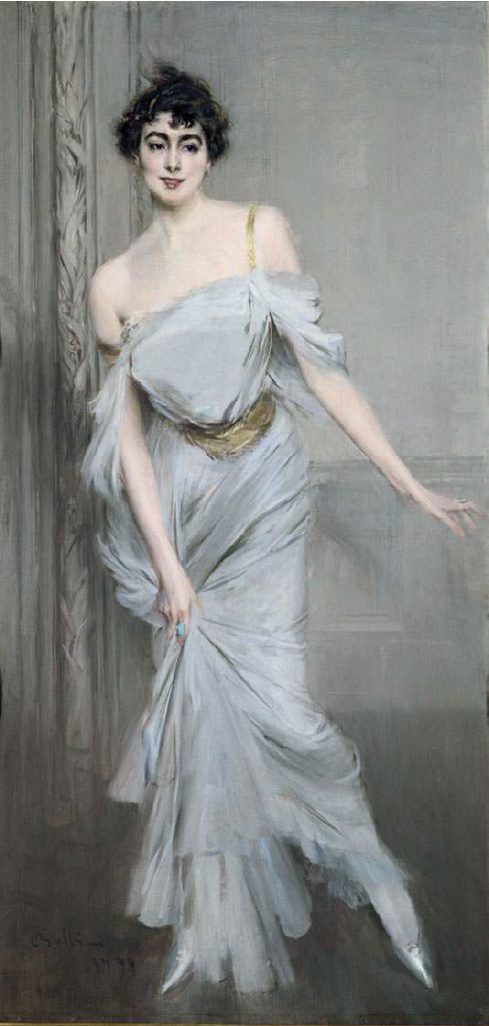
Take a moment to really look at "Madame Max" by Giovanni Boldini. Notice how the figure of Jeanne Max seems to glide toward you, her white dress flowing with an almost ethereal lightness. The way the fabric falls, with one strap slipping off her shoulder, adds a playful touch to her confident pose.
These details matter because they capture not just her physical beauty but also the spirit of the Belle Époque—a time when women like Jeanne were beginning to assert their independence and charm in society. Boldini’s brushwork, especially his famous “saber cuts,” creates a dynamic sense of movement, making her appear both elegant and alive, as if she might step right off the canvas.
Painted in 1896, this portrait was more than just a depiction; it was a statement. Boldini was known for his ability to capture the essence of his subjects, and here, he immortalizes a woman who was at the heart of Parisian high society, hosting the elite in her salon.
As you stand here, think about the world Jeanne Max inhabited—a world of glamour and social change. What do you think her life was like, mingling with the most influential figures of her time?
Giovanni Boldini, born on December 31, 1842, in Ferrara, Italy, was a renowned portrait painter who spent most of his life in Paris. The son of a religious painter, he showed artistic talent from a young age, eventually studying in Florence where he encountered the Macchiaioli, whose influence shaped his early work. Boldini moved to London, gaining fame for his portraits of high society, including notable figures like Lady Holland.
In Paris, he became a prominent figure in the art scene, known for his dynamic brushwork and vibrant style, earning him the nickname "Master of Swish." His relationships with artists like Edgar Degas and his romantic entanglements enriched his life and work. Boldini's portraits captured the essence of the Belle Époque, making him a sought-after artist among the elite.
Despite his success, he struggled to adapt to changing artistic trends and faded from prominence in the early 20th century. He died on January 11, 1931, in Paris, leaving behind a legacy that continued to be celebrated posthumously, with major exhibitions highlighting his contributions to portraiture and the evolution of modern art.
Giovanni Boldini's "Madame Max" was painted in 1896 and quickly became a sensation at the Salon of the Société nationale des beaux-arts, where it was displayed. The portrait captures Jeanne Max, a celebrated society singer known for her charm and elegance, who hosted the elite of Paris in her salon. Critics praised Boldini's ability to convey movement and grace, with François Thiébault-Sisson noting that in the art of accentuating unexpected poses, Boldini had no rival. Over time, it found its home in the Musée d'Orsay, where it continues to draw admiration for its vibrant portrayal of Belle Époque society.
In "Madame Max," Boldini employs his signature 'saber cuts' technique, which gives the fabric of Jeanne's flowing dress an almost ethereal quality. Notice how the brushwork varies—while the face is rendered with meticulous detail, the dress is painted with long, sweeping strokes that suggest movement and fluidity. This contrast enhances the dynamic pose of Madame Max, who steps slightly towards the viewer, her left leg raised and her body poised in a way that exudes confidence and sensuality. The palette of whites and grays not only harmonizes with the subject's attire but also creates a dreamlike atmosphere, drawing the viewer's eye to her radiant presence. The framing minimizes distractions, focusing our attention squarely on her, as if she is about to step out of the canvas.