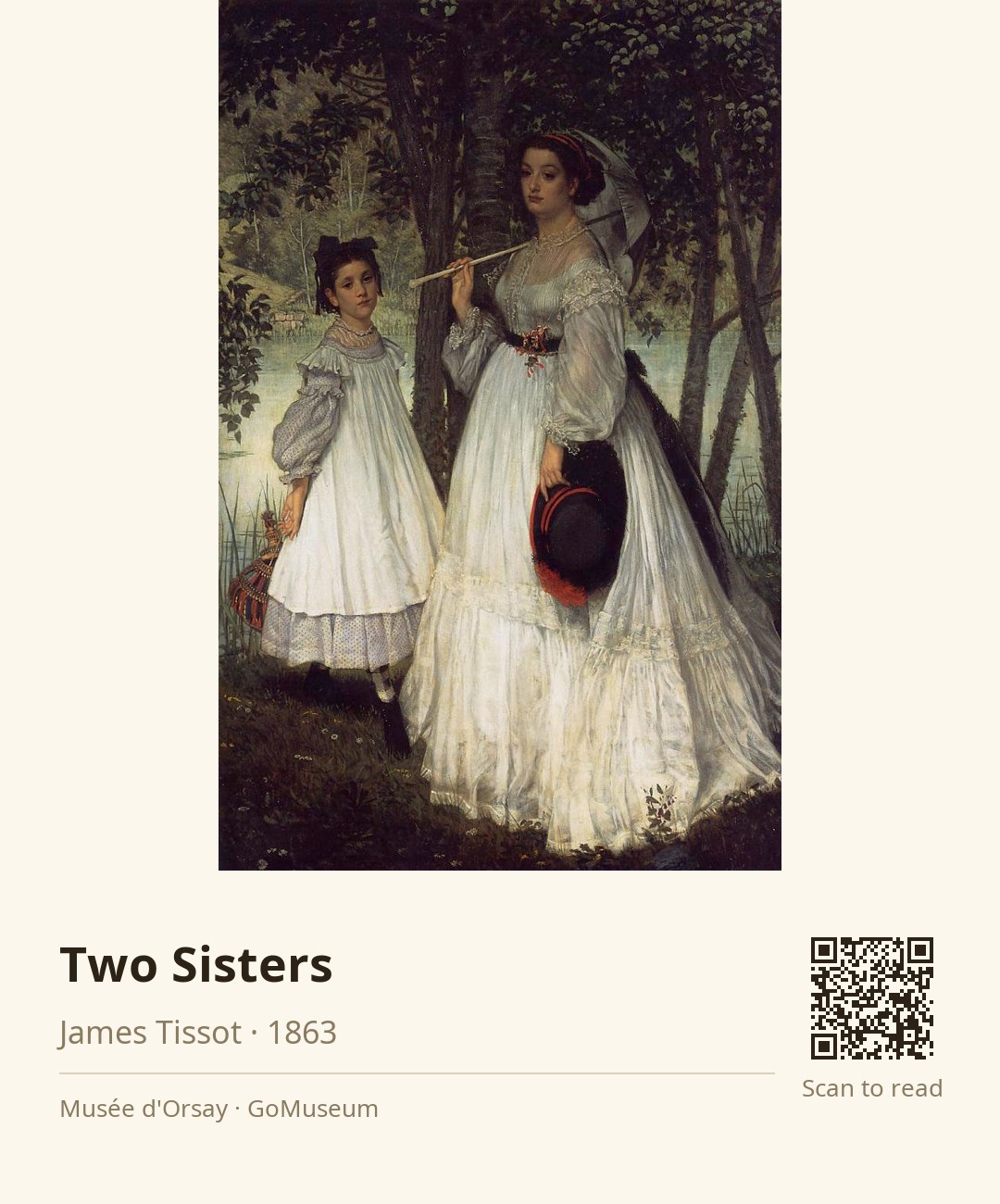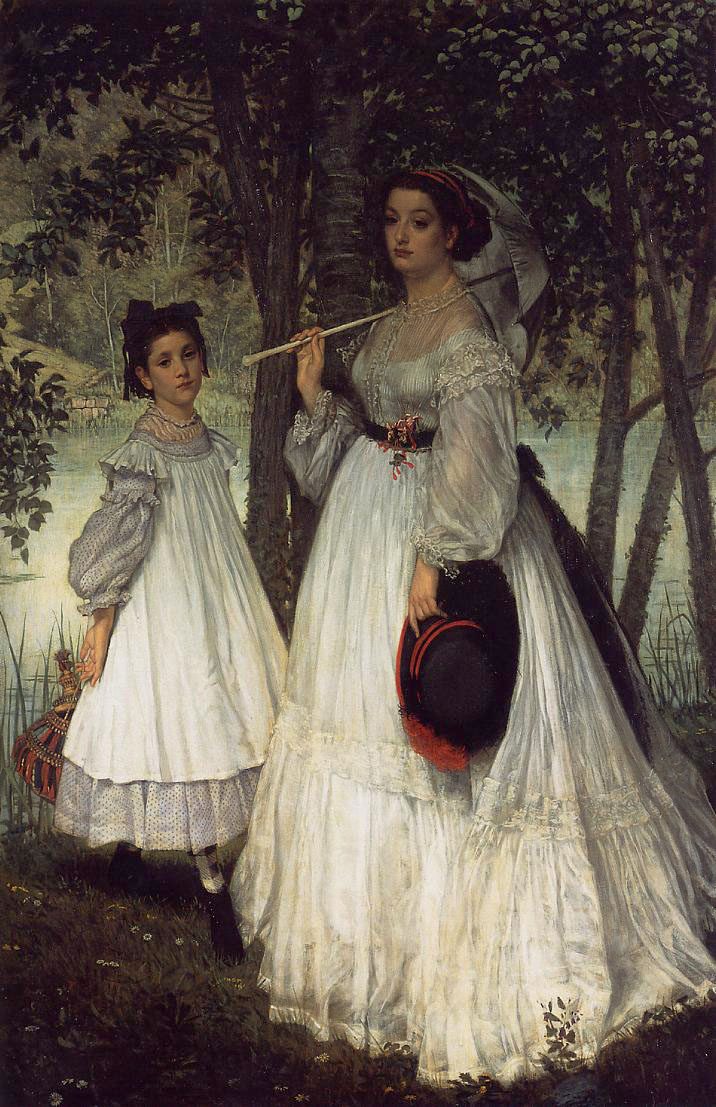
Take a moment to really look at "Two Sisters." Notice how the elder sister holds her parasol with such grace, almost as if she’s shielding herself from more than just the sun. The way her gaze meets yours feels like a secret invitation into their world. And then there’s the younger sister, her expression caught between surprise and delight, as if they’ve just stumbled upon a hidden moment in the woods.
These details matter because they capture a fleeting sense of intimacy and spontaneity. Tissot painted this in 1863, a time when artists were beginning to embrace the beauty of everyday life, moving away from grand historical themes. Here, he invites us into a slice of Victorian leisure, where the natural world and human connection intertwine.
Tissot was influenced by Gustave Courbet, who also celebrated the ordinary, but Tissot's focus on fashion and the female experience set him apart. This painting was controversial at its 1864 Salon debut, not just for its style, but for its modernity—an artist stepping boldly into the present.
As you stand here, think about what these sisters might be whispering to each other. What stories do you imagine they share in this serene moment?
James Tissot, born Jacques Joseph Tissot in Nantes in 1836, was a French painter and illustrator renowned for his depictions of Victorian high society and women's fashion during the Belle Époque. Initially trained at the École des Beaux-Arts in Paris, he embraced realism and impressionistic techniques, capturing the nuances of contemporary life. Tissot's early works focused on medieval themes, but after moving to London in 1871, he shifted to genre paintings that resonated with British audiences, earning acclaim for his photorealistic style.
His tumultuous life included service in the Franco-Prussian War and a close relationship with Kathleen Newton, who inspired many of his works until her untimely death. Tissot's social circle included notable figures like Edgar Degas and James Whistler, reflecting his integration into the artistic elite. Later in life, he experienced a religious awakening, leading him to create biblical subjects that garnered significant recognition. Tissot's legacy endures as a pivotal figure in 19th-century art, bridging traditional techniques with modern themes, ultimately earning him a place in art history. He passed away in 1902, leaving behind a rich tapestry of works that continue to captivate audiences.
James Tissot's "Two Sisters," painted in 1863, made its debut at the Salon des Artistes français in Paris in 1864, where it stirred quite a buzz. Critics were taken aback not just by the painting's style but by its modernity, as Tissot had ventured into the realm of everyday life, moving away from the historical themes that dominated the art scene. The painting was a turning point for Tissot, who had previously focused on historical subjects. The same model appeared in both this work and another piece submitted to the Salon, causing a stir among viewers and critics alike. One critic remarked that Tissot had finally stepped into the present century, marking a significant shift in his career. After its exhibition, the painting was acquired by Albert Bichet and later became part of the Musée d'Orsay's collection in 1904, after passing through various hands, including a stint at the Louvre. This journey through different collections reflects the evolving appreciation of Tissot's work over time.
As you gaze at "Two Sisters," pay attention to Tissot's masterful brushwork. His technique combines meticulous detail with a loose, almost spontaneous feel, capturing the fleeting moment of the sisters' stroll. The light filters through the trees, casting dappled shadows on their dresses, which are painted with a vibrant palette that brings out the richness of the fabric. Notice how the elder sister's parasol not only serves a practical purpose but also creates a striking contrast against the lush greens of the background. Tissot's composition is carefully structured; the sisters are positioned in a way that draws your eye naturally from one to the other, creating a sense of intimacy. The scale of the painting, quite large at over two meters tall, envelops you in their world, making you feel as if you are part of this serene moment. It's a delicate balance of realism and impressionism, where every brushstroke feels intentional yet alive.
This painting, displayed at the Salon of 1864, stirred conversations about modernity in art, particularly due to its en plein air technique. Tissot's choice to depict contemporary life, especially fashionable women in natural settings, influenced a generation of artists who began to explore similar themes. Critics noted that Tissot had 'entered our century,' reflecting a broader movement towards realism and impressionism.
One intriguing aspect of 'Two Sisters' is its connection to controversy at the 1864 Salon in Paris. Tissot's choice to paint en plein air, or outdoors, was quite bold for the time. Critics were shocked, not just by the technique but also by the modernity of the scene. It was a departure from the historical and mythological subjects that dominated the art world, marking a significant shift in Tissot's career. This painting was not just a portrait; it was a statement that Tissot was ready to embrace contemporary life and its complexities.
The same model appeared in both 'Two Sisters' and Tissot's other submission, 'Portrait of Mademoiselle L.L.', which surprised viewers and critics alike, adding a layer of intrigue to the exhibition.
Growing up in a family involved in the drapery and millinery businesses, Tissot developed a keen interest in fabrics and fashion, which became a hallmark of his paintings, particularly in his depictions of women's clothing.