Les cyprès à Cagnes by Henri-Edmond Cross
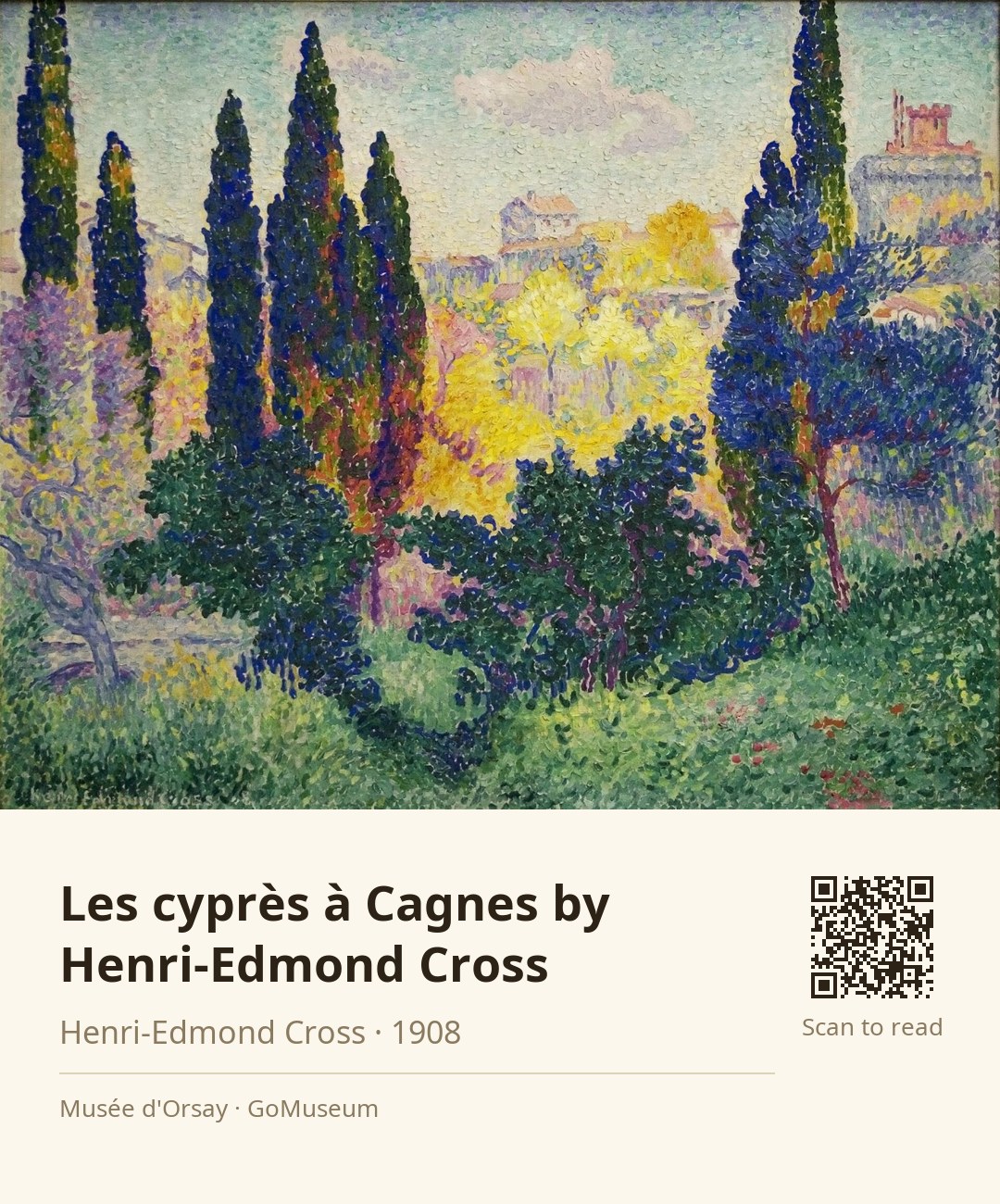
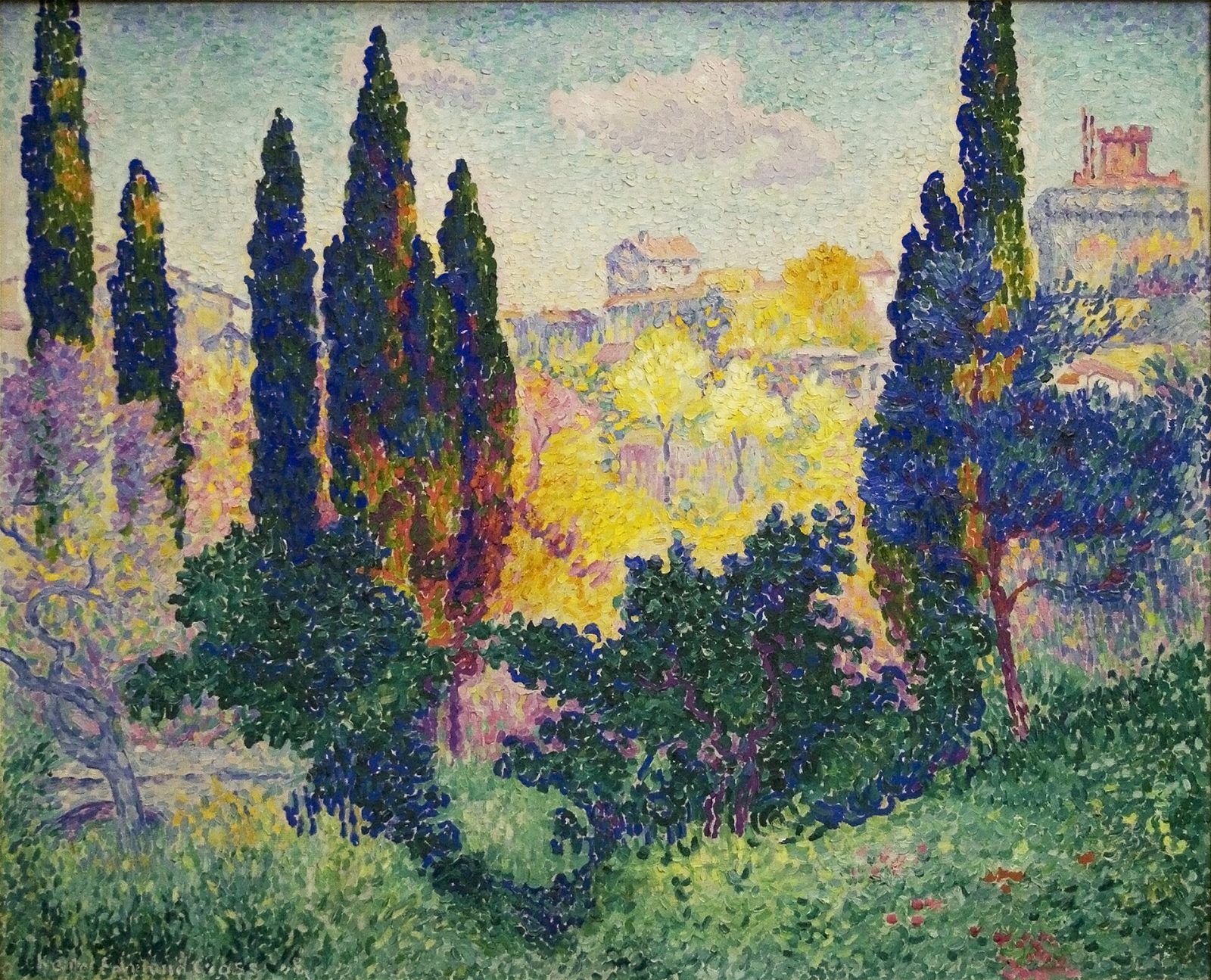
🎧 This work has audio narration — listen in the appTall cypress trees rise prominently in Henri-Edmond Cross's "Les cyprès à Cagnes," their slender forms painted in deep blues and greens. The vibrant foliage surrounding them bursts with yellows and pinks, creating a striking contrast that draws the eye. This lively color palette, combined with the distinct dabs of paint characteristic of pointillism, captures the essence of a sunlit Mediterranean landscape.
The cypress trees, often associated with immortality, stand as sentinels over a tranquil scene that includes hints of a village and a castle-like structure in the background. This choice of subject reflects Cross's deep connection to the southern French landscape, where he settled permanently in 1891. The interplay of light and color in this work not only showcases his mastery of Neo-Impressionism but also reveals his desire to convey the beauty of nature through a vibrant, almost dreamlike lens.
Cross's artistic journey began in the late 19th century, evolving from dark Realism to the bright colors of Impressionism and finally embracing Neo-Impressionism. By 1908, when he painted this work, he had become a pivotal figure in the movement, influencing contemporaries like Henri Matisse. "Les cyprès à Cagnes" exemplifies his dedication to capturing the light and atmosphere of the Provençal landscape, a theme that permeated much of his later work.
Henri-Edmond Cross, born on May 20, 1856, in Douai, France, was a pivotal figure in Neo-Impressionism and a precursor to Fauvism. Initially trained in Realism, he evolved his style under the influence of artists like Paul Signac and Georges Seurat, adopting a lighter palette and divisionist techniques. His early works, characterized by dark tones, transitioned to vibrant landscapes inspired by the Mediterranean light after he moved to southern France in 1891.
Cross's artistic journey was marked by a commitment to anarchist ideals, which shaped his subject matter, often depicting utopian scenes. He co-founded the Société des Artistes Indépendants, promoting unjuried exhibitions that fostered artistic freedom. His marriage to Irma Clare in 1893 further enriched his life and work, as she became a frequent subject of his paintings.
Cross's influence extended to notable artists like Henri Matisse, cementing his place in art history. His legacy is preserved in major collections worldwide, where his vibrant landscapes and innovative techniques continue to inspire. He passed away on May 16, 1910, leaving behind a rich body of work that reflects both his artistic evolution and his philosophical convictions.
Henri-Edmond Cross painted 'Les cyprès à Cagnes' in 1908, during a vibrant period of his artistic career. This work was created after he had fully embraced Neo-Impressionism, a style he adopted around 1891. The painting was part of his exploration of the southern French landscape, where he had settled permanently in 1891. The piece reflects his deep connection to the region, particularly Cagnes-sur-Mer, where he often painted en plein air. Cross's art was well-received, especially among his contemporaries, and he became a significant figure in the Neo-Impressionist movement, influencing artists like Henri Matisse. The provenance of this painting traces back to Chollet vicomte Guy du, highlighting its esteemed history. Throughout his life, Cross's works were celebrated in exhibitions, including the Salon des Artistes Français, where he first showcased his talent in 1881.
In 'Les cyprès à Cagnes,' Cross employs a pointillist technique that brings the landscape to life with vibrant energy. The brushwork is a dance of tiny, distinct dabs of color, creating a shimmering effect that captures the Mediterranean light. The deep blues and greens of the cypress trees contrast beautifully with the lively yellows and pinks of the surrounding foliage, drawing your eye through the composition. The vertical lines of the trees anchor the scene, while the horizontal expanse of the landscape invites you to explore the tranquil setting. Cross's choice of oil paint on canvas allows for rich layering, enhancing the luminosity of the colors. This technique not only showcases his mastery but also reflects his desire to convey the essence of nature in a way that feels almost dreamlike, inviting viewers into a sun-soaked Provençal paradise.
A curious tidbit about Cross is that he was not only an artist but also a passionate advocate for anarchist principles. His political beliefs influenced his choice of subjects, as he often sought to depict a utopian world through his art.
Cross was a passionate advocate for anarchist principles, which influenced his artistic choices and the themes he explored in his work.
During his Mediterranean trip, Cross met Paul Signac, who became a close friend and had a significant influence on his artistic development.
Cross began painting in the Neo-Impressionist style in 1891, showcasing his first large piece in an Indépendants exhibition shortly thereafter.