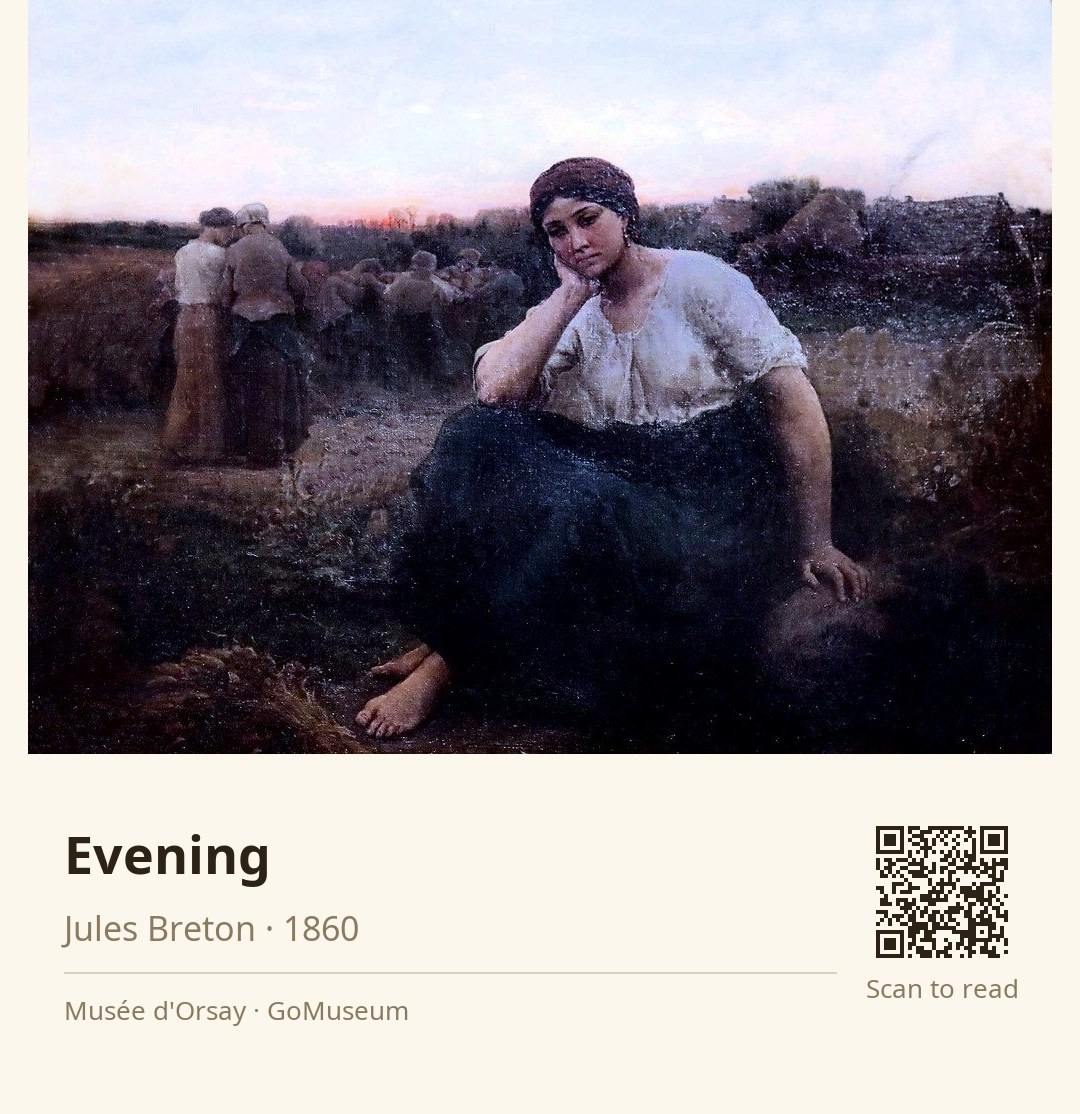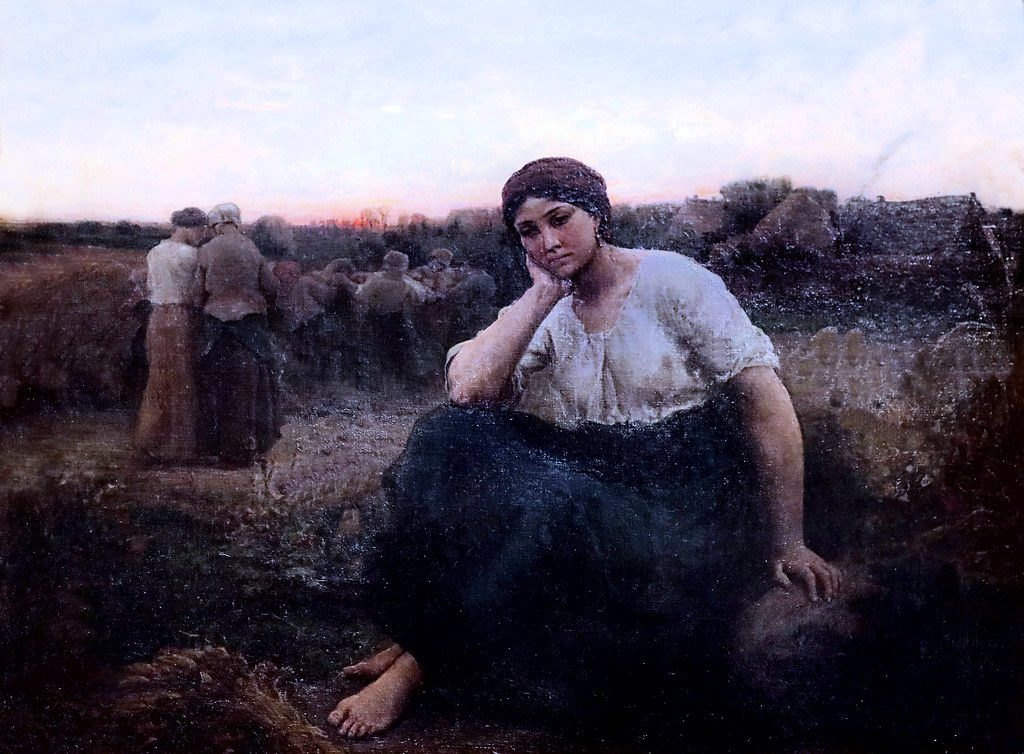
A young woman rests her head on her hand, lost in thought, her bare feet tucked beneath her dark skirt. The soft hues of the dusky sky envelop her, while a group of women in earth-toned clothing gather in the middle distance, possibly taking a break from agricultural work. This scene captures a moment of quiet reflection amidst the labor of rural life, a theme that resonates deeply in Jules Breton's work.
The contemplative expression on the woman's face suggests a connection to the land and the daily struggles of those around her. Breton's choice of muted earth tones and smooth brushwork evokes a serene yet somber mood, reflecting the beauty and hardship of rural existence. The painting, titled "Evening," embodies the artist's dedication to portraying the lives of peasant women, often seen in his works as symbols of resilience and grace.
Breton, a 19th-century naturalist painter, drew inspiration from his upbringing in the French countryside, where he developed a profound respect for tradition and the beauty of everyday life. His focus on peasant imagery became a hallmark of his career, leading to widespread acclaim during his lifetime. "Evening," created in 1860, exemplifies his ability to capture the essence of rural existence through a single, poignant moment.
Jules Adolphe Aimé Louis Breton, born on May 1, 1827, in Courrières, France, was a prominent 19th-century naturalist painter known for his evocative depictions of rural life. Raised in a family deeply connected to the land, Breton's early experiences in the French countryside profoundly influenced his artistic vision. After studying under notable artists in Belgium and Paris, he developed a style that celebrated the beauty of peasant life, often portraying solitary female figures against golden sunsets.
Breton's career took off with works like "The Gleaners," which highlighted the dignity of agricultural laborers. His paintings resonated with audiences, particularly in the United States, where he became highly sought after. Throughout his life, he received numerous accolades, including the Legion of Honor, and was elected to the Institut de France.
Despite facing criticism from contemporaries like Baudelaire and Zola, Breton maintained a significant place in art history, admired by figures such as Vincent van Gogh. His legacy endures through his poetic representations of rural existence, capturing the essence of a bygone era and the resilience of the human spirit. He passed away on July 5, 1906, leaving behind a rich body of work that continues to inspire.
In 'Evening', Breton employs smooth brushwork to create a serene atmosphere, inviting viewers into the quiet moment of contemplation experienced by the young woman. The muted earth tones dominate the palette, enhancing the emotional weight of the scene while subtly suggesting the warmth of the setting sun. The composition draws the eye toward the foreground, where the woman's thoughtful expression contrasts with the distant group of women engaged in labor. This juxtaposition highlights the duality of rural life—both its beauty and its hardships. The scale of the painting allows for an intimate connection with the subject, making her solitude feel palpable. Breton's technique of layering paint contributes to the soft transitions in color, evoking a sense of tranquility that envelops the viewer.
Breton's focus on peasant imagery became prominent after he realized that he was not suited to be a historical painter, turning instead to the memories of nature and rural life from his youth.
The auction in 1886 was notable because the painting sold for $45,000, making it the second highest price paid for a painting by a living artist at that time.
Breton created copies of his works because they were extremely popular during his lifetime, allowing him to meet the high demand from collectors and art enthusiasts.