The Rut of Spring. Battle of Stags
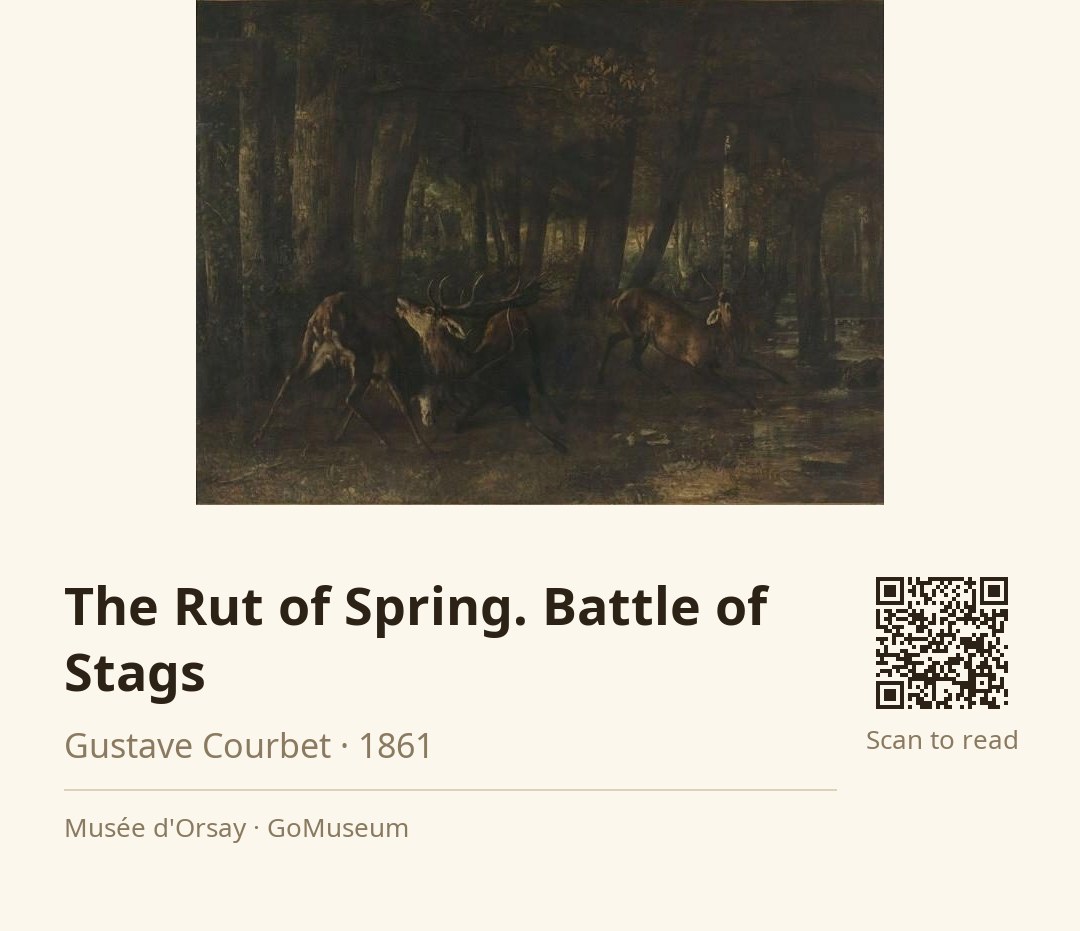
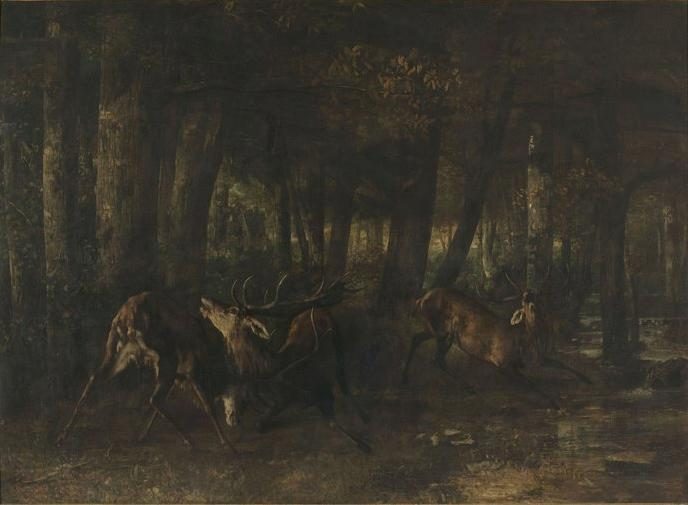
🎧 This work has audio narration — listen in the appTake a moment to really look at "The Rut of Spring. Battle of Stags" by Gustave Courbet. Notice how the stags are locked in fierce combat, their antlers entwined in a dramatic struggle. The way Courbet captures the tension in their muscles and the wildness of the forest around them pulls you right into the scene. These details matter because they showcase Courbet's commitment to realism, a movement he championed. He painted not just what he saw, but what he felt about nature's raw power and the instinctual battles of life. The energy in this painting reflects the cycle of nature, a theme that resonates deeply with the human experience of struggle and survival. Created in 1861, this work was exhibited at the Salon des Artistes Français, where it stirred conversation and admiration alike. Courbet was known for breaking away from traditional artistic conventions, focusing instead on the visceral reality of his subjects—like these stags, which symbolize both aggression and vitality. As you stand here, think about the wildness of nature and the battles we all face, whether in the animal kingdom or our own lives. What struggles resonate with you today?
Gustave Courbet, born on June 10, 1819, in Ornans, France, was a pioneering painter who championed the Realism movement in 19th-century art. Rejecting the conventions of academic painting and the idealism of Romanticism, he focused on depicting the world as he observed it, often portraying unidealized peasants and workers in monumental compositions. His early works gained recognition, notably "After Dinner at Ornans," which won him a gold medal at the Salon of 1849, allowing him to exhibit without jury approval.
Courbet's commitment to realism was revolutionary; he believed that art should stem from personal experience rather than historical or mythological themes. His bold approach often sparked controversy, challenging societal norms and addressing social issues, which resonated with later movements like Impressionism and Cubism. Despite facing criticism and imprisonment for his political involvement during the Paris Commune, Courbet continued to create until his death on December 31, 1877, in Switzerland.
His legacy endures as a transformative figure in art history, whose unflinching depictions of everyday life laid the groundwork for modern artistic expression. Today, Courbet is celebrated for his vigorous and uncompromising work, which continues to engage audiences with its raw honesty and depth.
Gustave Courbet's "The Rut of Spring. Battle of Stags" was created in 1861 and first exhibited at the Salon des Artistes Français in Paris, where it was assigned the number 717. The painting quickly became a topic of conversation, stirring both admiration and debate among critics and the public alike. It was later shown at the Exposition Universelle in London in 1862, where it was listed under class 38, number 124. The painting remained in Courbet's possession until his death, after which it was passed to his sister, Juliette. It was sold at auction in Paris at Hôtel Drouot in 1881. This work exemplifies Courbet's commitment to realism, showcasing the raw, unfiltered aspects of nature and life, which was a departure from the idealized forms of previous artistic movements. Its journey through exhibitions and ownership reflects the evolving appreciation for Courbet's bold approach to art, marking a significant moment in the history of 19th-century painting.
As you gaze at "The Rut of Spring. Battle of Stags," pay attention to Courbet's vigorous brushwork. The strokes are bold and expressive, capturing the tension and energy of the stags in combat. Notice how he uses a palette dominated by earthy tones, with splashes of vibrant color that draw your eye to the stags' antlers and the wild foliage surrounding them. The composition is dynamic, with the stags positioned in a diagonal line that suggests movement and conflict. Courbet's choice of scale, with the painting measuring over five meters wide, immerses you in this dramatic scene, making you feel almost as if you are part of the forest. The way light filters through the trees adds depth, creating a sense of realism that pulls you into the rawness of nature. This technique not only highlights the physical struggle of the stags but also evokes a visceral response, making the viewer acutely aware of the primal instincts at play.
Gustave Courbet's 'The Rut of Spring. Battle of Stags' is a striking example of how he challenged the norms of 19th-century art. By focusing on the raw, untamed nature of animal life, Courbet shifted the conversation from idealized beauty to the gritty reality of existence. This painting not only showcases his commitment to realism but also influenced future movements, including Impressionism and Naturalism. Artists began to see the value in portraying the world as it is, rather than how it should be. Courbet's boldness in depicting such a visceral scene paved the way for others to explore themes of nature and the human condition with a new lens, making his work a cornerstone in the evolution of modern art.
Interestingly, Courbet was not just an artist but also an activist. His involvement in the Paris Commune of 1871 led to his imprisonment for six months. He was accused of having a role in the destruction of the Vendôme Column, a symbol of imperial power, which he vehemently opposed.
Courbet's brushwork in 'The Rut of Spring. Battle of Stags' is characterized by vigorous and expressive strokes that enhance the tension and energy of the scene, reflecting his commitment to realism and direct observation.
Growing up in a wealthy family in Franche-Comté, Courbet was surrounded by the strong forces of nature and rural life, which deeply influenced his choice to depict unidealized subjects like peasants and animals in their natural environments.