The Meal (The Bananas)
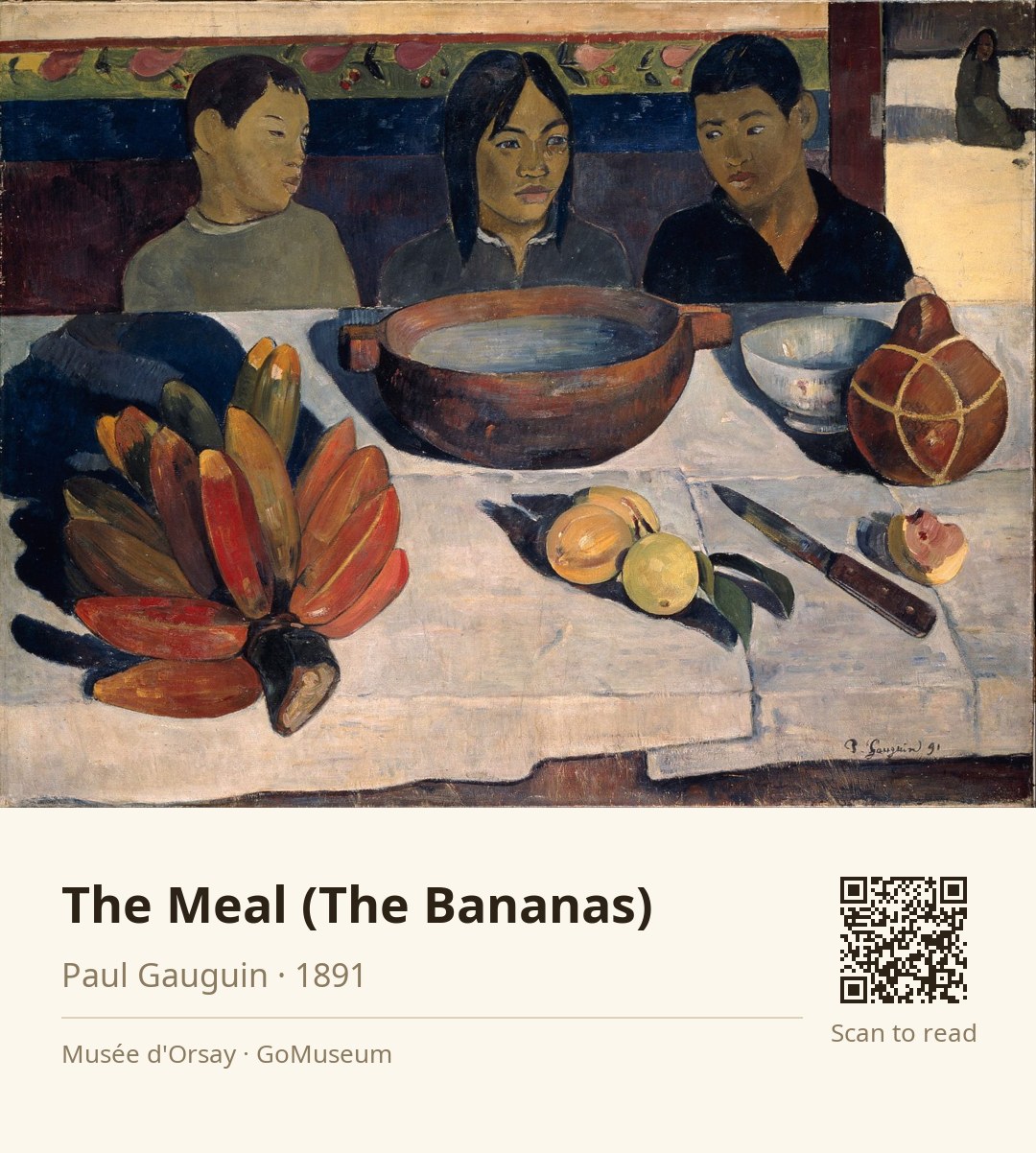
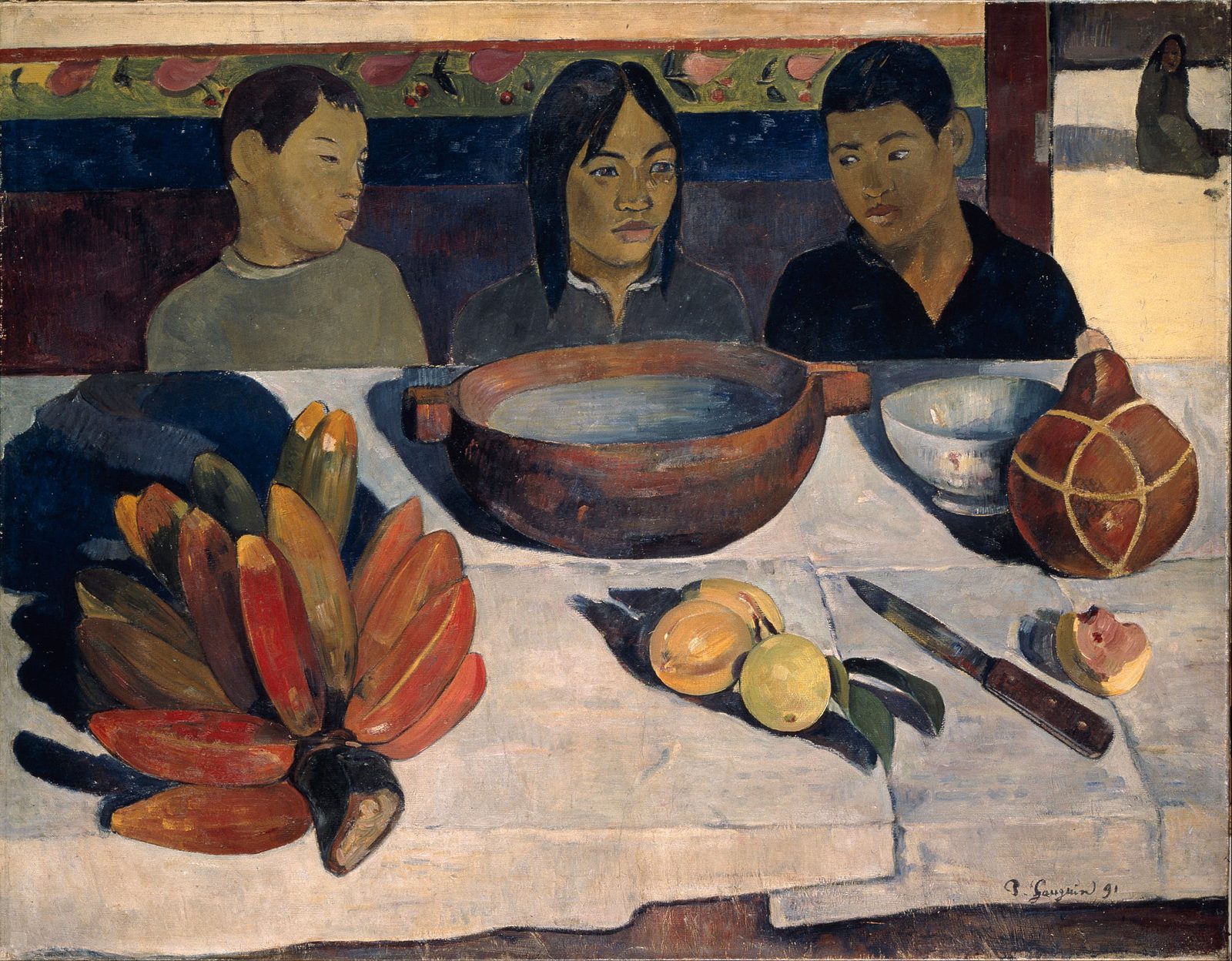
🎧 This work has audio narration — listen in the appTake a moment to really look at "The Meal," or as it’s also known, "The Bananas." Notice how the vibrant colors leap off the canvas, especially the deep reds of the bananas contrasted against the stark white tablecloth. It’s almost as if Gauguin is inviting you to reach out and grab a piece of that fruit yourself. Now, look closely at the three children seated at the table. Their hands and arms are mostly hidden, creating a sense of mystery about what they’re doing. This detail matters because it draws you into their world, making you wonder about their thoughts and interactions. Are they sharing a moment of joy, or is there something deeper going on beneath the surface? Painted in 1891 during Gauguin’s time in Tahiti, this piece reflects his fascination with the simplicity and beauty of life there, far removed from the chaos of Europe. Gauguin was seeking a paradise, and in this painting, he captures a slice of that ideal—a moment of stillness amid the vibrant life of the island. As you stand here, think about the stories these children might tell if they could speak. What do you imagine their lives were like? What dreams and hopes did they hold as they shared this meal? Let your imagination wander as you absorb the scene.
Eugène Henri Paul Gauguin was a French artist born on June 7, 1848, in Paris. His early life in Peru, where he experienced a privileged childhood, deeply influenced his artistic vision. Initially a stockbroker, Gauguin turned to painting full-time after a financial crisis in 1882. He was largely self-taught, drawing inspiration from his connections with artists like Camille Pissarro, who introduced him to Impressionism.
Gauguin's work evolved into a distinct style characterized by bold colors and symbolic themes, diverging from traditional Impressionism. His time in Brittany and later in Tahiti marked significant phases in his career, where he sought to capture the essence of native life and spirituality. Despite struggling with health and financial issues in his later years, his art gained recognition posthumously, largely due to the efforts of art dealer Ambroise Vollard.
Today, Gauguin is celebrated as a key figure in Post-Impressionism and a precursor to modern art, influencing artists like Picasso and Matisse. His exploration of color and form continues to resonate, securing his place in art history as a visionary who sought to transcend the confines of Western civilization.
Paul Gauguin painted 'The Meal' in 1891 while living in Tahiti, a place he sought as a refuge from the chaos of European life. The painting was first exhibited at the Salon d'Automne in Paris in 1906, where it was met with a mix of intrigue and confusion, typical of Gauguin's bold style. Over the years, it changed hands several times, passing through notable collectors like Alexis Rouart and André Meyer before entering public collections in 1954. Today, it resides at the Musée d'Orsay in Paris, where it continues to captivate audiences with its rich colors and enigmatic subjects.
As you gaze at 'The Meal,' take note of Gauguin's masterful use of color and light. The brushwork feels almost restless, with bold strokes that create a dynamic interplay between the vibrant reds of the bananas and the stark white of the tablecloth. This contrast draws your eye, making the fruit appear almost luminous. The composition is structured with a foreground that emphasizes the fruit, while the children, shrouded in shadow, evoke a sense of mystery. The light source, positioned low, casts elongated shadows that enhance the depth and drama of the scene. Gauguin's choice to obscure the children's hands adds to the intrigue, inviting you to ponder their actions and emotions, while the flatness of the background keeps the focus on the intimate moment at the table.
Interestingly, Gauguin's time in Tahiti was marked by a desire to escape European civilization, which he found stifling. He often romanticized the lives of the Tahitian people in his work, yet he faced criticism for his portrayal of their culture.
In the upper right corner of the painting, there is a fourth figure seated in the distance, which adds an element of intrigue and raises questions about their relationship to the three children at the table.
After a financial crisis in 1882, Gauguin left his successful career as a stockbroker to pursue painting full-time, which marked a significant turning point in his life and art, leading him to explore new themes and styles.