The Bridge at Moret
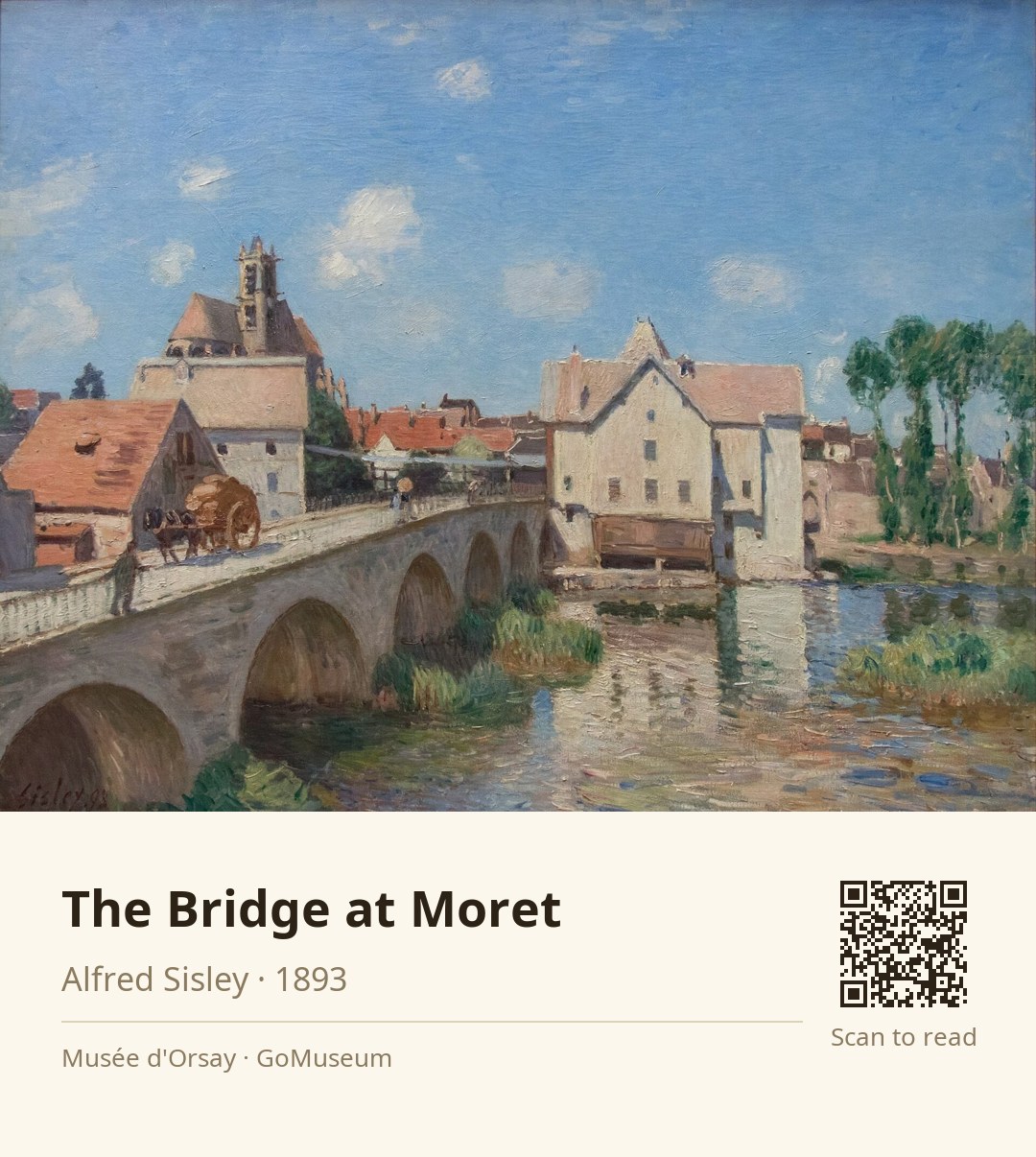
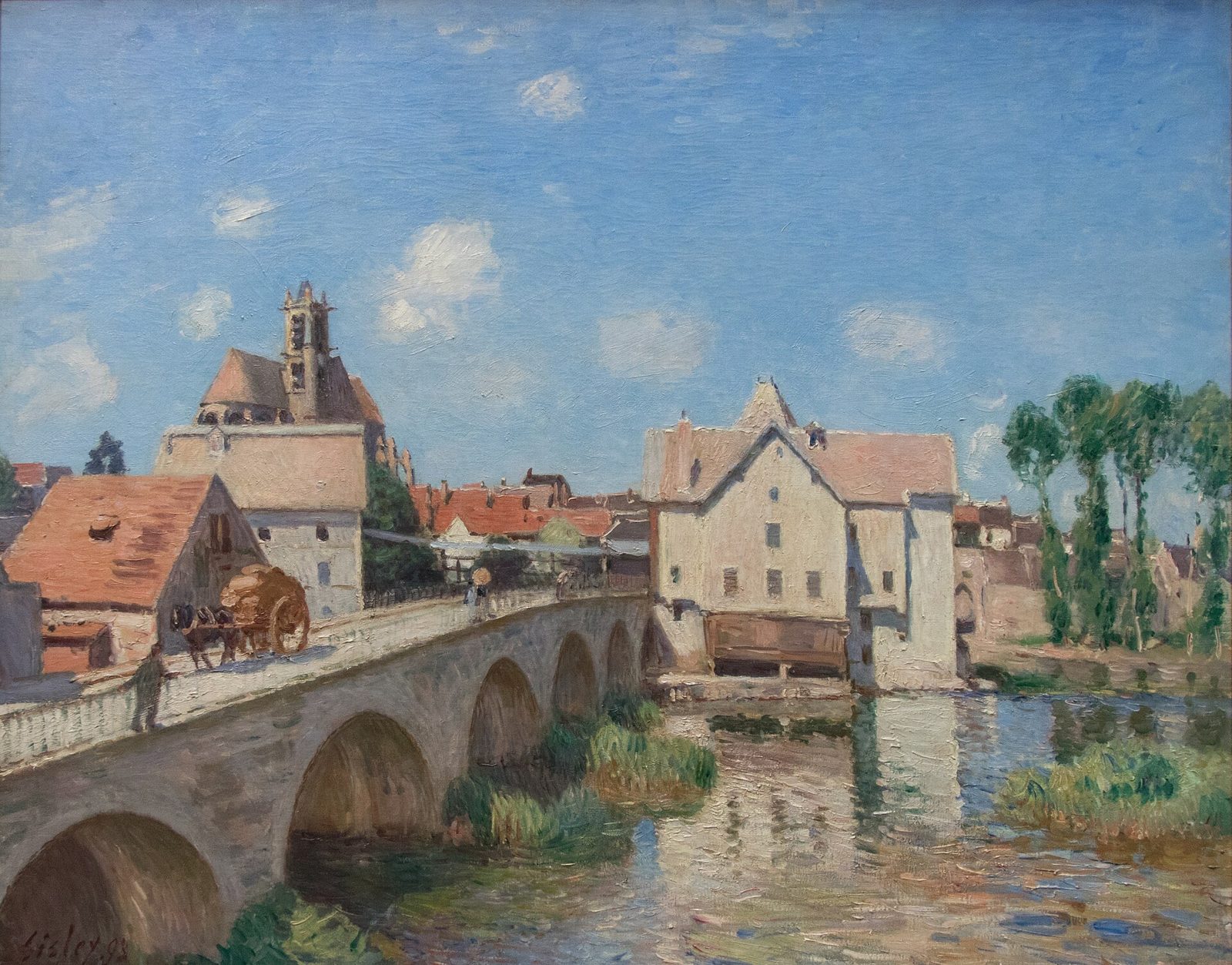
🎧 This work has audio narration — listen in the appThe stone bridge in the foreground of Sisley’s painting is not just a structure; it’s a gateway to the tranquil life of Moret-sur-Loing. With its graceful arches, the bridge invites a horse-drawn cart and a few pedestrians, suggesting a lively yet serene interaction between nature and daily life. The red-tiled roofs of the buildings to the left and the church’s bell tower in the distance add a charming architectural rhythm to the scene.
This composition captures a moment of harmony, where the soft brushwork and light palette evoke the peaceful atmosphere of a village bathed in sunlight. The reflections in the river mirror the structures and the bright blue sky, creating a sense of unity between the elements. Sisley’s choice of color and technique emphasizes the beauty of everyday life, illustrating how nature and human activity coexist in this idyllic setting.
Alfred Sisley, an Impressionist painter, created this work in 1893, focusing on the landscapes of Moret-sur-Loing, where he spent significant time. His dedication to capturing the essence of the outdoors defines much of his oeuvre, which largely consists of serene landscapes.
Alfred Sisley was a British-born Impressionist landscape painter, born in Paris on October 30, 1839, to affluent expatriate parents. His dedication to painting outdoors, or en plein air, marked him as one of the most consistent figures within the Impressionist movement. Sisley’s work primarily focused on landscapes, with notable series depicting the River Thames, the floods at Marly-le-Roi, and the Gothic church at Moret-sur-Loing. Despite his talent, he struggled for recognition and financial stability throughout his life, often relying on the support of patrons and friends.
Sisley's artistic journey began in earnest after returning to Paris from London, where he had been sent to pursue a business career. Instead, he found his calling in art, studying at the École des Beaux-Arts and forming close friendships with fellow artists like Monet and Renoir. His personal life was marked by hardship, particularly after the Franco-Prussian War disrupted his family's financial support. He married Eugénie Lescouezec, and together they faced many challenges, including the loss of a child and Sisley’s ongoing financial instability.
Although Sisley’s work was largely overlooked during his lifetime, it has since gained significant appreciation, solidifying his place in art history as a key contributor to Impressionism and French landscape painting. His delicate depictions of nature continue to resonate, showcasing the beauty of the world around him. Sisley passed away on January 29, 1899, in Moret-sur-Loing, leaving behind a legacy that would flourish posthumously.
Alfred Sisley's 'The Bridge at Moret' was painted in 1893, during a time when he was deeply immersed in the serene landscapes of Moret-sur-Loing. The work was exhibited in Paris in 1930, where it garnered attention, reflecting Sisley's growing recognition posthumously. The painting has changed hands several times, with its provenance tracing back to Depeaux, then to Eduardo Mollard, and finally to Enriqueta Alsop. This journey through various collectors highlights the evolving appreciation for Sisley’s work, which was often overlooked during his lifetime.
In 'The Bridge at Moret', Sisley employs a soft brushwork technique that creates a gentle, almost ethereal quality to the scene. His choice of oil paint on canvas allows for a vibrant yet delicate palette, with light colors that evoke the warmth of sunlight bathing the village. The composition is structured around the bridge, which serves as a focal point, drawing the viewer's eye across the canvas. The reflections in the water are not merely imitations of the structures above but are painted with a fluidity that suggests movement and life. Sisley’s technique captures the essence of the moment, where the tranquility of the village harmonizes with the natural beauty surrounding it.
A curious tidbit about Sisley is that despite being one of the leading figures of Impressionism, he struggled for recognition and financial stability throughout his life. His family’s wealth allowed him to pursue painting, but after the Franco-Prussian War, his financial support dwindled, forcing him to rely on patrons like Depeaux. Interestingly, Sisley never achieved the fame he deserved during his lifetime, but his works are now celebrated and highly valued in the art world, showcasing the irony of posthumous acclaim.
Eugénie Lescouezec worked as an artist's model and florist in Paris's Batignolles quarter when she met Sisley.
Sisley visited Britain three times, with his first trip in 1874 following the First Impressionist Exhibition.
Initially overlooked during his lifetime, Sisley's works are now highly celebrated and valued in the art world.