The turtle seller
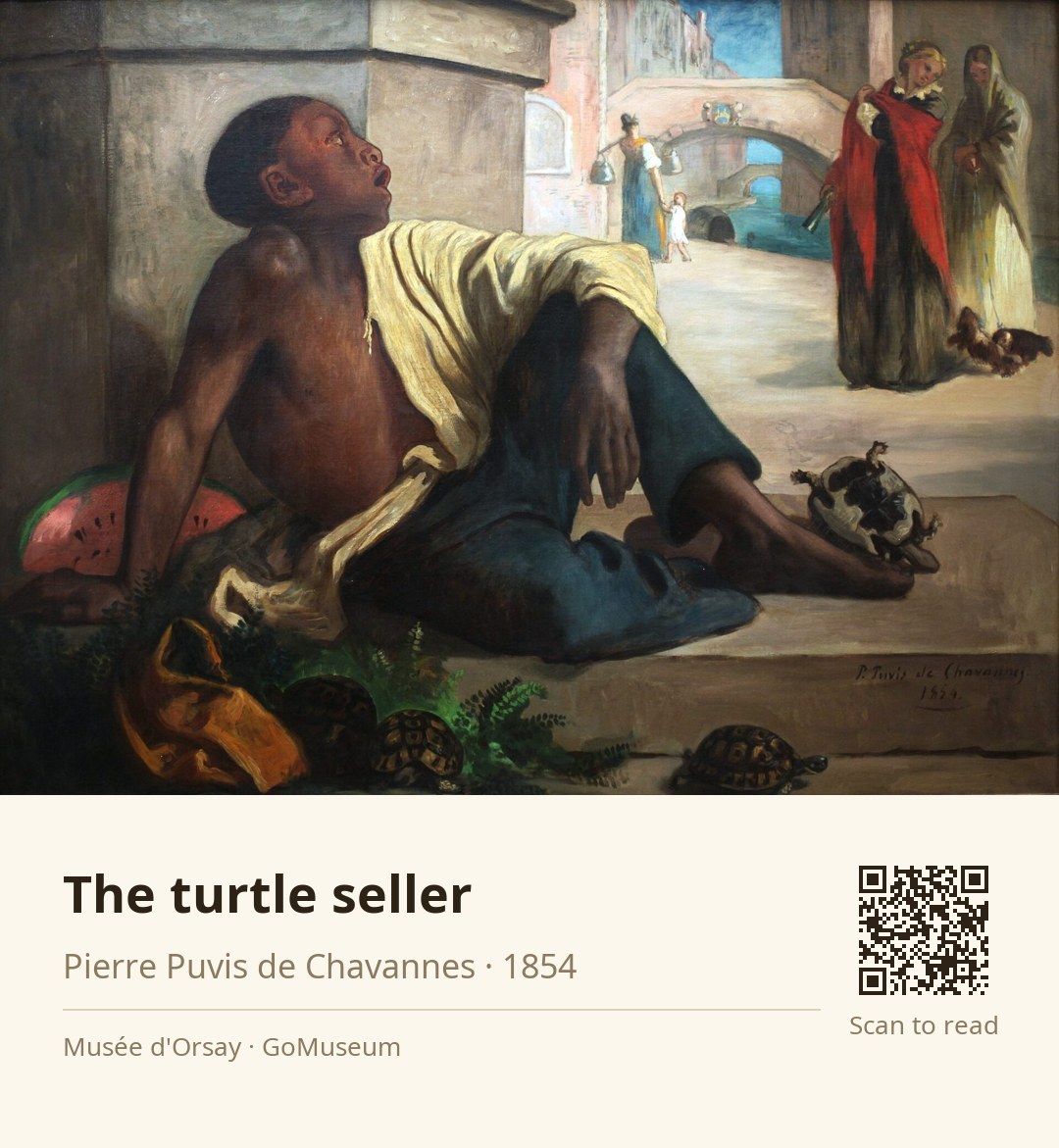
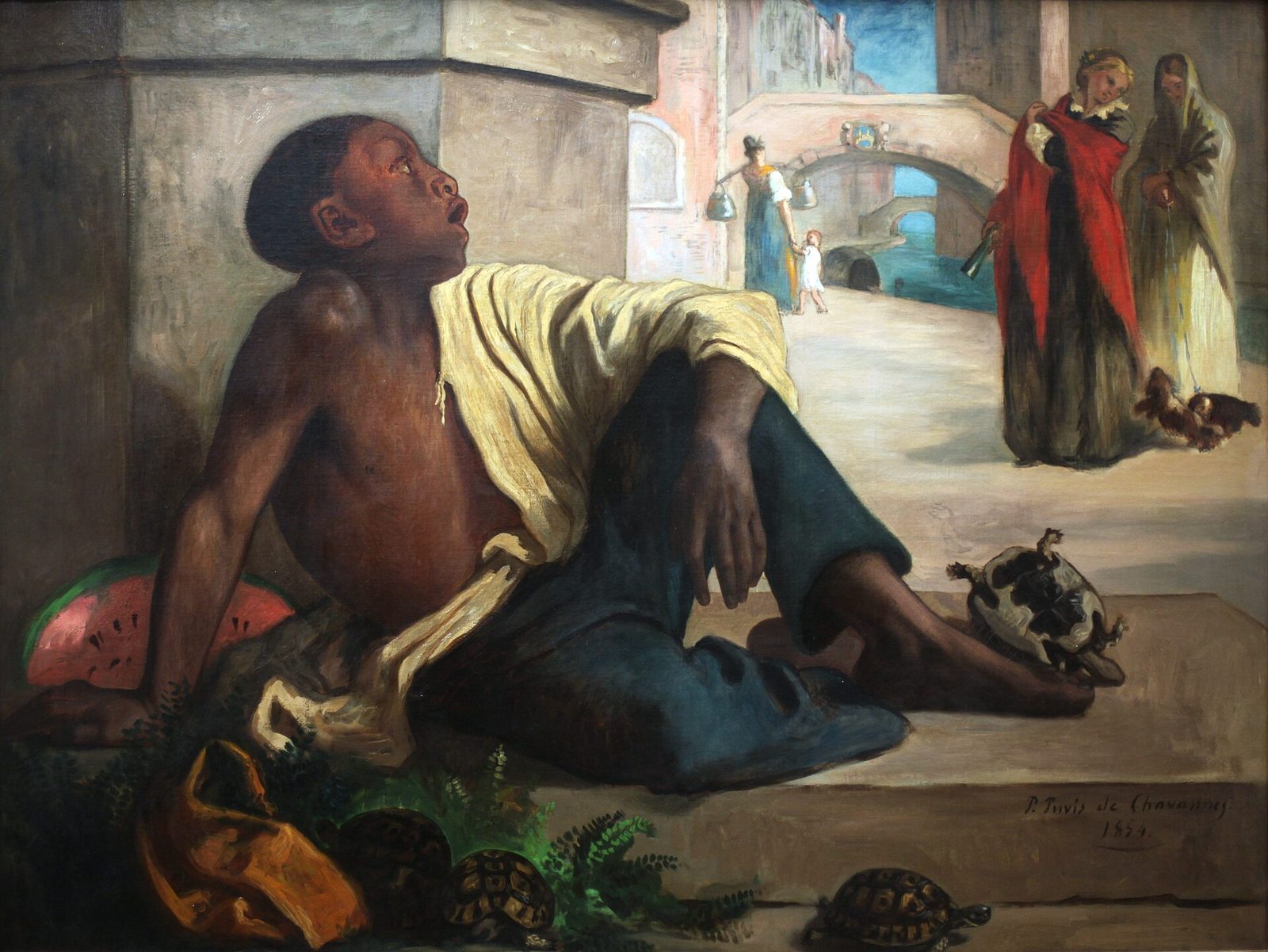
🎧 This work has audio narration — listen in the appTake a moment to really look at "The Turtle Seller" by Pierre Puvis de Chavannes. Notice the young turtle seller in the foreground, leaning casually against a column, his gaze fixed on the well-dressed women nearby. His relaxed posture contrasts sharply with the bustling scene around him. Now, focus on the turtles themselves—one is even upside down!
Puvis painted this scene in 1854, capturing a slice of everyday life that feels both timeless and specific to its place. The gray-pink tones create a dreamy atmosphere, inviting you to ponder the stories of those depicted. The turtle seller, a symbol of commerce and survival, stands in stark contrast to the affluent ladies, raising questions about social class and the roles people play in society.
As you stand here, think about the balance of work and leisure in this painting. What do you think Puvis wanted us to feel about these interactions?
Pierre Puvis de Chavannes, born on December 14, 1824, in Lyon, emerged as a pivotal figure in 19th-century French painting, often celebrated as "the painter for France." His artistic journey began after a transformative trip to Italy, leading him to abandon his initial pursuit of engineering. He studied under notable artists like Eugène Delacroix and Thomas Couture but ultimately forged an independent path.
Puvis's work is characterized by a symbolist style, blending allegory with a unique decorative aesthetic. His murals, commissioned for public and private institutions, reflect a deep engagement with the evolving identity of France during the Third Republic. Notable works include the cycles at the Musée de Picardie and the Panthéon in Paris, where he tackled themes of national identity and cultural heritage.
Despite initial struggles at the Salon, Puvis gained recognition with his allegorical pieces, which resonated with the political and cultural discourse of his time. His ability to navigate various ideologies allowed him to create art that appealed to a broad audience. As a co-founder of the Société Nationale des Beaux-Arts, he influenced a generation of artists, leaving a lasting legacy in the world of mural painting and symbolist art. Puvis de Chavannes passed away on October 24, 1898, but his contributions to French art continue to be celebrated.
Pierre Puvis de Chavannes painted 'The Turtle Seller' in 1854, a time when he was still establishing his reputation in the art world. The painting was first exhibited at the Société artistique des Bouches-du-Rhône in Marseille in 1855, where it caught the eye of critics and patrons alike. It remained in Puvis's possession until 1898, after which it passed to his nephew, Camille Jordan, who took it to London. The painting changed hands several times over the years, traveling through various collections in Belgium and the United States before finally being acquired by the Musée d'Orsay in Paris in 2014.
As you gaze at 'The Turtle Seller,' notice how Puvis employs a palette dominated by soft gray-pink tones, creating a dreamlike quality that envelops the scene. The brushwork feels almost ethereal, with delicate strokes that lend a sense of movement to the figures, especially the turtles, which seem to embody the fragility of life and trade. The composition is carefully structured, with the turtle seller leaning against a column that draws your eye to the well-dressed women, establishing a visual hierarchy that speaks to social dynamics. The contrast between the relaxed posture of the seller and the bustling activity around him highlights the tension between leisure and labor. Puvis's choice of scale—89 by 118 cm—allows for an intimate yet expansive view of this Venetian moment, inviting you to step into the narrative.
One curious detail about 'The Turtle Seller' is that the painting features an upside-down turtle, a choice that might seem whimsical at first glance. However, this detail serves as a subtle reminder of the precariousness of life and trade, especially in a bustling place like Venice. This unexpected element invites viewers to reflect on the fragility of existence, making the painting not just a portrayal of a moment but a deeper commentary on the human condition.
The turtle seller is depicted as scantily dressed, which not only highlights his lower social status but also contrasts sharply with the well-dressed women nearby, emphasizing the disparities in wealth and class within the bustling Venetian scene.