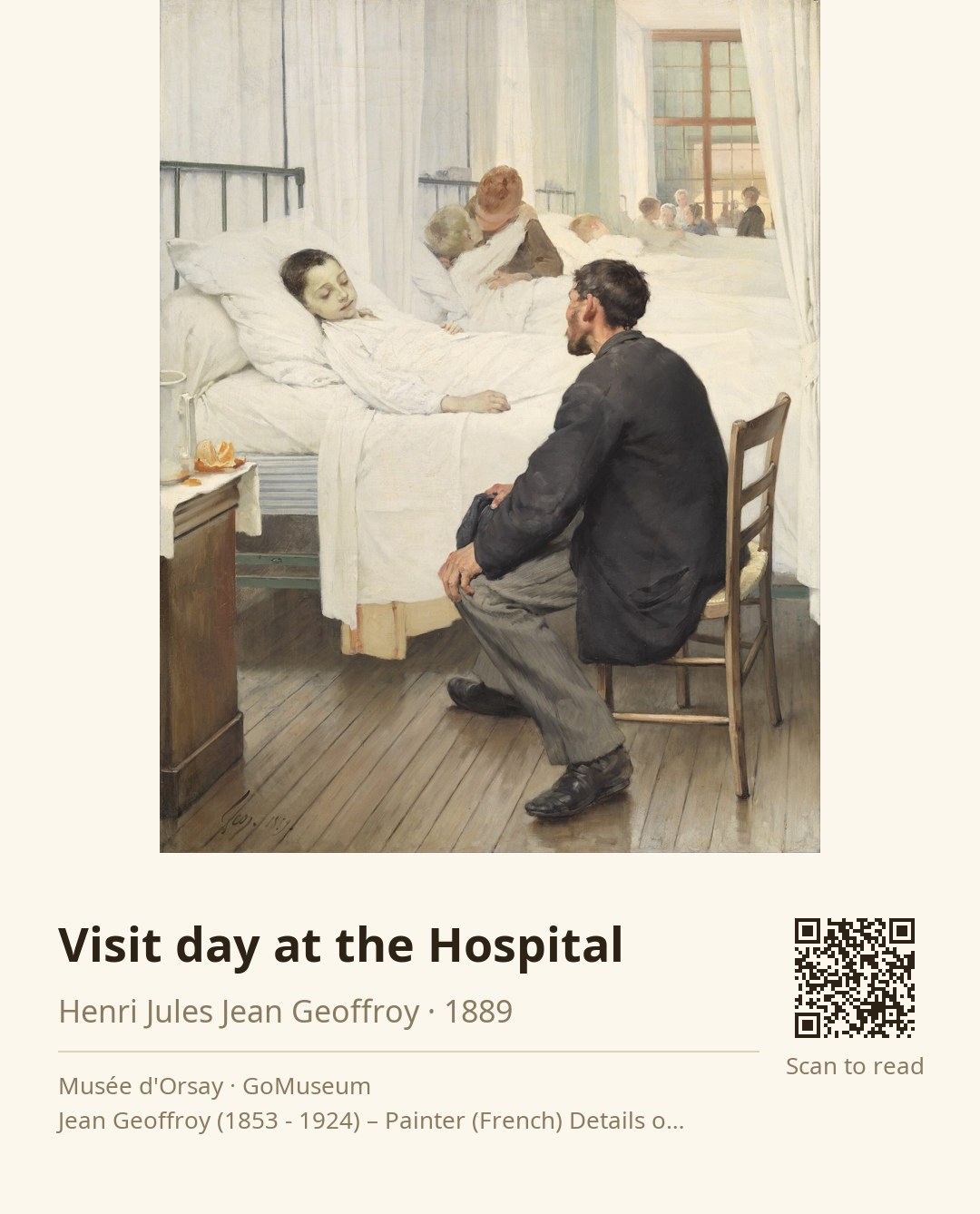
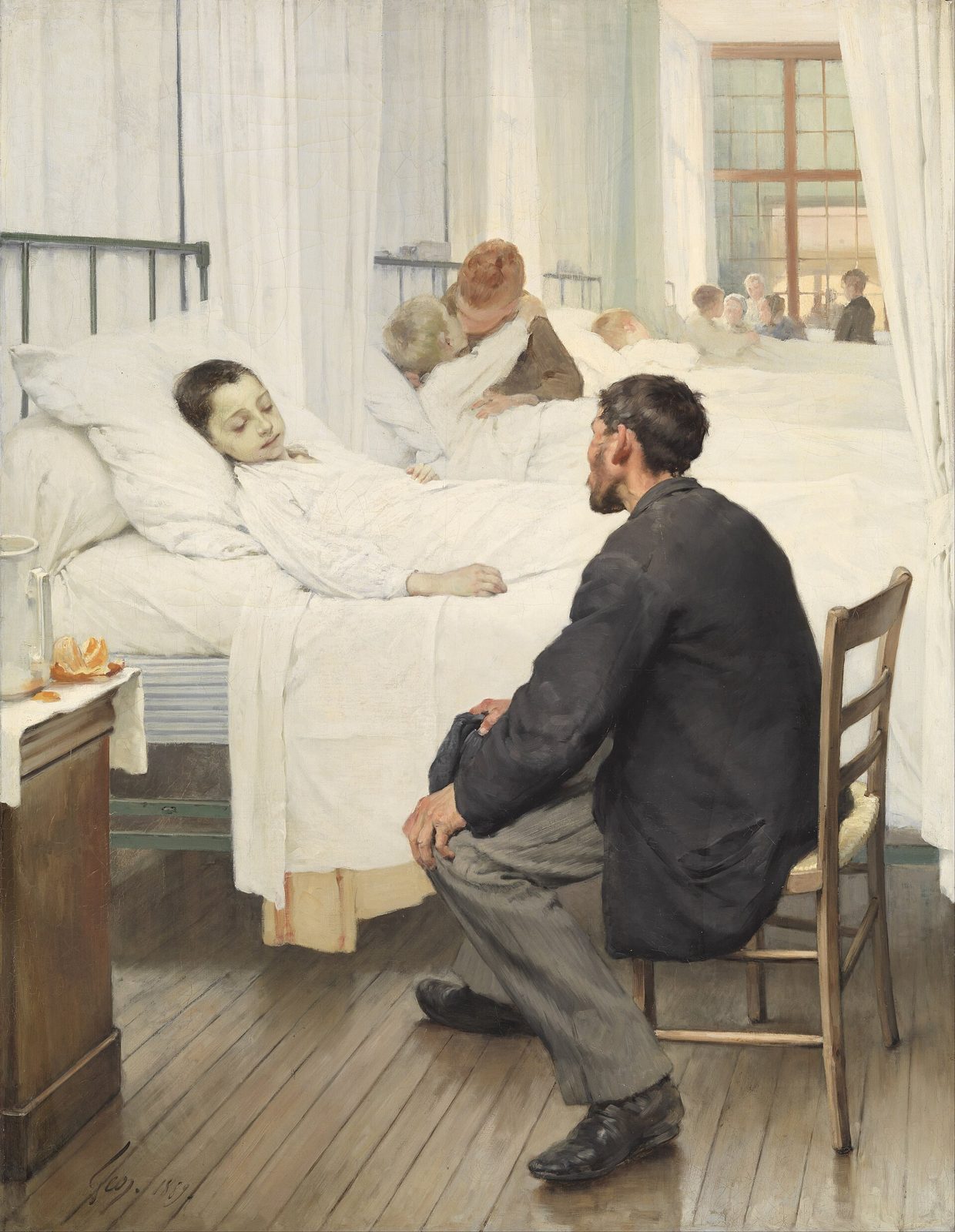
 Image: Jean Geoffroy (1853 - 1924) – Painter (French) Details on Google Art Project
Visit day at the Hospital
🎧 This work has audio narration — listen in the appTake a moment to really look at "Visit Day at the Hospital." Can you feel the weight of the scene? In the foreground, a father leans forward, hands resting on his knees, his face etched with worry as he gazes at his sick son lying in bed. Notice the contrast between the father’s rugged, ruddy complexion and the pale, swollen face of the boy. This isn’t just a visit; it’s a moment of raw emotion captured in time. These details matter because they tell a story of vulnerability and love. Geoffroy, known for his keen observations of everyday life, shines a light on the struggles of working-class families during a time when such subjects were rarely depicted in art. The starkness of the hospital room, devoid of religious symbols, emphasizes the secular nature of care, reflecting the social changes of the late 19th century in France. Created in 1889, this painting is more than just a snapshot; it’s a commentary on the human experience, a poignant reminder of the bond between parent and child in times of hardship. As you stand here, think about the countless families who have faced similar moments. What emotions does this scene stir in you?
Henri-Jules-Jean Geoffroy, known as Géo, was a French painter and illustrator born in 1853 in Marennes. He moved to Paris at a young age, where he studied at the École des Beaux-Arts under notable artists. His career began with exhibitions at the Salon, and he became a member of the Salon des Artistes Français in 1883. Géo gained recognition for his charming genre scenes depicting children, often inspired by his life living above a school. His works reflect the social changes of the Third Republic, capturing the innocence and struggles of childhood with sincerity.
Throughout his career, he received several accolades, including a gold medal at the 1900 Exposition Universelle and a Chevalier in the Legion of Honor. His illustrations for children's books, signed as "Géo," further established his reputation. Géo's legacy endures through his poignant portrayals of youth and his contributions to educational art. He passed away in 1924, leaving behind a collection that continues to be cherished by the Girard family, who played a significant role in his life.
Henri Jules Jean Geoffroy's painting, 'Visit Day at the Hospital,' was created in 1889 and first showcased at the Salon de la Société des artistes français in Paris that same year. It quickly caught the attention of the French Ministry of Education, which purchased the piece and allocated it to the Musée du Luxembourg. Over the years, its home shifted; in 1926, it was reassigned to the Louvre, but for a time, it hung in the Hôtel de Ville in Vichy. It wasn't until 2012 that it found its way to the Musée d'Orsay, where it resides today. Critics lauded the work for its emotional depth and social commentary, with publications like L'Artiste praising Geoffroy's nuanced figures and the naturalism that captured a poignant moment in hospital life. The painting's stark, secular setting—void of religious symbols—was noted as a reflection of the changing social landscape of late 19th-century France.
As you gaze at 'Visit Day at the Hospital,' pay attention to the brushwork that Geoffroy employs to create a sense of intimacy and urgency. The father’s rugged features are rendered with a roughness that speaks to his working-class background, while the delicate handling of the boy’s pallid skin contrasts sharply, enhancing the emotional weight of the scene. Notice how the composition draws your eye; the father leans forward, hands on his knees, creating a visual line that connects you to his worry. The spartan hospital room, with its simple iron bedstead and the small nightstand, is painted with a muted palette that emphasizes the stark reality of their situation. The use of light, particularly how it falls across the figures, adds a layer of drama, illuminating the father's face while casting shadows that hint at the gravity of their circumstances. This careful arrangement of elements pulls you into the moment, making you feel the tension and love that permeates the air.
Critics remarked on how the secular nature of the scene—without crucifixes or nuns—was a bold statement, reflecting the growing secularization of society in France during the late 19th century. This choice not only highlights the emotional bond between the father and son but also underscores the shift in how care and compassion were viewed in an increasingly modern world.
The nightstand features a water jug and a partially eaten orange, which adds a subtle layer of realism and everyday life to the hospital scene.
Geoffroy lived above a private school with two teachers, which inspired him to paint scenes of children and everyday life, shaping his career as a painter of genre scenes.