 Image: Sailko
The demolisher
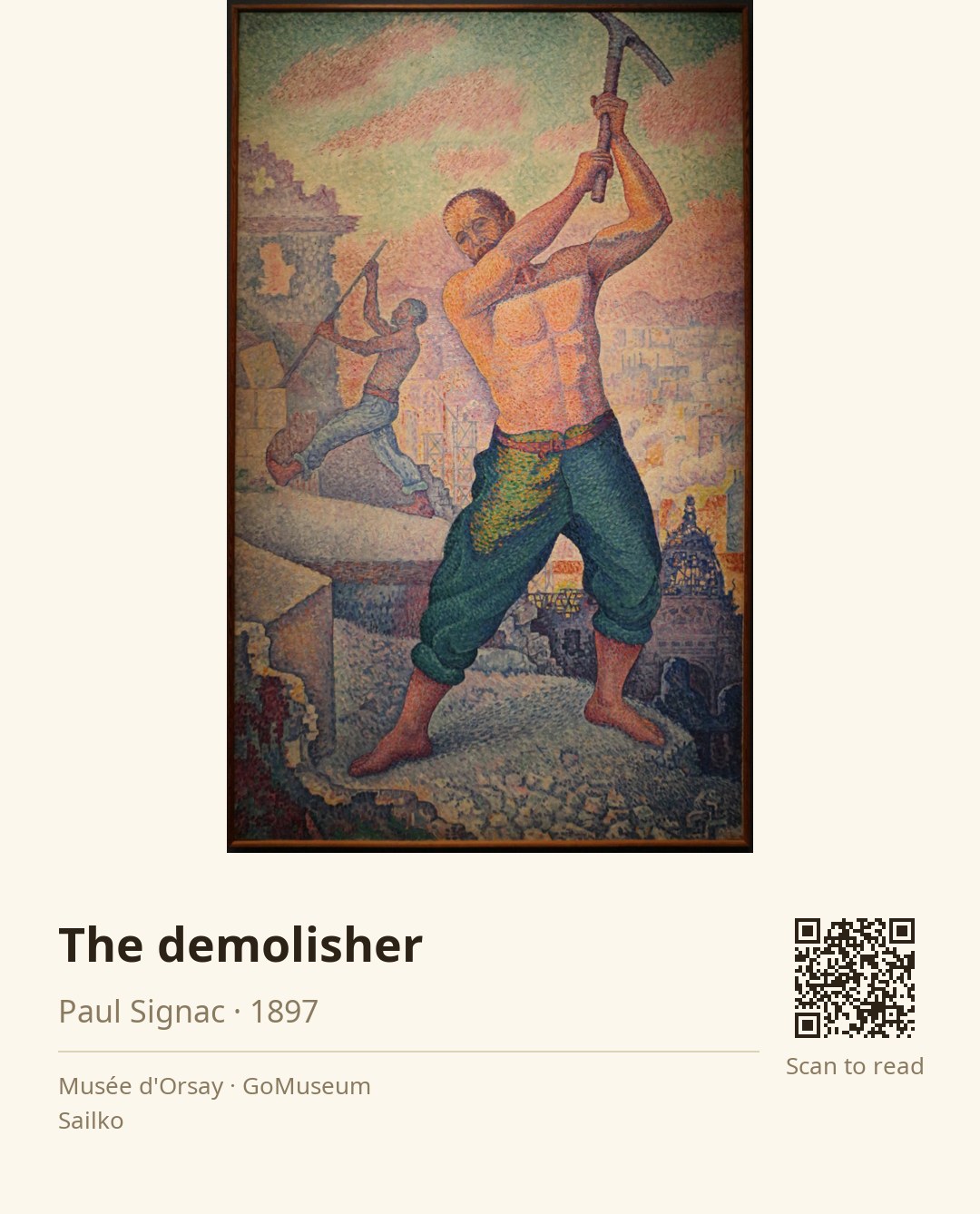
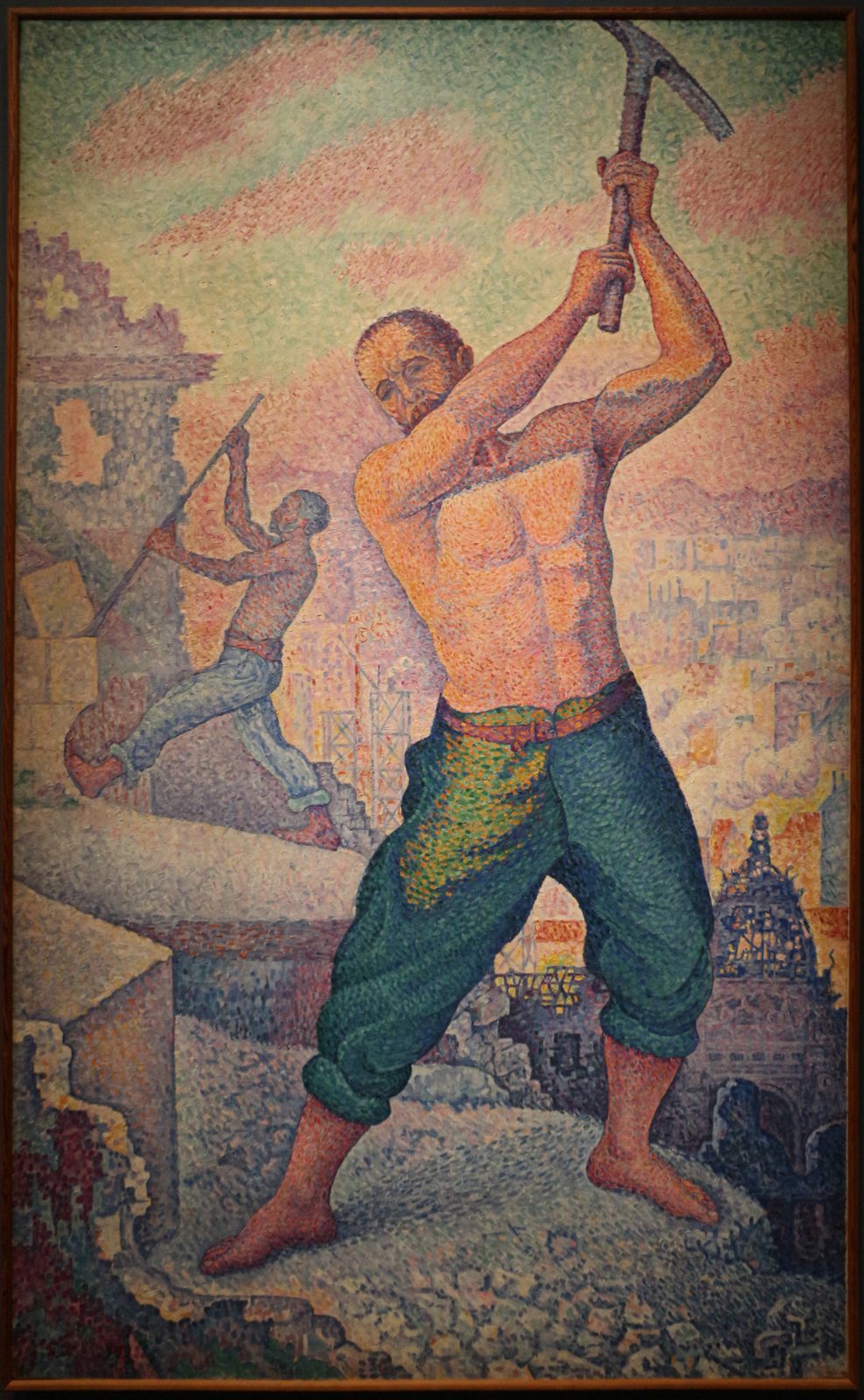
🎧 This work has audio narration — listen in the appTwo muscular men dominate the scene in "The Demolisher," their powerful forms poised against a backdrop of crumbling structures. The central figure, shirtless and clad in green pants, raises a pickaxe in a dynamic stance that radiates strength and urgency. Nearby, another laborer mirrors this intensity, contributing to the sense of movement amidst the ruins, while the soft pink and blue hues of the sky, achieved through a pointillist technique, create a striking contrast to the industrial elements below.
This depiction of laborers amidst destruction speaks to the resilience and energy of rebuilding in an industrial landscape. The figures are not merely workers; they embody the spirit of progress and the physicality of their task, suggesting a narrative of renewal and transformation. The cityscape, with its smokestacks and architectural remnants, reinforces the theme of industrial change, capturing a moment where human effort meets the remnants of the past.
Paul Signac, a pivotal figure in the Neo-Impressionist movement, created this work in 1897, a time when he was deeply influenced by the principles of color theory and the systematic approach to painting developed alongside Georges Seurat. His commitment to the technique of Pointillism, characterized by the juxtaposition of small dots of color, aimed to engage the viewer's eye in a unique way, blending colors optically rather than physically on the canvas.
Paul Signac was a French Neo-Impressionist painter born on November 11, 1863, in Paris. Initially encouraged to pursue architecture, he chose to follow his passion for painting, inspired by the Impressionists and particularly by Claude Monet's works. His encounter with Georges Seurat in 1884 profoundly influenced his artistic direction, leading him to develop the technique of Pointillism, where small dots of pure color blend in the viewer's eye rather than on the canvas.
A passionate sailor, Signac often painted seascapes and coastal scenes, spending summers in the south of France, where he envisioned an anarchist utopia. He co-founded the Société des Artistes Indépendants, promoting artistic freedom and innovation, serving as its president from 1908 until his death in 1935. His friendships with notable artists like Vincent van Gogh and Henri Matisse enriched his creative journey, while his writings on color theory and art further solidified his role as a key figure in the evolution of modern art.
Signac's legacy endures through his influence on subsequent movements, particularly Fauvism, and his commitment to artistic independence, making him a pivotal figure in the transition from Impressionism to modern art.
In 'The Demolisher,' Signac employs a meticulous Pointillist technique, using tiny dots of color to create a vibrant, dynamic scene. The muscular figures of the laborers are rendered with a sense of urgency and movement, achieved through the careful placement of colors that blend optically rather than physically. This method not only enhances the physicality of the men but also imbues the entire composition with energy. The background, filled with crumbling structures and smokestacks, contrasts sharply with the soft pink and blue hues of the sky, which are layered with delicate dots that suggest a fleeting moment of beauty amidst industrial decay. The scale of the figures against the expansive cityscape emphasizes their monumental struggle, while the overall composition draws the viewer into a narrative of resilience and transformation, making the painting not just a visual experience but an emotional one.
Political repression against anarchists in France led Signac to change the title of his 1893 painting from 'In the Time of Anarchy' to 'In the Time of Harmony' to ensure it could be accepted by a gallery.
Signac developed a friendship with Vincent van Gogh, and they often painted together in Asnières-sur-Seine, focusing on river landscapes and cafés.