The Congress of Paris
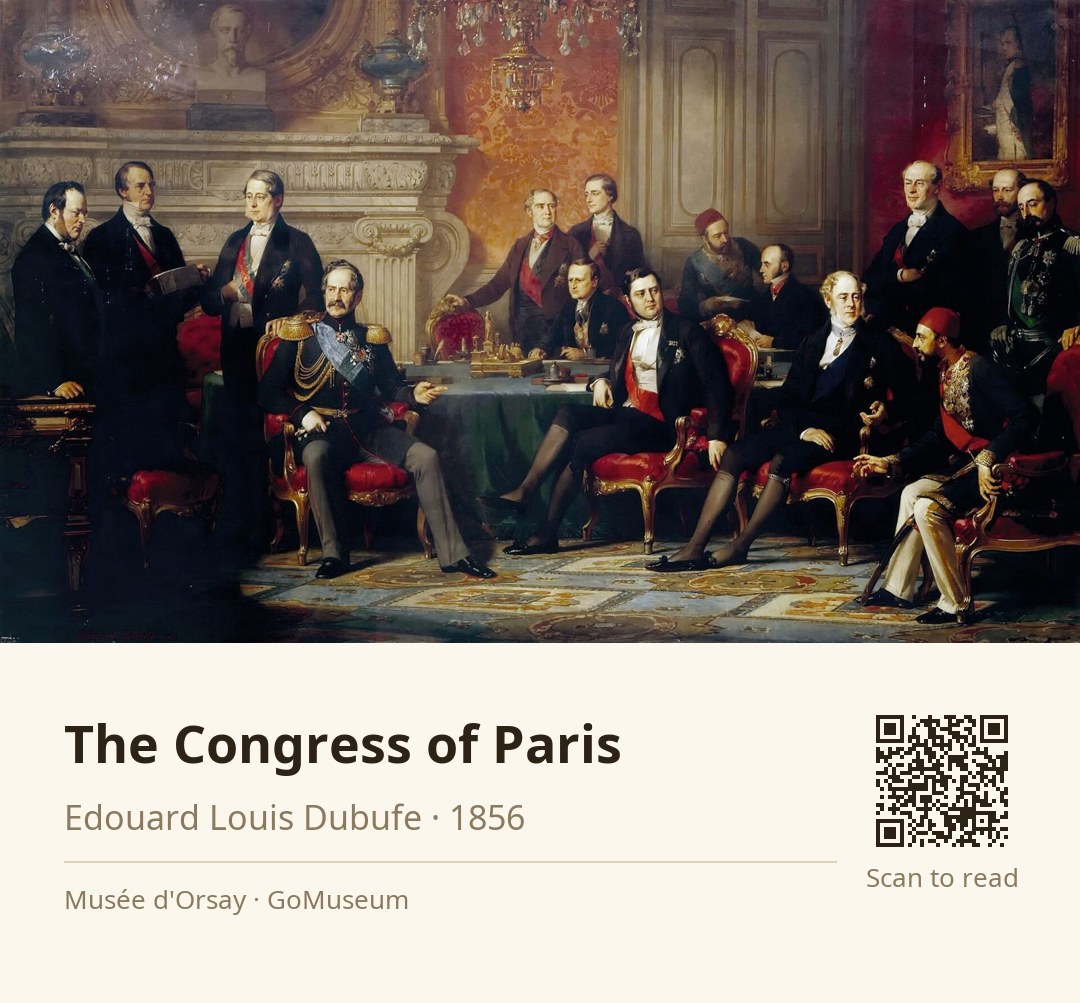
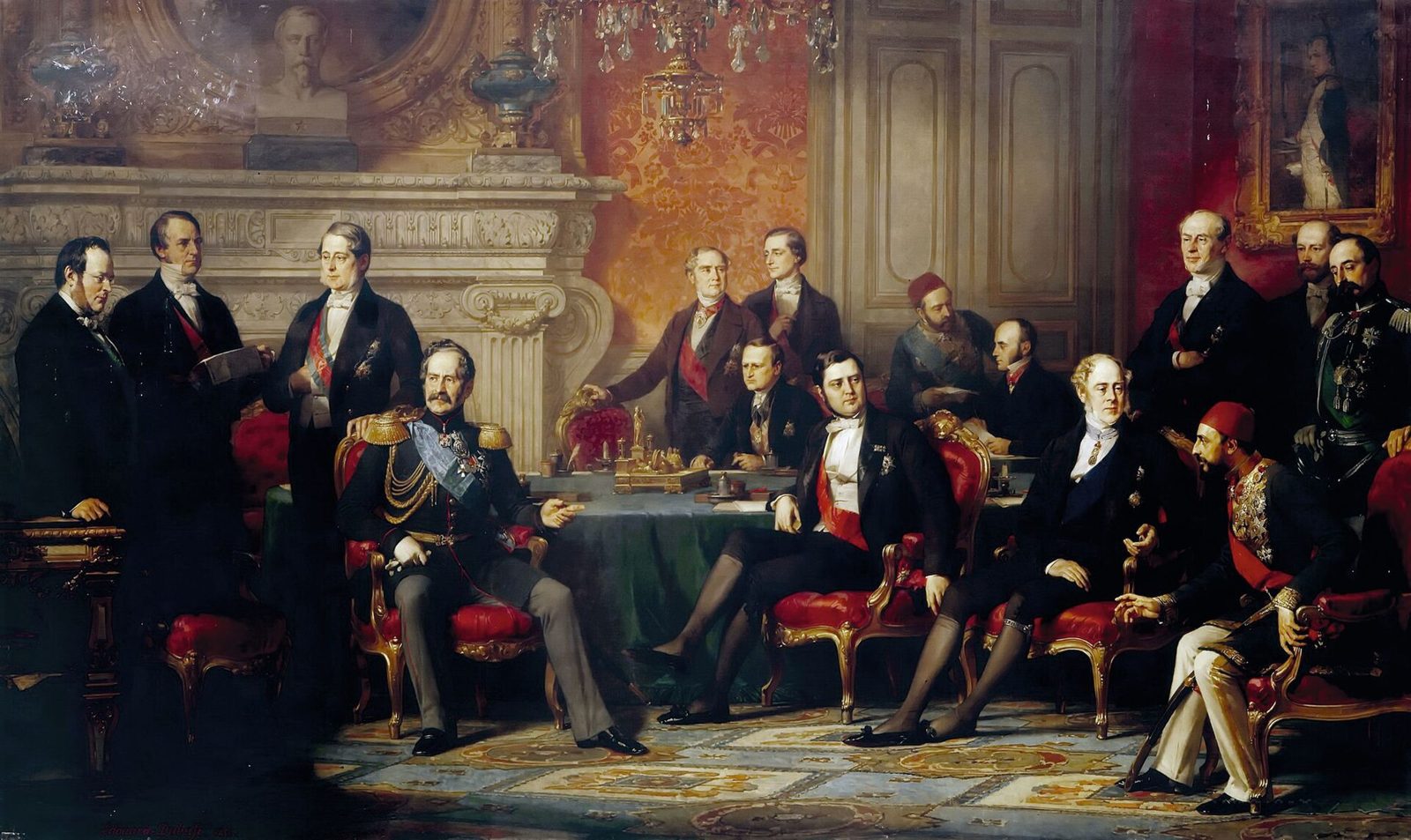
🎧 This work has audio narration — listen in the appTake a moment to really soak in the scene before you. This is Edouard Dubufe's "The Congress of Paris," painted in 1856, and it captures a pivotal moment in history—the negotiations that ended the Crimean War. Notice the array of diplomats gathered here, their expressions a mix of tension and hope.
Look closely at the figure on the left: a bust of Napoleon III, watching over the proceedings. It’s not just decoration; it symbolizes the weight of his influence on this historic gathering. And then, shift your gaze to the right, where a portrait of Napoleon I looms large. This juxtaposition of the two emperors hints at the legacy and ambition that shaped France during this era.
These details matter because they reflect the complex interplay of power and diplomacy. The Congress wasn't just about ending a war; it was about reshaping Europe and establishing a new balance of power. Dubufe, commissioned by Napoleon III himself, understood the importance of this moment and sought to immortalize it on canvas.
As you stand here, think about the stakes involved for these men. They were not just negotiating treaties; they were crafting the future of nations. What do you think it felt like to be in that room, knowing the weight of history rested on their shoulders?
Édouard Louis Dubufe, born in Paris on March 31, 1819, was a prominent French portrait painter known for his elegant depictions of the aristocracy during the Second Empire. He was the son of painter Claude Marie Paul Dubufe and received his initial training from his father before studying under Paul Delaroche at the École des Beaux-Arts. His career took off in 1853 with notable portraits of Emperor Napoléon III and Empress Eugénie, establishing him as a leading portraitist of his time. Dubufe's personal life was marked by tragedy; he lost his first wife, Juliette, in childbirth shortly after their son was born. Despite this, he continued to thrive artistically, receiving commissions from high society and the imperial court. His work was sometimes critiqued, notably by Émile Zola, who questioned his artistic integrity. Dubufe remarried in 1866 and passed away in Versailles on August 11, 1883. His legacy endures through his portraits, which capture the elegance of 19th-century French society.
Edouard Dubufe's 'The Congress of Paris' was commissioned by none other than Napoleon III himself, reflecting the emperor's desire to immortalize this significant diplomatic gathering. The painting was completed in 1856 and made its public debut at the Salon des artistes français in Paris in 1857, where it was met with considerable attention. The Congress, held from February 25 to March 30, 1856, was pivotal in concluding the Crimean War, a conflict that had seen the alliance of Britain, France, the Ottoman Empire, and Sardinia against Russia. The painting now resides in the Palace of Versailles, a fitting home for a work that encapsulates such a crucial moment in European history.
As you gaze at 'The Congress of Paris,' take a moment to appreciate the sheer scale of this painting—308 by 510 centimeters. Dubufe's brushwork is both meticulous and dynamic, capturing the nuanced expressions of the diplomats. Notice how the light plays across the figures, highlighting their faces while casting shadows that suggest the weight of their responsibilities. The composition is carefully structured, with the bust of Napoleon III anchoring the left side, while the imposing portrait of Napoleon I on the right creates a visual dialogue across the canvas. This arrangement not only emphasizes the continuity of power but also the tension in the room. The color palette is rich yet restrained, with deep reds and golds that evoke a sense of grandeur, while the cooler tones of the diplomats' attire ground the scene in reality. Each stroke seems to pulse with the energy of negotiation, making you feel the stakes involved.
One intriguing aspect of 'The Congress of Paris' is that it not only captures the momentous gathering of diplomats but also cleverly includes a bust of Napoleon III on the left and a painting of his uncle, Napoleon I, on the right. This juxtaposition subtly hints at the weight of history and legacy that loomed over the negotiations, as if to say that the decisions made here were not just about the present, but also about how they would be viewed through the lens of the past.
Among the diplomats portrayed are the Count of Cavour, Lord Cowley, and Mehmed Emin Âli Pasha, highlighting the diverse representation of nations involved in the negotiations.