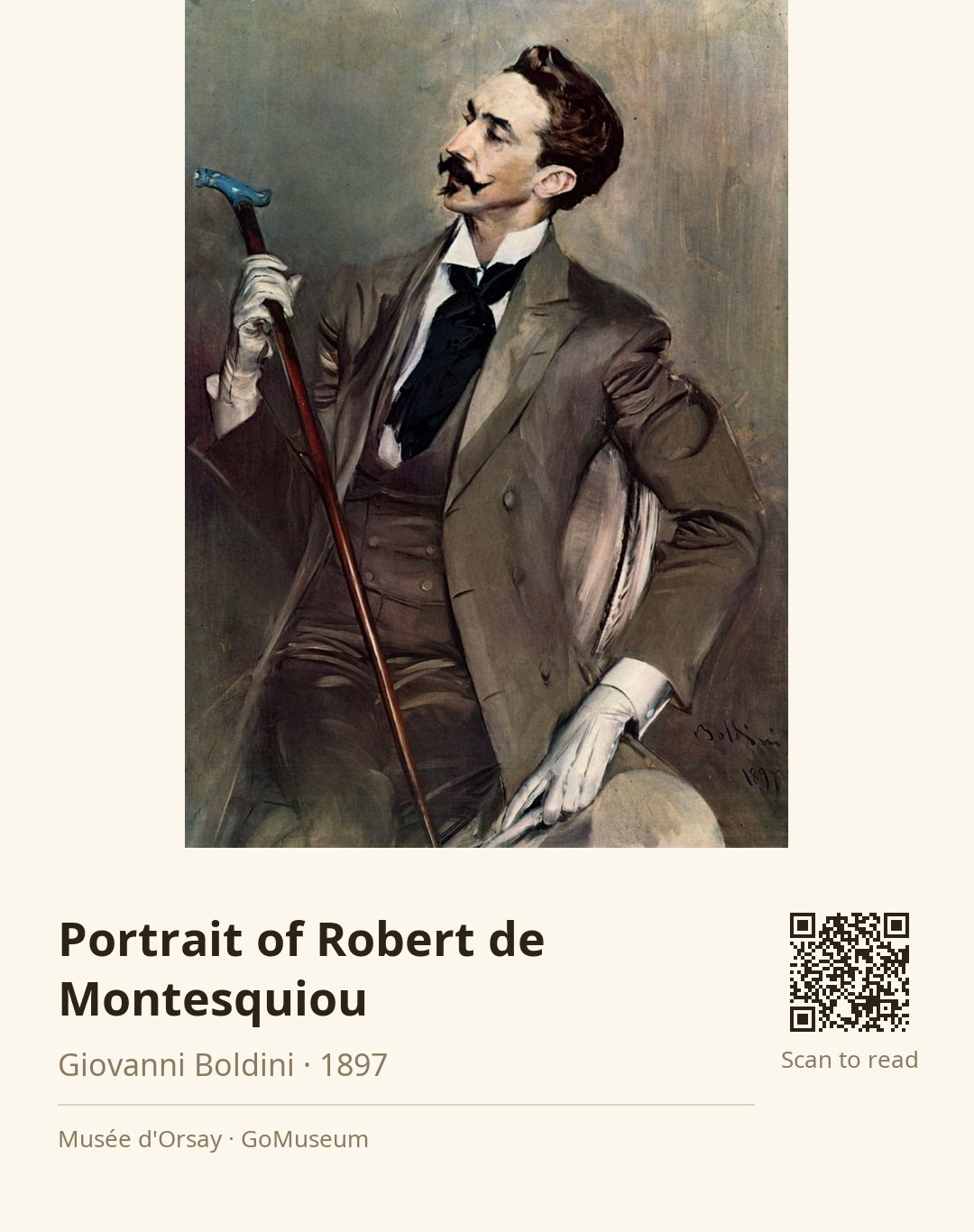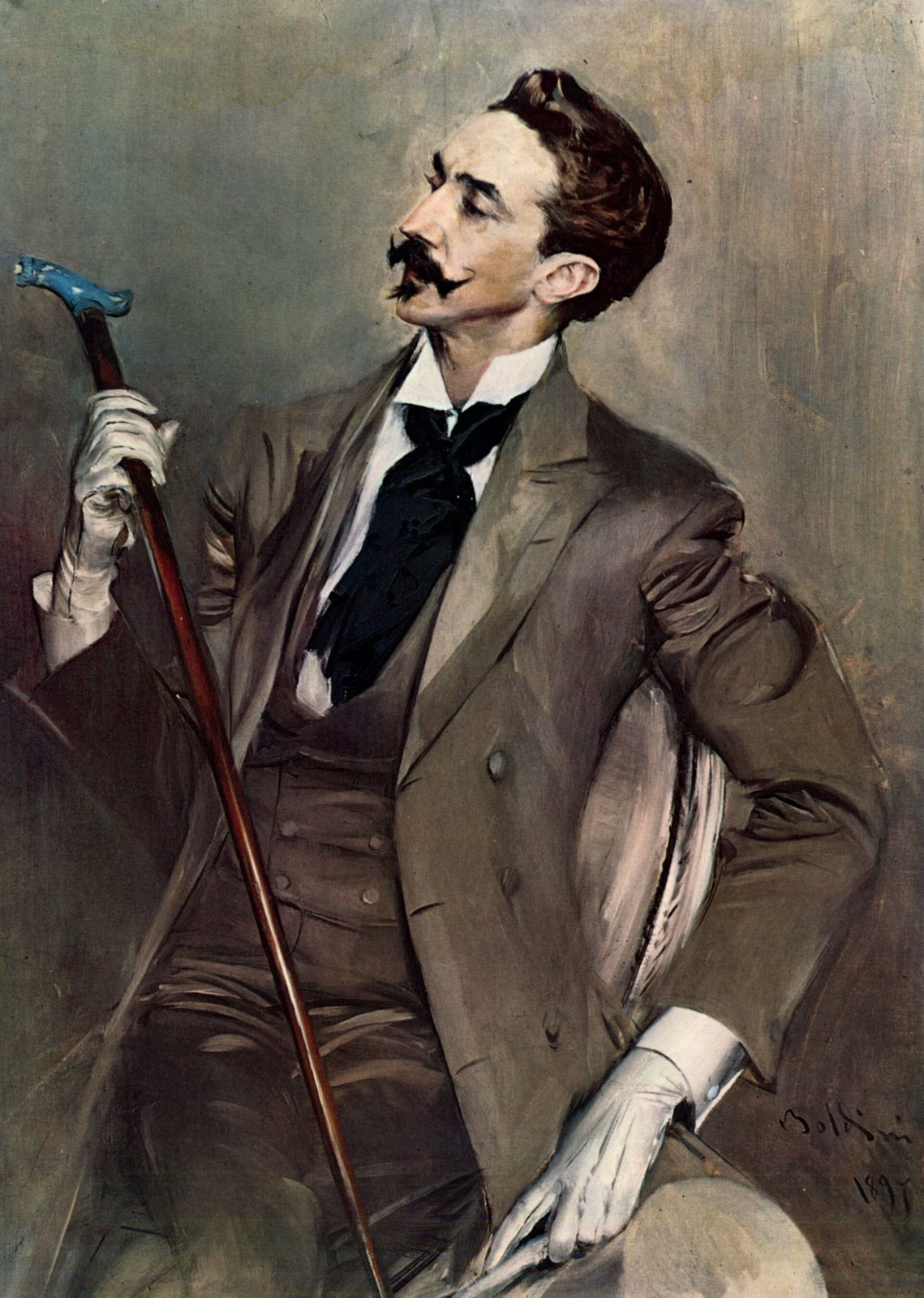
Portrait of Robert de Montesquiou
🎧 This work has audio narration — listen in the appTake a moment to really look at this striking portrait of Robert de Montesquiou by Giovanni Boldini. Notice how the count’s elegant attire, especially those refined white gloves and dove gray suit, seems to shimmer with a life of its own. The way he holds his walking stick, almost like a scepter, adds an air of regal detachment, doesn’t it?
These details matter because they encapsulate the essence of Montesquiou himself—a quintessential dandy of late 19th-century Paris, known for his flamboyant lifestyle and artistic sensibilities. Boldini doesn’t just capture his likeness; he delves into his psyche, portraying not just a man, but an entire aesthetic philosophy. This was a time when art was about more than just representation; it was about expressing the inner character and emotions of the subject.
Commissioned in 1897, this painting reflects the era's fascination with beauty and individuality, and it was a hit at its debut, instantly admired for its vibrant brushwork and psychological depth. Boldini, often called the "Master of Swish," was renowned for his ability to convey movement and elegance, and here, he does just that.
As you stand here, think about what it means to be a dandy in today’s world. How do we express our identities through our appearance? What do you think Boldini would say about modern elegance?
Giovanni Boldini, born on December 31, 1842, in Ferrara, Italy, was a renowned portrait painter who spent most of his life in Paris. The son of a religious painter, he showed artistic talent from a young age, eventually studying in Florence where he encountered the Macchiaioli, whose influence shaped his early work. Boldini moved to London, gaining fame for his portraits of high society, including notable figures like Lady Holland.
In Paris, he became a prominent figure in the art scene, known for his dynamic brushwork and vibrant style, earning him the nickname "Master of Swish." His relationships with artists like Edgar Degas and his romantic entanglements enriched his life and work. Boldini's portraits captured the essence of the Belle Époque, making him a sought-after artist among the elite.
Despite his success, he struggled to adapt to changing artistic trends and faded from prominence in the early 20th century. He died on January 11, 1931, in Paris, leaving behind a legacy that continued to be celebrated posthumously, with major exhibitions highlighting his contributions to portraiture and the evolution of modern art.
In 1897, Giovanni Boldini received a commission for the Portrait of Robert de Montesquiou from Olga Veil-Picard, a prominent noblewoman in Paris. This painting was unveiled at the Salon de la Société Internationale des Beaux-Arts, where it quickly captivated audiences with its vibrant brushwork and psychological depth. Montesquiou, a celebrated figure in Parisian society, was known for his dandyism and artistic sensibilities, and he was deeply involved in the aesthetic movements of his time. The portrait remained in Montesquiou's collection until his death in 1921, after which it was transferred to the Louvre and eventually found its home in the Musée d'Orsay.
Boldini's technique in this portrait is nothing short of mesmerizing. The way he handles the oil paint creates a shimmering effect, particularly in Montesquiou's dove gray suit and white gloves, almost as if the fabric breathes with life. Notice how the brushstrokes vary from fluid and sweeping to precise and meticulous, capturing both movement and stillness. The composition is dynamic; Montesquiou's pose, with his body facing forward yet his head turned in profile, creates a sense of engagement with an unseen audience. This interplay of angles adds depth and intrigue, inviting you to ponder what thoughts occupy his mind.
Montesquiou was a significant inspiration for Proust's characters, particularly the Baron de Charlus in 'In Search of Lost Time,' showcasing his impact on literature as well as art.