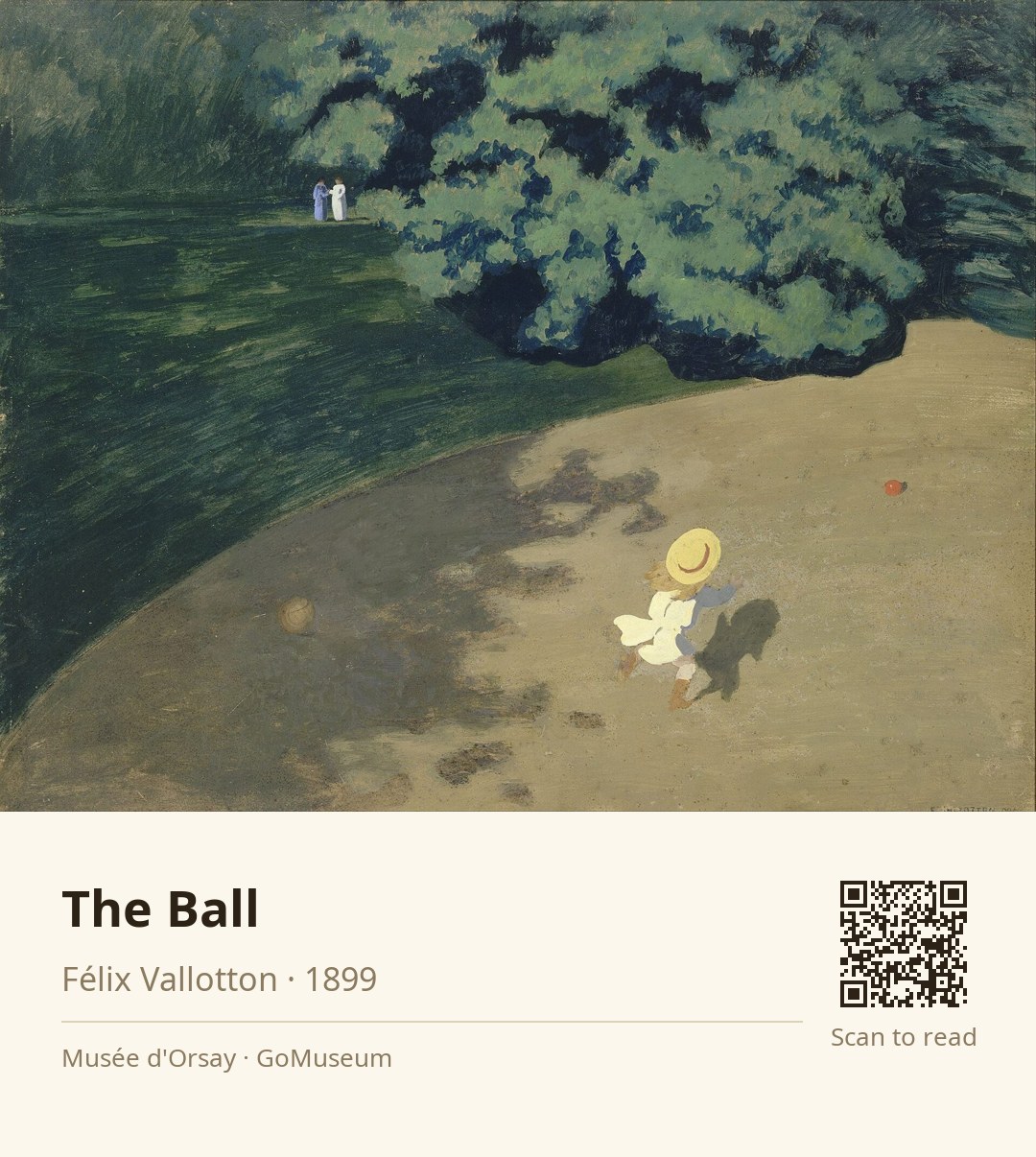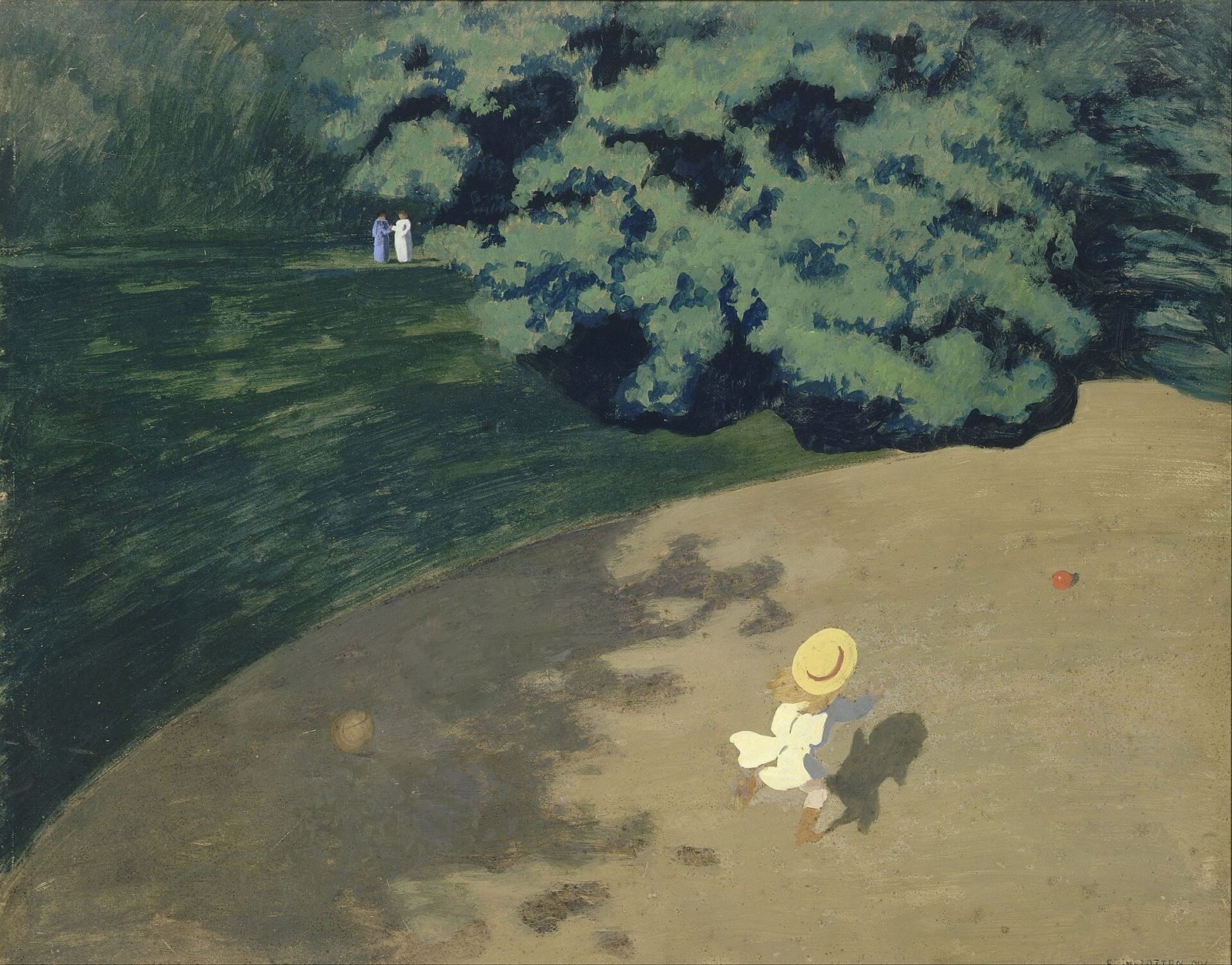
Take a moment to really look at "The Ball" by Félix Vallotton. Notice how the child, emerging from the shadows, is chasing a vibrant red ball, while the background is filled with two elegantly dressed women in white and blue. This contrast between the bright red and the muted tones around it pulls your eye right to the action, doesn’t it?
What’s fascinating here is how Vallotton plays with light and shadow. The child is almost swallowed by the darkness, yet he’s racing toward the sunlight, symbolizing innocence and joy breaking through the gloom. This painting, created in 1899, captures a fleeting moment of childhood exuberance, inviting us to remember our own carefree days.
Vallotton was part of the Nabi movement, which sought to express emotional experiences rather than just depict reality. This piece exemplifies that philosophy, as it’s less about the park and more about the feeling of playfulness and freedom.
So, as you stand here, think about the last time you felt that rush of joy in a simple moment. What does that memory evoke for you?
Félix Vallotton, born in Lausanne in 1865, emerged as a significant figure in the art world, particularly within the Les Nabis group. His early life in a strict Protestant family shaped his disciplined approach to art. After moving to Paris in 1882, he honed his skills at the Académie Julian, influenced by masters like Ingres and Holbein. Vallotton's work, initially realistic, evolved into a distinctive style characterized by bold contrasts in his woodcuts, which gained him international acclaim.
His woodcuts, especially the series "Intimités," explored intimate domestic scenes, revealing complex human interactions. Although he shifted focus to painting after 1901, his later works maintained a keen observation of reality, often infused with dark humor. Vallotton's artistic journey was marked by personal struggles, including health issues and the impact of World War I, which inspired his later works. He also contributed to art criticism and literature, showcasing his multifaceted talent.
Vallotton's legacy lies in his innovative approach to woodcut techniques and his candid portrayal of life, earning him a respected place in modern art history. He passed away in 1925, leaving behind a rich body of work that continues to resonate.
Félix Vallotton's painting 'The Ball' was created in 1899 and is now housed at the Musée d'Orsay in Paris. This piece is considered Vallotton's most recognized work, showcasing his unique approach as a member of the Nabi movement. Vallotton's work gained traction in the art world, and 'The Ball' was part of his journey towards establishing a name for himself among the avant-garde artists in Paris. The painting was later owned by notable figures, including Mr. Rodrigues in 1935 and Carle Dreyfus, highlighting its esteemed provenance.
As you gaze at 'The Ball', pay close attention to Vallotton's masterful use of light and shadow. The child, cloaked in darkness, contrasts sharply with the vibrant red of the ball, drawing your eye into the action. The brushwork feels deliberate yet fluid, capturing the movement of the child as he races toward the sunlight. Notice how the composition is structured; the upward arc of the sandy path leads your gaze from the foreground to the distant figures, creating a sense of depth. The absence of a sky forces your focus on the characters and their interaction with the environment, while the high horizon line gives the painting a unique perspective. Vallotton’s choice of muted colors for the background enhances the brightness of the child’s white attire and the red ball, making the moment feel both fleeting and significant.
Interestingly, Vallotton was not only a painter but also a prolific writer and art critic. He kept a meticulous notebook throughout his life, documenting over 1,700 works.
Growing up in a strict, conservative family, Vallotton was encouraged to pursue classical studies, which laid a foundation for his later artistic endeavors. His early exposure to drawing classes and the works of masters like Ingres shaped his realistic style before he embraced the more emotional approach of the Nabi movement.