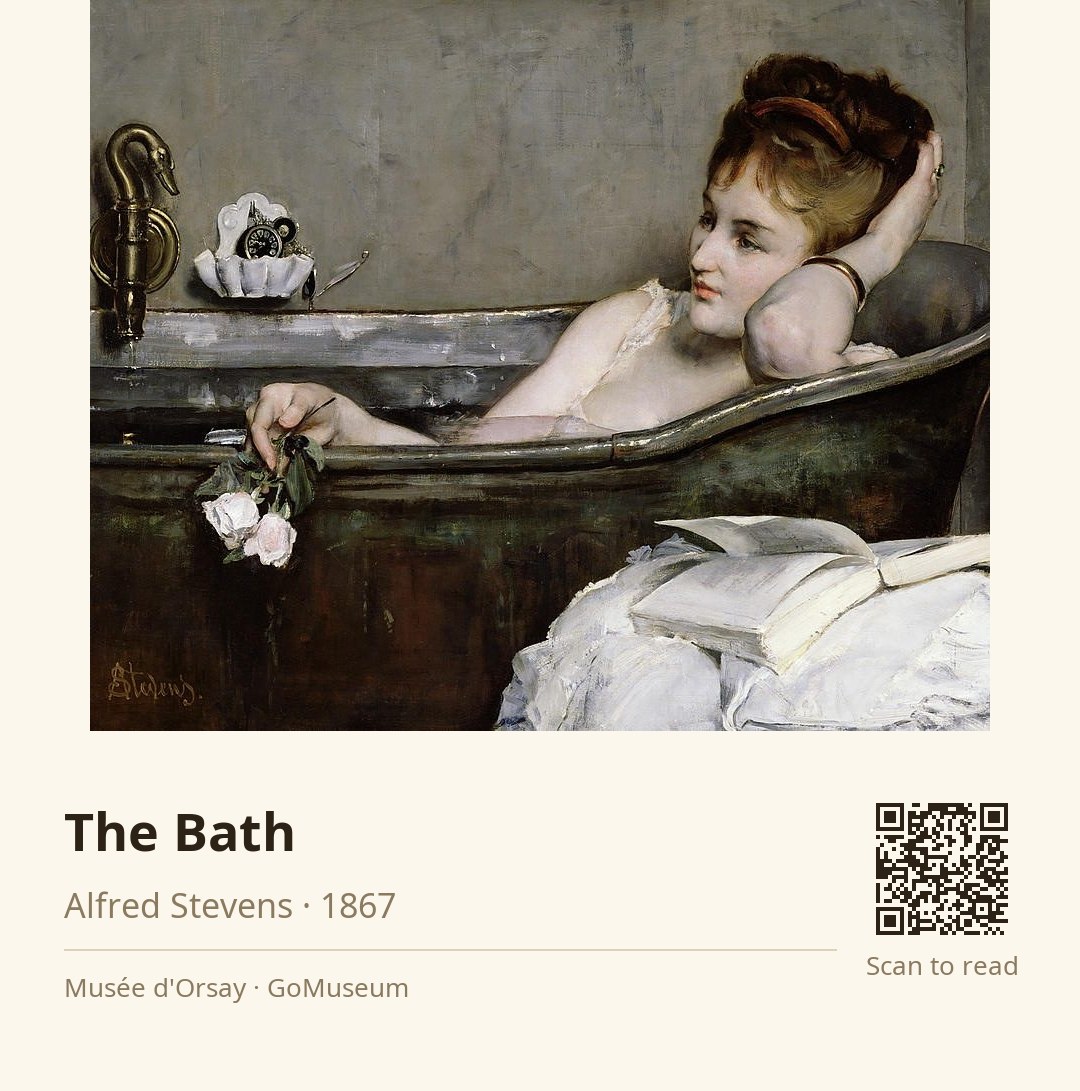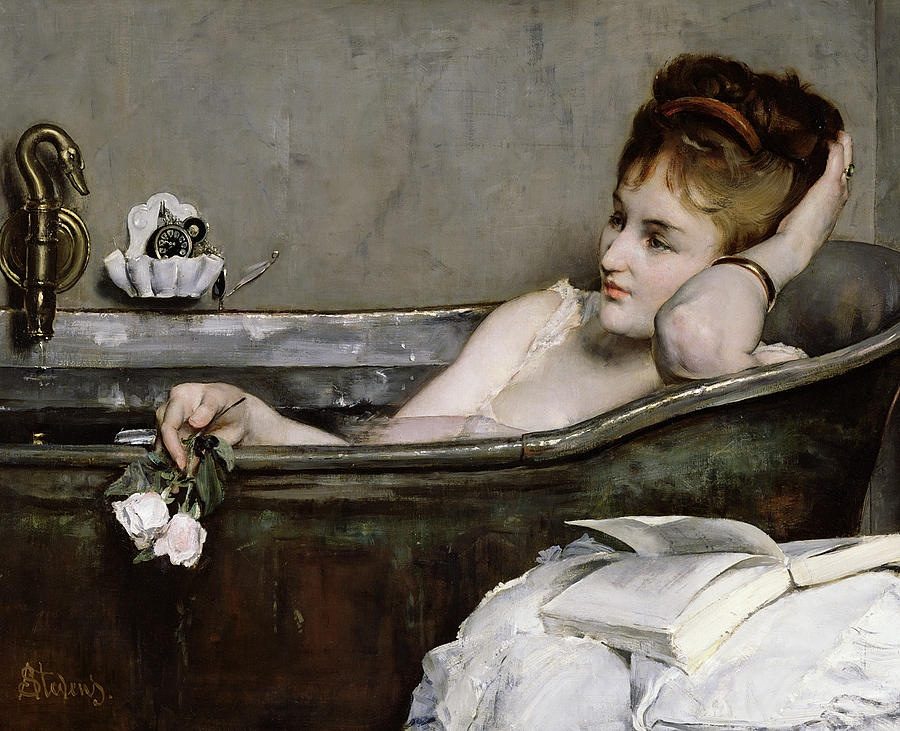
Take a moment to really look at "The Bath" by Alfred Stevens. Notice how the young woman, seemingly lost in thought, holds two delicate white roses instead of a bath brush. Isn’t it intriguing how those roses draw your eye? They symbolize beauty and love, but they also hint at something deeper, perhaps a longing or a moment of reflection in her luxurious surroundings.
Now, let’s focus on that swan-shaped tap above the tub. It’s not just a quirky design choice; it evokes the myth of Leda and the swan, adding an undercurrent of sensuality to the scene. This juxtaposition of elegance and eroticism is a hallmark of Stevens’ work, capturing the essence of Parisian life in the late 19th century.
Stevens, a Belgian artist who thrived in Paris, was known for his depictions of fashionable women, often inspired by the wealthy demi-mondaines of his time. This painting, created in 1867, showcases his mastery of domestic interiors, a style that would later influence the Impressionists.
As you stand here, think about the world this woman inhabits. What stories might she have to tell? What dreams linger in her mind as she relaxes in her bath? Let your imagination wander—after all, art is as much about the viewer's interpretation as it is about the artist's vision.
Alfred Émile Léopold Stevens, born on May 11, 1823, in Brussels, was a prominent Belgian painter celebrated for his depictions of elegant modern women. Coming from a family steeped in the arts, he was influenced by his father's passion for painting and his brothers' artistic pursuits. After studying at the Académie Royale des Beaux-Arts and later the École des Beaux-Arts in Paris, Stevens quickly gained recognition for his social realist works, notably addressing urban poverty. His painting "What is called vagrancy" garnered attention from Napoleon III, leading to significant social change.
By the 1860s, Stevens had established himself as a leading figure in the Parisian art scene, known for his refined portrayals of upper-middle-class life. His works, characterized by a realistic style and meticulous detail, often featured fashionable women in intimate settings, reflecting the era's fascination with modernity and Japonisme. Despite initial reservations about Impressionism, he later embraced aspects of the movement, evolving his style.
Stevens was well-connected, mingling with notable figures like Édouard Manet and Alexandre Dumas. His legacy lies in his ability to blend genre painting with contemporary themes, securing his place in art history as a master of capturing the elegance and complexities of 19th-century Parisian life. He passed away on August 24, 1906, leaving behind a rich body of work that continues to resonate.
Alfred Stevens painted 'The Bath' around 1867, during a vibrant period of his career in Paris. This work was showcased at the 1867 Universal Exposition, a grand event that celebrated art and industry. It was a time when Paris was a cultural hub, and Stevens was right at the center, gaining recognition for his depictions of fashionable women. The painting was well-received, contributing to Stevens' growing reputation as a master of domestic interiors. Today, it resides in the Musée d'Orsay, a testament to its enduring appeal and significance in the art world.
Notice how the soft brushwork creates a sense of intimacy, wrapping the viewer in the warm glow of the scene. The delicate handling of paint brings the luxurious materials to life—the shimmer of the satin and the softness of the woman's skin contrast beautifully with the hard surfaces of the tub and fixtures. The composition is carefully structured; the figure is positioned at an angle that invites your gaze to flow naturally across the canvas. The swan-shaped tap, a focal point, adds an unexpected twist, drawing the eye upward and creating a dialogue between the sensuality of the figure and the elegance of the surroundings. The roses she holds, instead of a bath brush, evoke a sense of stillness and contemplation, enhancing the painting's emotional depth.
One surprising detail about 'The Bath' is that it was showcased at the 1867 Universal Exposition in Paris, a major event that highlighted the best of contemporary art. This was a time when Stevens was gaining significant recognition, and the painting's presence there marked a pivotal moment in his career.
Stevens came from a family deeply involved in the arts, with connections to notable figures and a rich artistic environment, which likely provided him with valuable social skills and opportunities that helped launch his career in Paris.
The painting was showcased at the 1867 Universal Exposition, a major event that not only elevated Stevens' profile but also marked a pivotal moment in his career, solidifying his reputation as a leading painter of fashionable women in Paris.