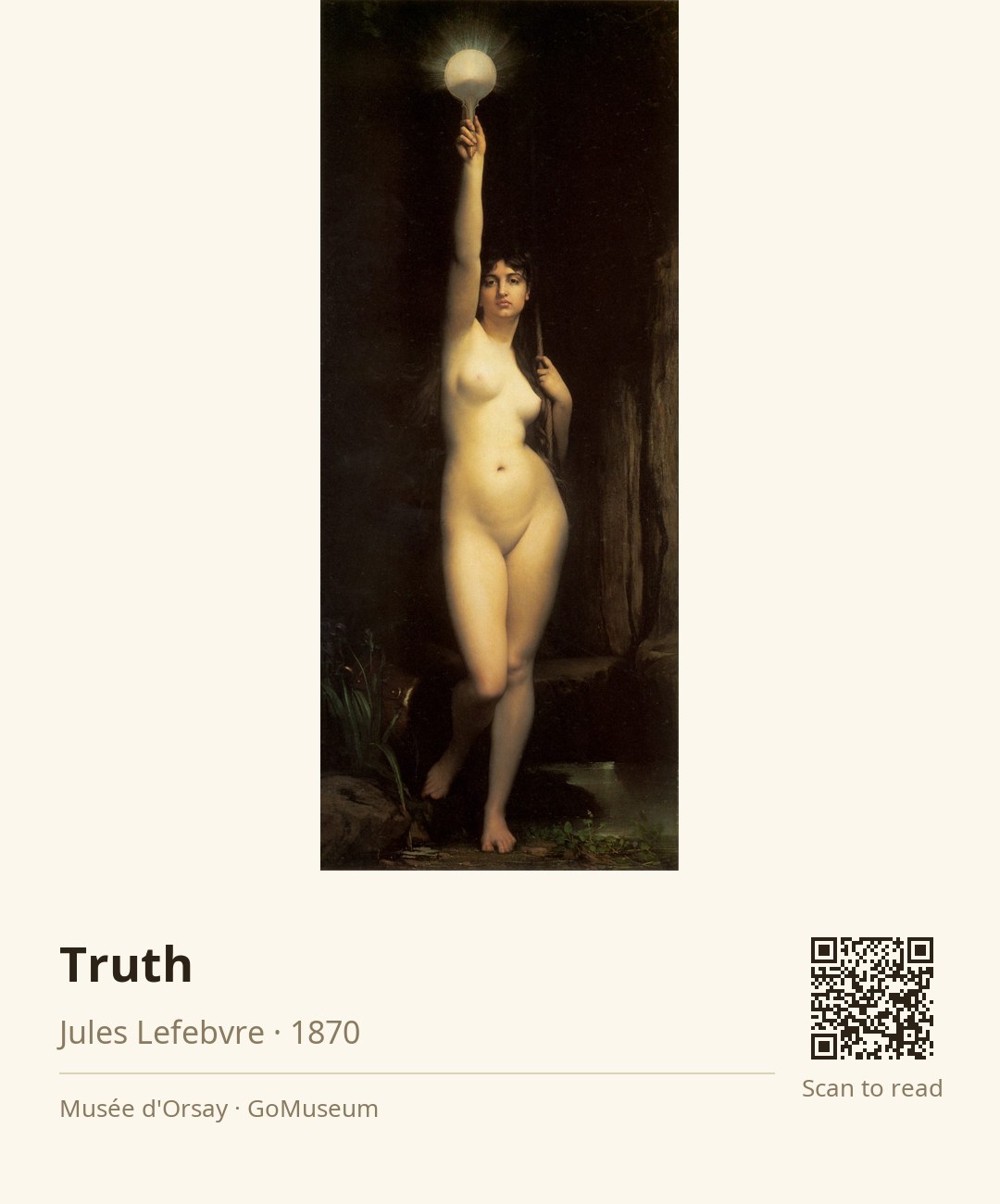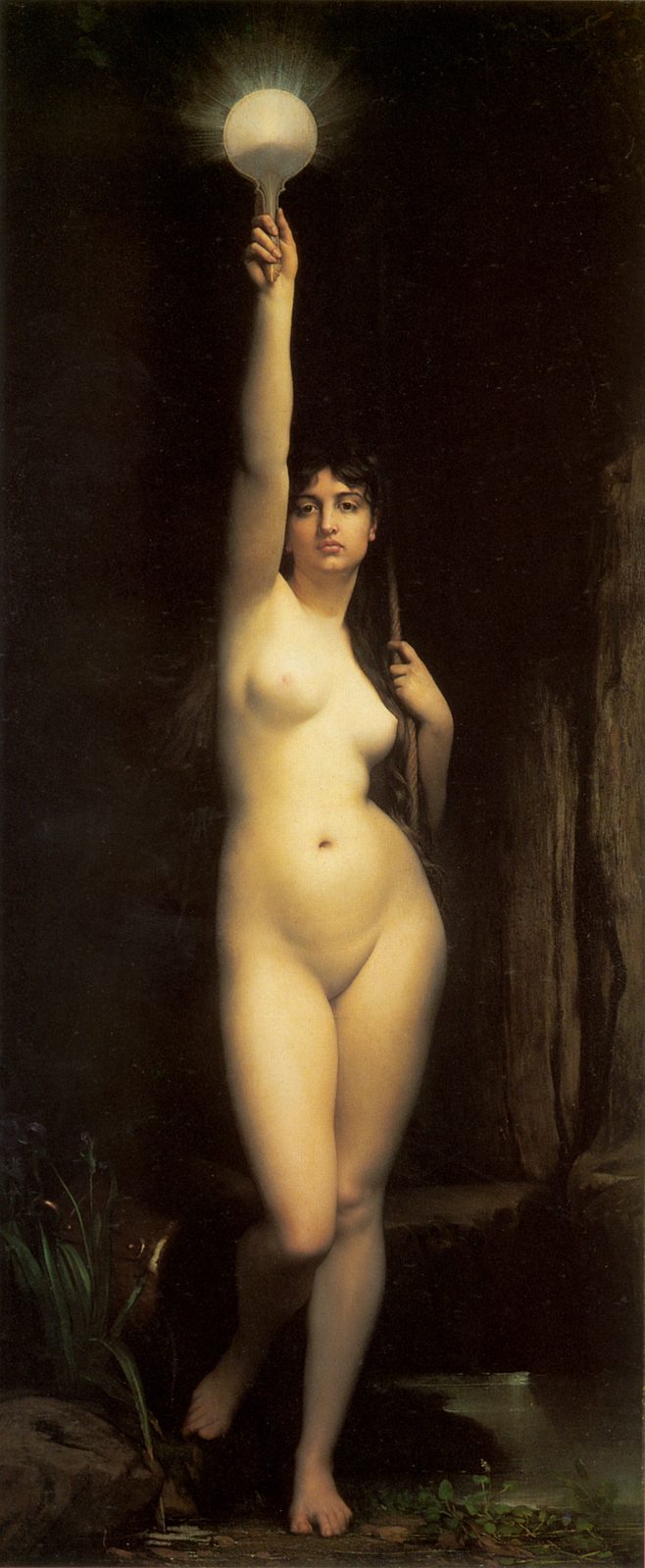
Take a moment to really look at "Truth" by Jules Lefebvre. Notice how the naked woman stands boldly, her right hand raised high, holding a golden mirror that seems to capture the light. That mirror isn’t just a prop; it symbolizes the illuminating power of truth itself. Now, look closely at her left hand gripping a rope that disappears into the darkness above. This isn’t just a random detail; it suggests she’s emerging from a well, a metaphor for the struggle to grasp truth, which can often feel hidden or elusive.
The model for this piece was the actress Sophie Croizette, adding an intriguing layer of performance to the artwork.
As you stand here, think about the idea of truth in your own life. What does it mean to you? How do you seek it out in the shadows? Let this painting remind you that while truth can be challenging to uncover, it’s often worth the journey.
Jules Joseph Lefebvre was a prominent French painter, educator, and theorist born on March 14, 1836, in Tournan-en-Brie. He studied at the École nationale supérieure des Beaux-Arts under Léon Cogniet and gained recognition by winning the prestigious Prix de Rome in 1861 for his work "The Death of Priam." Over his career, he exhibited 72 portraits at the Paris Salon, often featuring beautiful women, with notable works including "The Truth," which depicts a nude woman emerging from a well.
Lefebvre was not only an accomplished artist but also a dedicated teacher at the Académie Julian, influencing over 1,500 students, including notable figures like Fernand Khnopff and Edmund C. Tarbell. His teaching style was characterized by empathy and rigor, fostering a generation of artists who would shape the future of art.
Despite his accolades, Lefebvre faced criticism for being an academic painter in a changing art world. He passed away on February 24, 1911, in Paris, leaving behind a legacy that reflects both the beauty of his art and the complexities of his character. He was buried in Montmartre Cemetery, where his grave features a bas-relief of "The Truth," symbolizing his enduring impact on the art community.
Created in 1870, 'Truth' by Jules Lefebvre made its debut at the Salon des artistes français in Paris, where it was assigned the number 1663. This painting quickly caught the attention of the French state, which purchased it in 1871. Since then, it has found a home in the Musée d'Orsay, where it has been displayed since 1982. The painting depicts a naked woman, a motif that Lefebvre popularized, and it draws on the ancient aphorism by Democritus about truth being found in a well. The model for this striking figure was the actress Sophie Croizette, known for her theatrical performances and her work as a muse for various artists.
As you gaze at 'Truth,' take a moment to appreciate Lefebvre's masterful brushwork. The way he handles the oil paint creates a luminous quality, especially in the golden mirror that seems to capture and reflect light. Notice how the contrast between the bright figure and the dark, rocky background enhances the sense of drama. The composition is carefully structured, with the woman's contrapposto pose drawing your eye upward, emphasizing her raised arm and the mirror. This dynamic positioning not only conveys movement but also invites you to ponder the deeper meaning of truth itself. The scale of the painting, towering at 262 cm high, further amplifies its impact, making the figure feel almost larger than life, as if she’s stepping out of the canvas and into your reality.
Did you know that the model for 'Truth' was the famous French actress Sophie Croizette? While she was primarily known for her stage performances, she also posed for several artists, including her brother-in-law. This connection between theater and painting adds a layer of intrigue to Lefebvre's work, blending the worlds of performance and visual art in a single, striking image.
Lefebvre's portrayal of Truth as a nude woman holding a mirror inspired several French artists in the late nineteenth century, most notably Jean-Léon Gérôme, who created works with similar motifs, including 'Truth Coming Out of Her Well'.
In the background of 'Truth,' there's a fallen bucket and a body of water, which subtly reinforces the theme of emerging from a well and adds depth to the narrative of the struggle to uncover truth.
As a professor at the Académie Julian, Lefebvre taught over 1500 students, including notable American artists like Childe Hassam and Edmund Tarbell, which helped spread his influence and style beyond France, shaping future generations of artists.