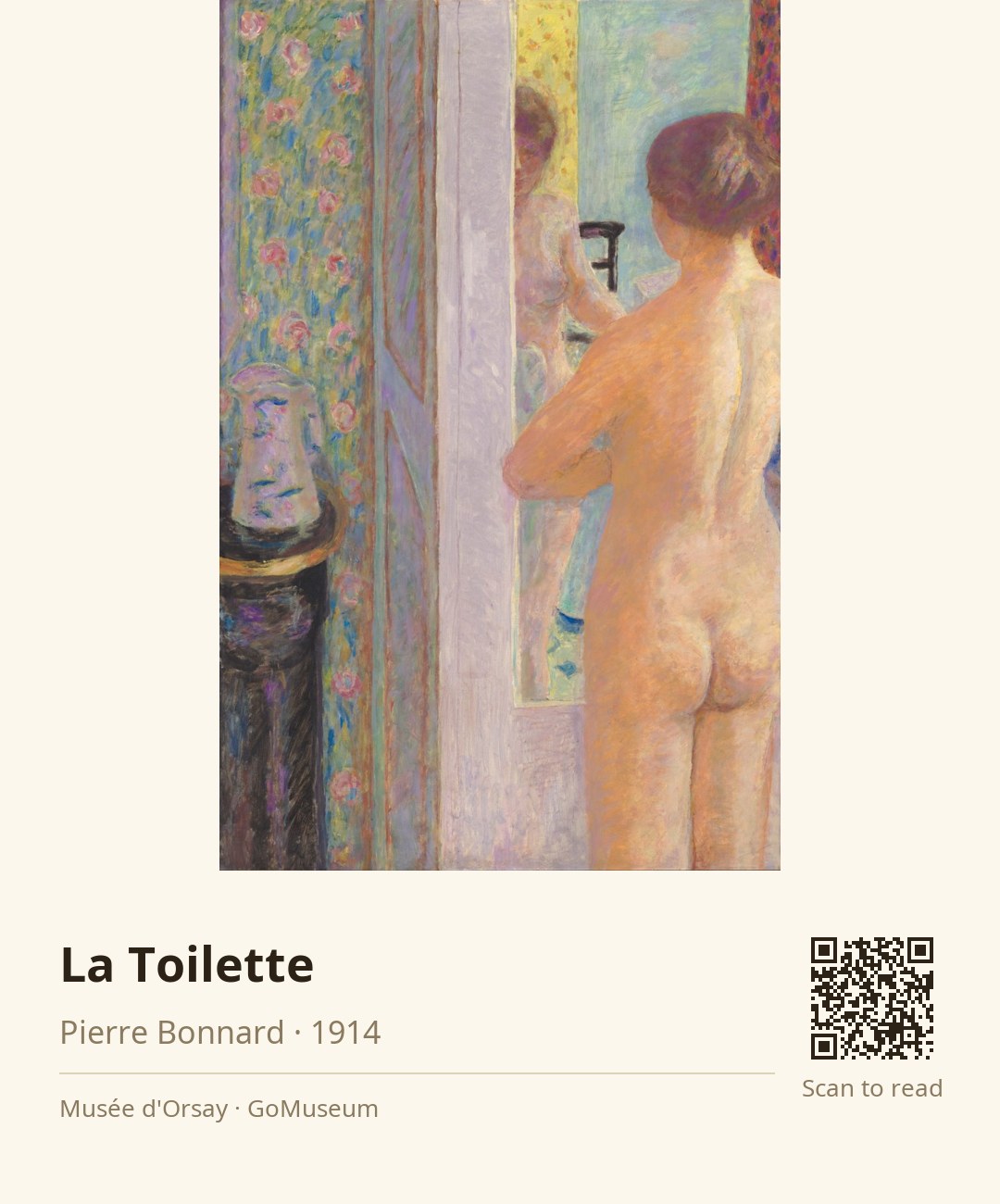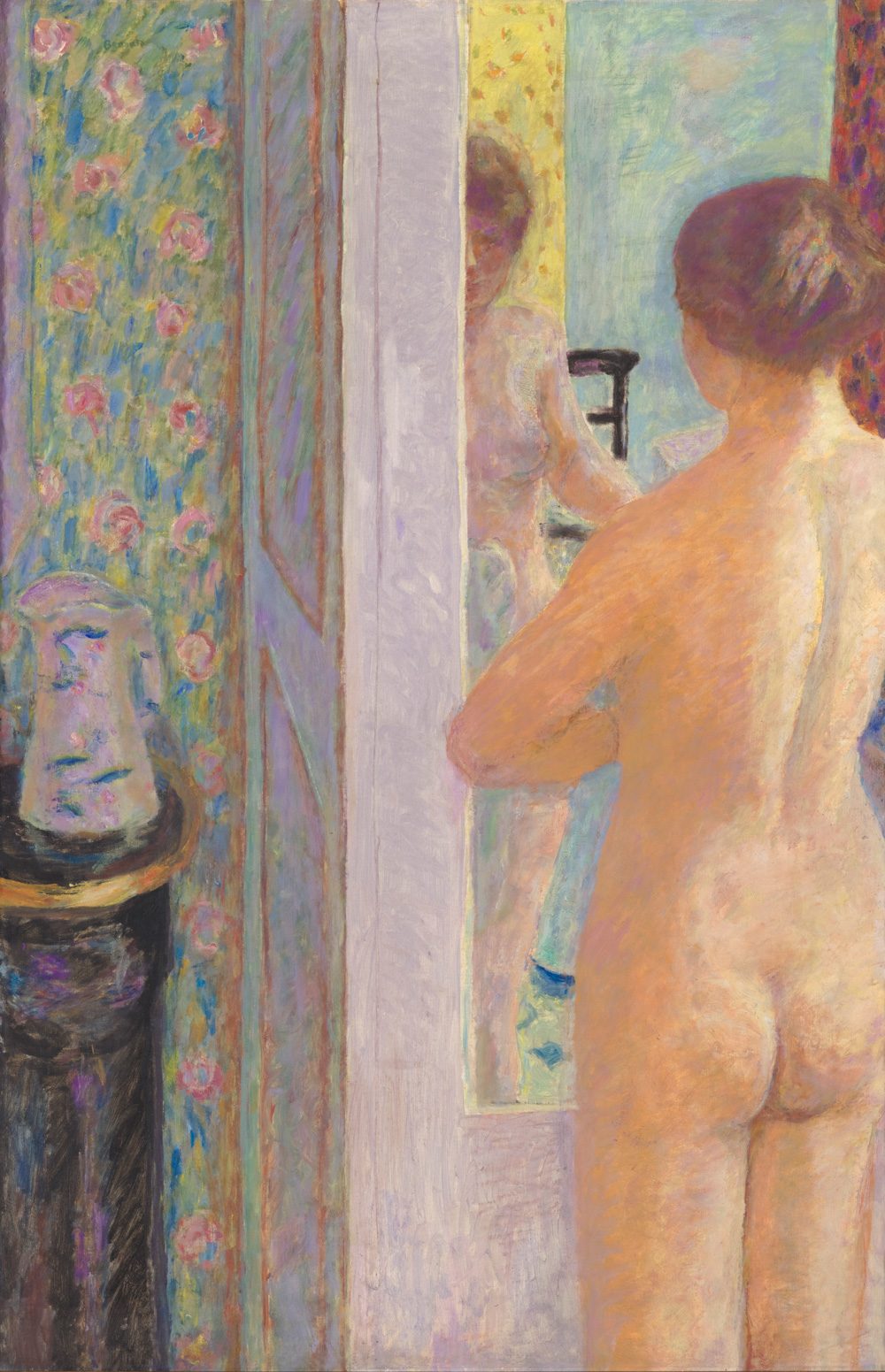
The figure of a woman stands gracefully before a mirror, her back turned to us, while her reflection reveals a glimpse of her front, partially hidden by the mirror's edge. Floral wallpaper adorned with pink roses creates a soft backdrop, while a small table with a pitcher hints at the intimate setting of this moment. The palette, rich in pastels of pink, blue, and yellow, breathes life into the scene, and the loose brushwork adds a sense of texture that invites you into this private space.
This portrayal of Marthe Bonnard, the artist's wife, captures a moment of daily ritual, emphasizing the interplay between reality and reflection. By positioning the mirror as a central element, Bonnard not only showcases the physical beauty of his subject but also suggests a deeper exploration of identity and self-perception. The soft colors and impressionistic style evoke a sense of warmth and intimacy, making the viewer feel like a silent observer in this personal act of grooming.
Pierre Bonnard was a French painter born on October 3, 1867, in Fontenay-aux-Roses. A founding member of the Post-Impressionist group Les Nabis, he was known for his vibrant colors and decorative style. His early influences included Paul Gauguin and Japanese art, which shaped his unique approach to painting. Bonnard's work often prioritized color and composition over subject matter, reflecting his belief in the emotional power of art.
Despite initially pursuing a career in law, Bonnard's passion for art led him to study at the Académie Julian and the École des Beaux-Arts, where he formed lasting friendships with fellow artists. His personal life was marked by a long relationship with Marthe de Méligny, who became his muse and model. Bonnard's paintings often depicted intimate domestic scenes, capturing the essence of everyday life with a sense of joy and nostalgia.
Over his prolific career, Bonnard transitioned from Impressionism to a more modern aesthetic, becoming one of the foremost colorists of the 20th century. His legacy endures as he is celebrated for his innovative use of light and color, positioning him as a significant figure in the evolution of modern art. Bonnard passed away on January 23, 1947, leaving behind a rich body of work that continues to inspire.
La Toilette was created in 1914 by Pierre Bonnard. It was first shown at the Bernheim-Jeune gallery in Paris in the same year. The painting entered public collections in 1922 when the French state acquired it from Bonnard, who had retrieved it from the gallery shortly before. Since 1986, it has been housed in the Musée d'Orsay.
The painting features a nude woman standing before a mirror, her back facing us while her reflection reveals her front, partially obscured by the mirror's edge. The interior is adorned with floral wallpaper showcasing pink roses against a green background. A small table with a pitcher adds to the intimate setting. The color palette is dominated by soft pastels—pinks, blues, and yellows—while the brushwork is loose and impressionistic, enhancing the texture and light within the scene. The mirror divides the composition, creating a dynamic interplay between reality and reflection.
La Toilette is categorized as genre art and is recognized for its portrayal of the nude form. This work exemplifies Bonnard's unique approach to domestic scenes, blending intimacy with a deeper exploration of identity.
Interestingly, the model for La Toilette is Marthe Bonnard, the artist's wife, who served as his muse for many of his works, highlighting their close personal and artistic relationship.
Pierre Bonnard was notably influenced by Japanese art, which inspired him to incorporate multiple perspectives and bold geometric patterns into his paintings.