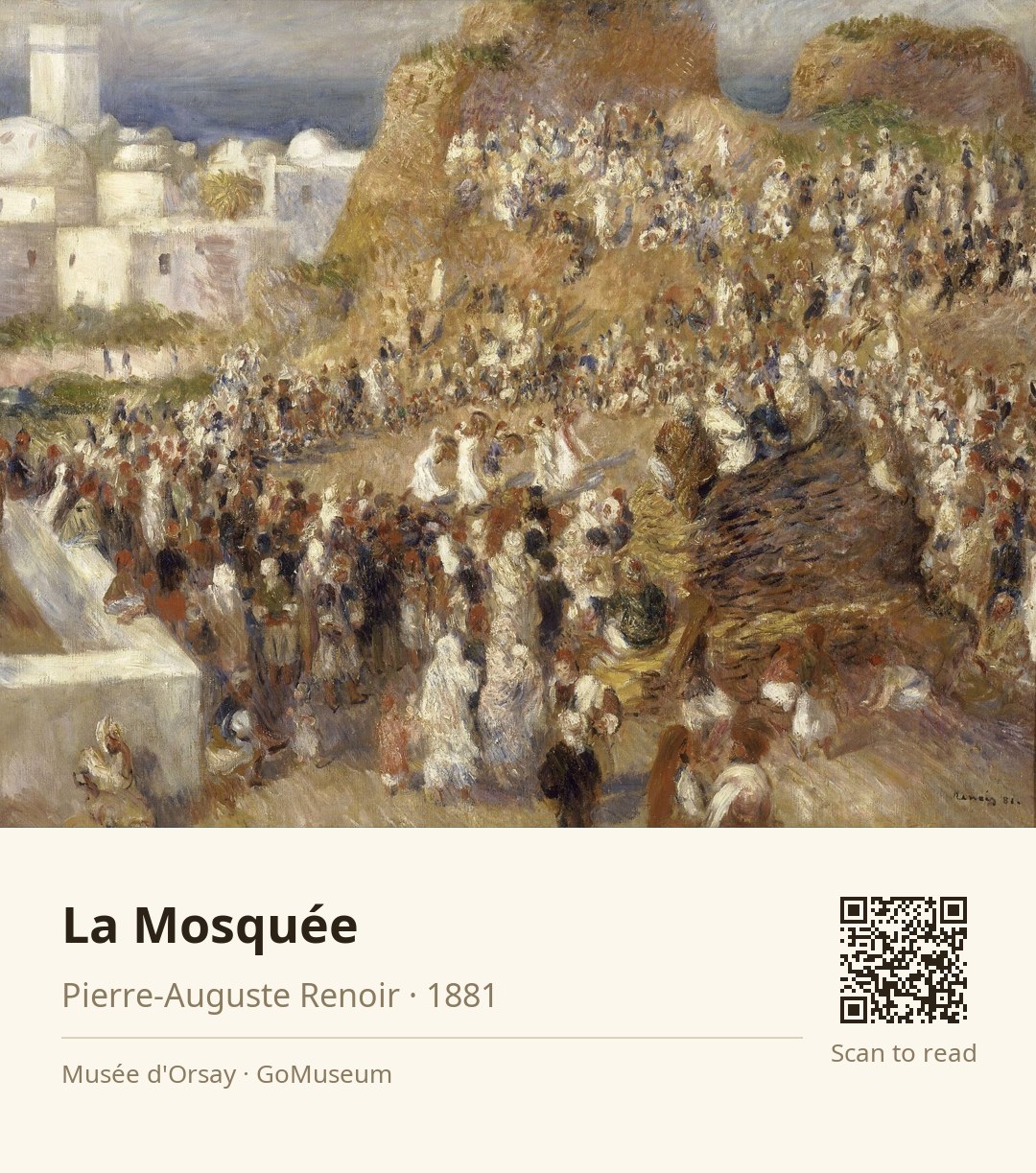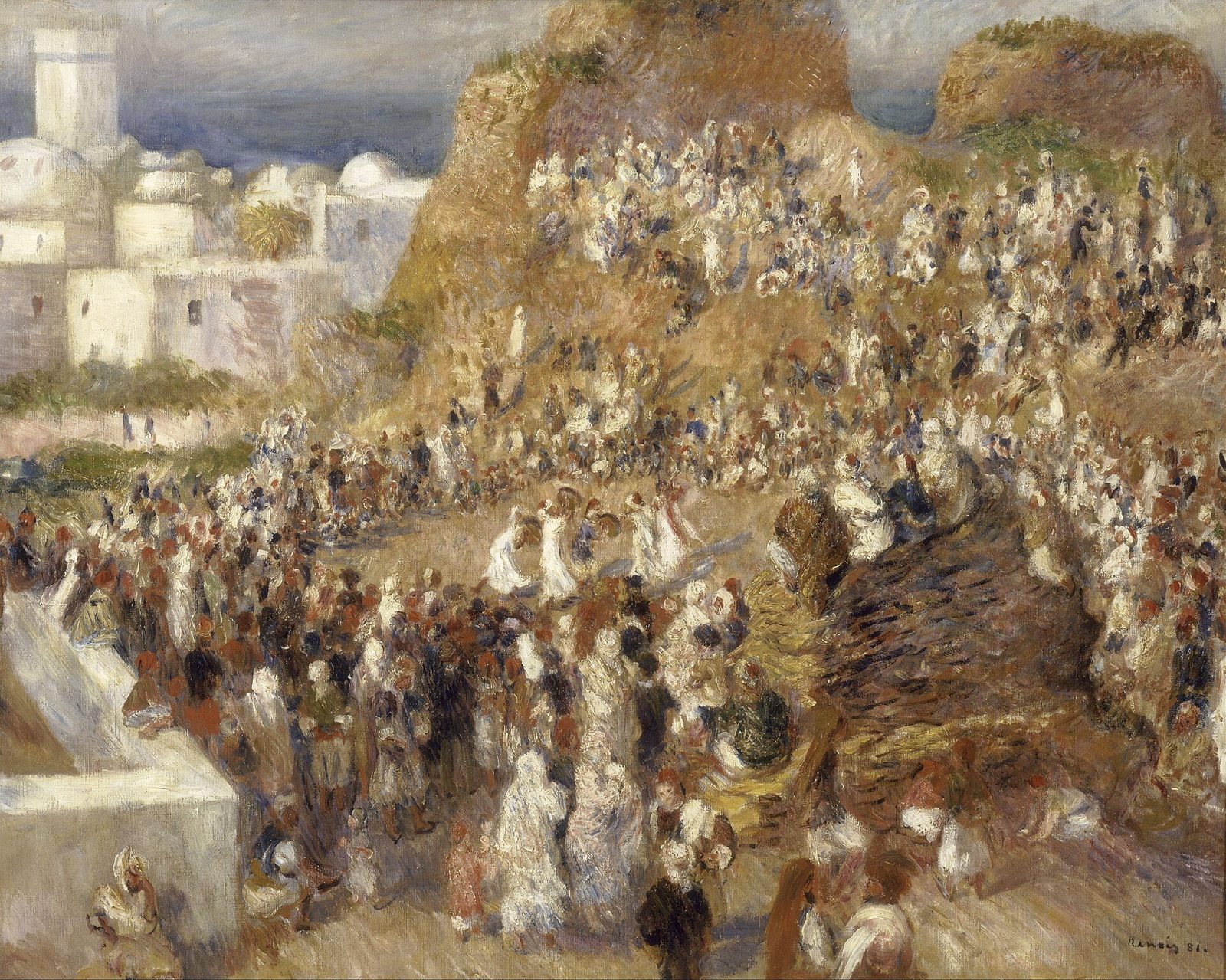
Take a moment to really absorb the vibrant energy of Renoir's "La Mosquée." Look closely at the lively crowd gathered around the musicians. Notice how their faces are illuminated, each one telling a story of joy and celebration. The way Renoir captures the light dancing across their features draws you into the scene, almost as if you can hear the music and feel the festive atmosphere. These details matter because they reflect Renoir's fascination with capturing human emotion and the spirit of community. Painted in 1881, this piece is not just a snapshot of a moment; it’s a celebration of life in Algeria, a place that inspired him deeply during his travels. The ruins of the ancient walls in the background remind us of the rich history of the region, hinting at the layers of culture and tradition that coexist in this vibrant setting. Renoir was part of the Impressionist movement, which sought to break away from traditional artistic conventions. This painting exemplifies that shift, blending the beauty of the landscape with the warmth of human interaction. As you stand here, think about how this artwork connects to the broader narrative of cultural exchange and the artist's journey. What feelings does this scene evoke for you? Can you imagine the sounds and scents of the celebration? Let that curiosity linger as you explore further.
Pierre-Auguste Renoir, born on February 25, 1841, in Limoges, France, emerged as a pivotal figure in the Impressionist movement. His early life in a modest family led him to Paris, where he honed his artistic skills amidst the masterpieces of the Louvre. Initially apprenticed in a porcelain factory, Renoir's passion for painting flourished, particularly after studying under Charles Gleyre, where he befriended fellow artists like Monet and Sisley.
Renoir's work celebrated feminine beauty and vibrant social scenes, exemplified in iconic pieces like "Dance at Le Moulin de la Galette." Despite facing criticism early on, he gained recognition, especially after participating in the first Impressionist exhibition in 1874. His style evolved over the years, transitioning towards realism influenced by classical masters like Raphael.
Throughout his life, Renoir balanced personal struggles, including health issues, with a prolific output, reportedly creating around four thousand works. He became a beloved figure in art history, known for his warm palette and expressive brushwork. Renoir passed away on December 3, 1919, leaving a legacy that continues to inspire artists and art lovers alike.
Its journey continued as it passed through various collections, including that of Claude Monet and later Margaret Biddle, before finding a permanent home at the Musée d'Orsay after being donated in 1957. The painting was well-received, showcasing the lively spirit of a celebration in Algeria, and it reflects the complex layers of history and culture that Renoir sought to capture. The ruins in the background, remnants of ancient walls, serve as a poignant reminder of the region's rich past, hinting at the interplay between the old and the new.
As you gaze at "La Mosquée," pay attention to Renoir's masterful brushwork. The lively strokes create a sense of movement, almost as if the crowd is pulsating with energy. Notice how the light plays across the faces of the musicians and the audience, illuminating their expressions with warmth and vibrancy. Renoir's use of color is particularly striking; the palette is rich and varied, with warm earth tones contrasting against the cooler hues of the background. This choice not only enhances the festive atmosphere but also draws your eye to the central figures. The composition is dynamic, with the crowd forming a semi-circle around the musicians, guiding your gaze towards the action at the heart of the celebration. The scale of the painting, quite large at 73.5 by 92 centimeters, immerses you in the scene, making you feel like a participant in this joyous gathering.
One intriguing tidbit about "La Mosquée" is that Renoir painted this piece after a series of travels that included visits to Spain and Italy, where he sought inspiration from the works of masters like Velázquez and Titian. This blend of influences is evident in the way he captures the essence of the scene, merging his Impressionist style with the rich cultural tapestry of Algeria.
Renoir initially showed a talent for singing and received encouragement from his music teacher, Charles Gounod. However, due to financial constraints, he had to abandon his music lessons at a young age to support his family.
While studying under Charles Gleyre, Renoir formed lasting friendships with fellow artists Claude Monet, Alfred Sisley, and Frédéric Bazille, which significantly impacted his artistic development and the formation of the Impressionist movement.