La Mort de Bara
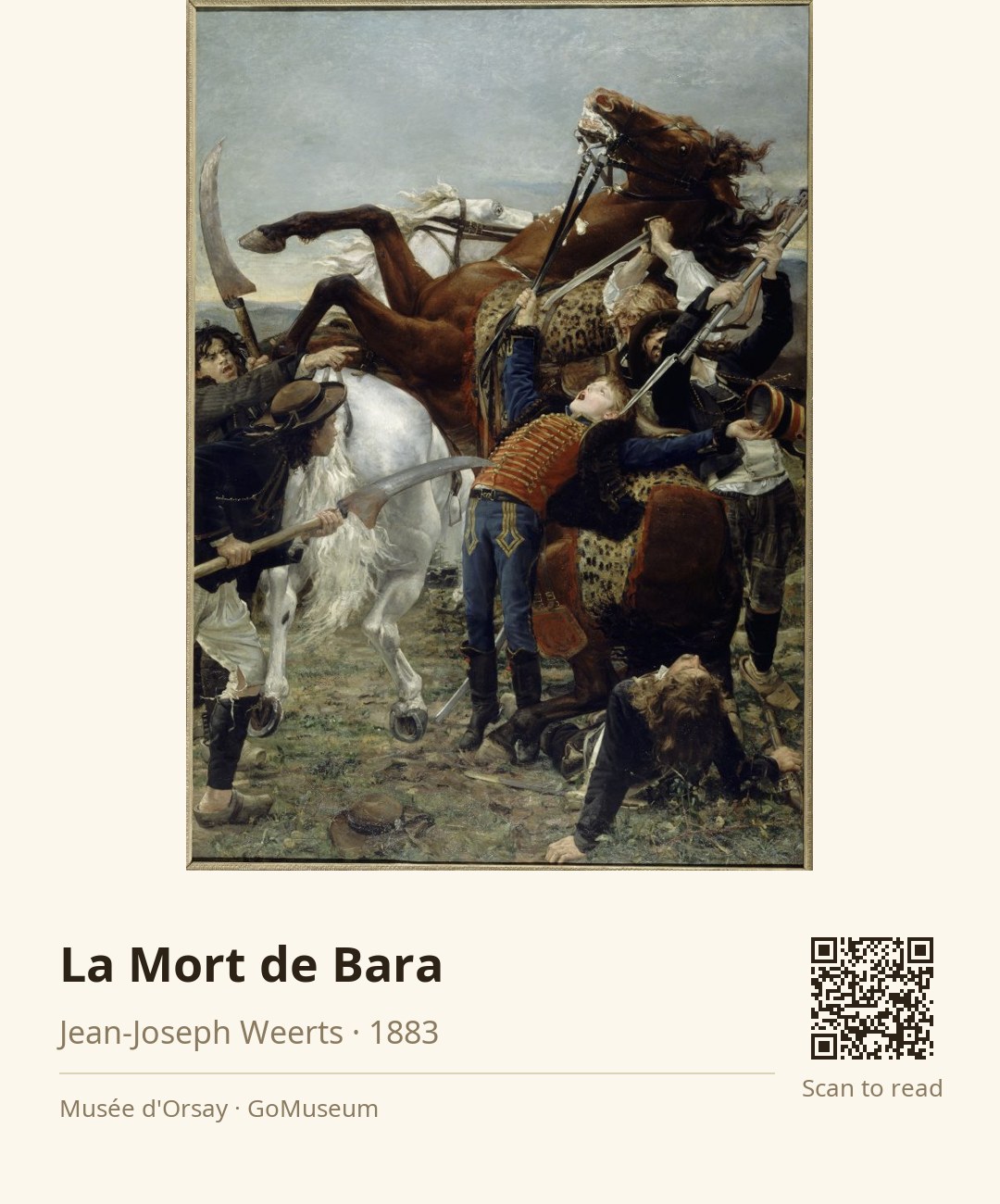
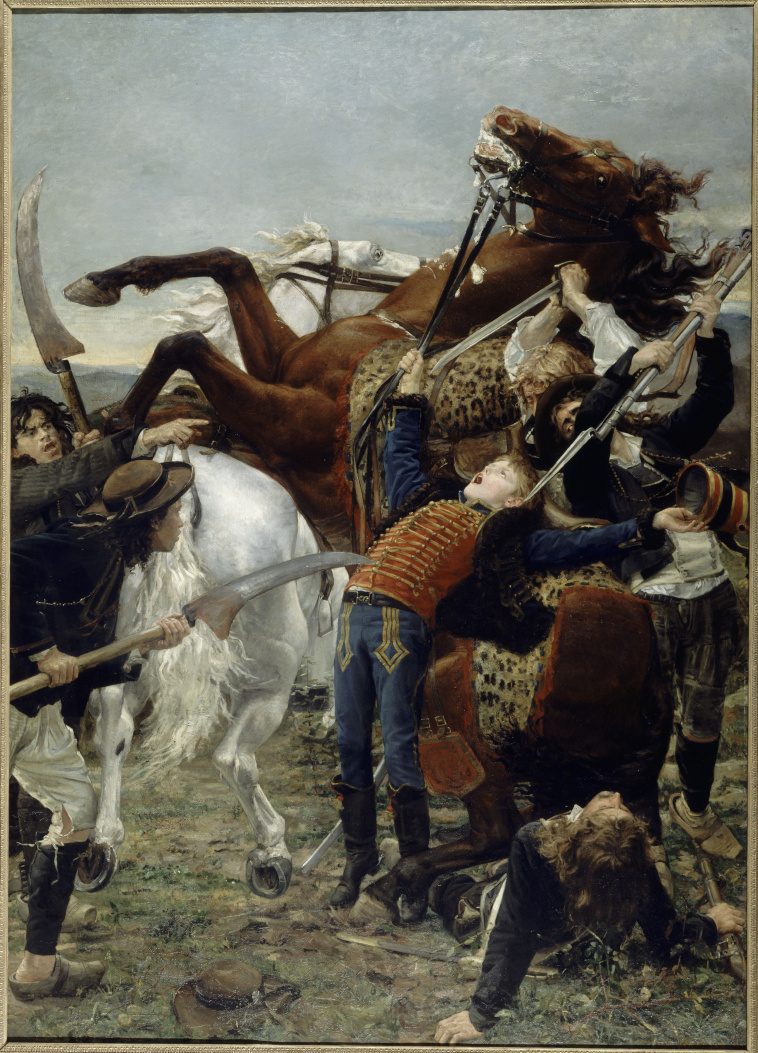
🎧 This work has audio narration — listen in the appTake a moment to really look at "La Mort de Bara." What strikes you first? It’s the intensity in the young soldier’s eyes, isn’t it? Joseph Bara, just a boy, captured in the very moment before his tragic end, surrounded by the Vendéans who threaten him with bloodied weapons. Notice how the colors of his hussar uniform pop against the darker, rougher attire of his attackers, highlighting his youth and innocence amidst the chaos.
This contrast is crucial. Weerts isn’t just painting a scene of violence; he’s telling a story of sacrifice and patriotism. Bara’s defiance—shouting “Long live the Republic!”—elevates him to a heroic status, a martyr for the ideals of the French Revolution. The painting was created during a time when the Third Republic sought to revive revolutionary heroes to strengthen national identity, making Bara a symbol of courage for future generations.
Jean-Joseph Weerts, the artist, was deeply affected by France’s recent losses and wanted to inspire a sense of pride and resilience through his work. This painting, exhibited in 1883, resonated so strongly that it was reproduced and hung in classrooms, teaching children about valor and sacrifice.
As you stand here, consider: what does this moment of impending tragedy evoke in you? How does it shape your understanding of heroism and sacrifice in history?
Jean-Joseph Weerts was a French painter born on May 1, 1846, in Roubaix, to Belgian parents. His early exposure to drawing came from his father, a mechanical engineer. Weerts honed his skills at the Académie des Beaux-arts de Roubaix and later at the École des Beaux-arts in Paris, where he studied under notable artists like Alexandre Cabanel. Throughout his career, he created nearly 700 works, focusing on portraits and historical and religious themes. His painting "The Death of Bara" earned him the Légion d'honneur in 1884, marking a significant recognition of his talent.
Weerts played a vital role in the academic art scene of his time, contributing to public buildings across France, including the Sorbonne and the Hôtel de Ville in Paris. He was a founding member of the Société nationale des beaux-arts and became a prominent figure in artistic circles. His works were widely reproduced, influencing public memory and education. After his death on September 28, 1927, he was buried at Père-Lachaise Cemetery, and a street in Roubaix was named in his honor. His legacy continues through monuments and exhibitions celebrating his contributions to art.
Commissioned by the government, this painting was part of a broader effort by the Third Republic to revive revolutionary heroes and instill a sense of national pride. The painting depicts Joseph Bara, a young soldier who became a martyr for the Republic after being killed by Vendéan rebels in 1793. Weerts, deeply affected by France's recent losses, particularly the Franco-Prussian War, sought to inspire resilience through his art. Its powerful imagery resonated widely, leading to mass reproductions that adorned classrooms, teaching children about valor and sacrifice. This artwork not only earned Weerts the Legion of Honour but also became a symbol of patriotic education for generations to come.
Weerts' technique in 'La Mort de Bara' is strikingly dynamic, capturing the very moment before tragedy strikes. Notice how he uses light to illuminate Bara's youthful face, contrasting it against the darker, rougher figures of the Vendéans. The brushwork feels almost frenetic, with bold strokes that convey movement and urgency. The composition is carefully structured; Bara is central, almost crucified in his stance, surrounded by the hesitant Vendéans, which heightens the drama of the scene. Weerts employs a rich color palette, particularly the vibrant hues of Bara's hussar uniform, to draw the viewer's eye and emphasize his innocence. The figures are not just static; they seem to breathe, caught in a moment of psychological tension, as if time has paused just before the violence erupts. This choice of capturing the action at its peak creates a visceral impact, making the viewer feel the weight of impending doom.
By reviving the memory of Joseph Bara, a young hero of the Revolution, Weerts tapped into a wave of patriotic fervor. This painting influenced how history was taught to children, as reproductions flooded classrooms, making Bara a model of courage and sacrifice. It served as a rallying cry for the Republic, embedding itself in the national consciousness and shaping the narrative of heroism in France for generations. Remember, this wasn't merely art; it was a tool for education and national identity.
Interestingly, Weerts was not the only artist to depict Joseph Bara; he was part of a wave of artists in the early 1880s who were commissioned to create works celebrating this young hero. In fact, just a year before 'La Mort de Bara,' Weerts painted a portrait of Bara as a hussar, which is now housed in La Piscine Museum in Roubaix.
The painting was reproduced in photogravure shortly after its creation, with hundreds of thousands of copies sent to schools, where it adorned classroom walls. This widespread distribution was part of the Third Republic's effort to present Joseph Bara as a heroic model for children, reinforcing patriotic values through education.
Weerts was deeply affected by France's recent losses, particularly the Franco-Prussian War, which fueled his desire to evoke a sense of pride and resilience in his work. His own patriotic sentiments and attachment to republican values shaped the dramatic and heroic representation of Bara in the painting.
Weerts may have drawn inspiration from a 1794 print by Philibert-Louis Debucourt titled 'Heroic Death of Young Barra,' which shares remarkable similarities in composition and the movements of the figures. This connection highlights the ongoing cultural dialogue around Bara's legacy in French art.