 Image: Sailko
The breakup letter
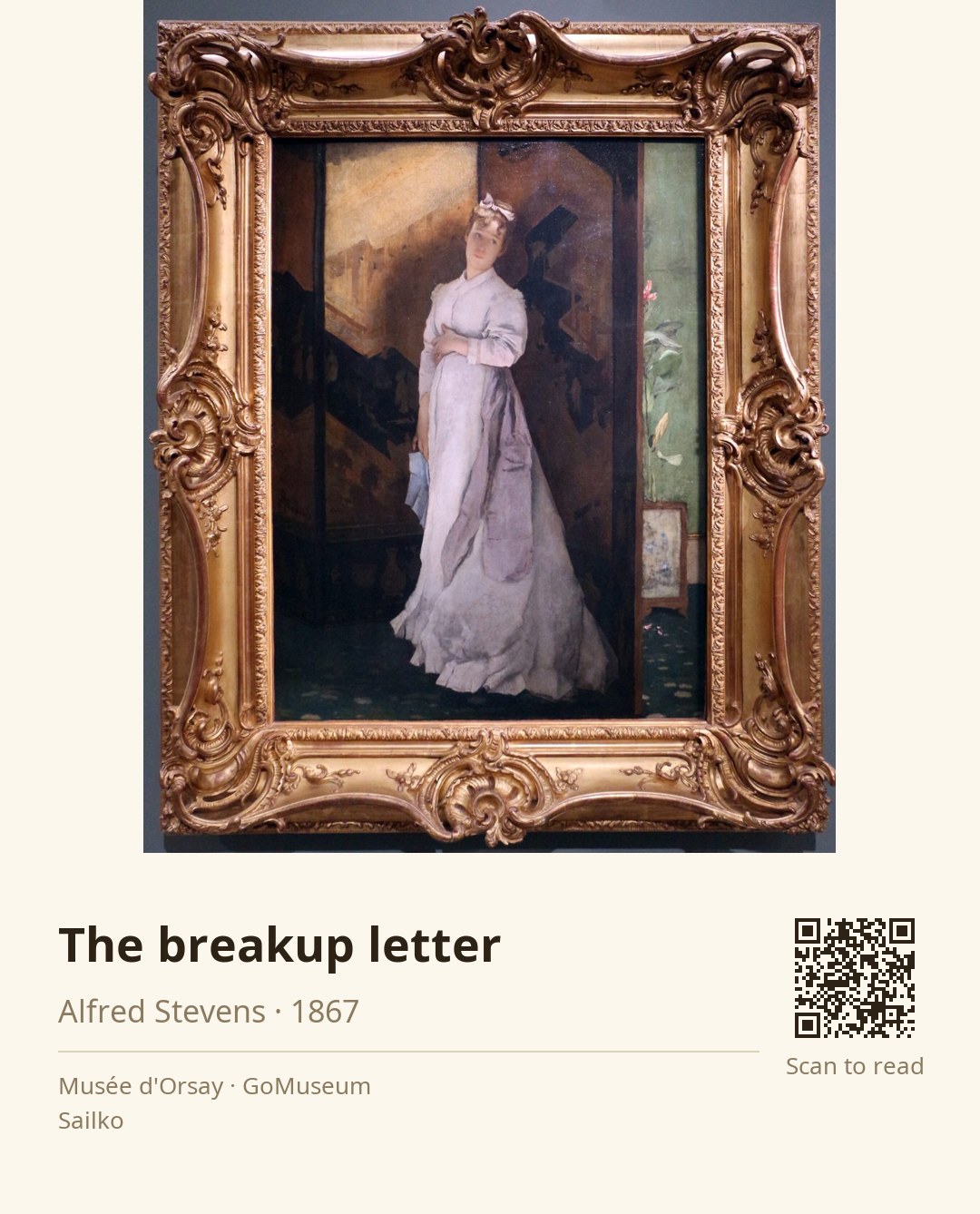
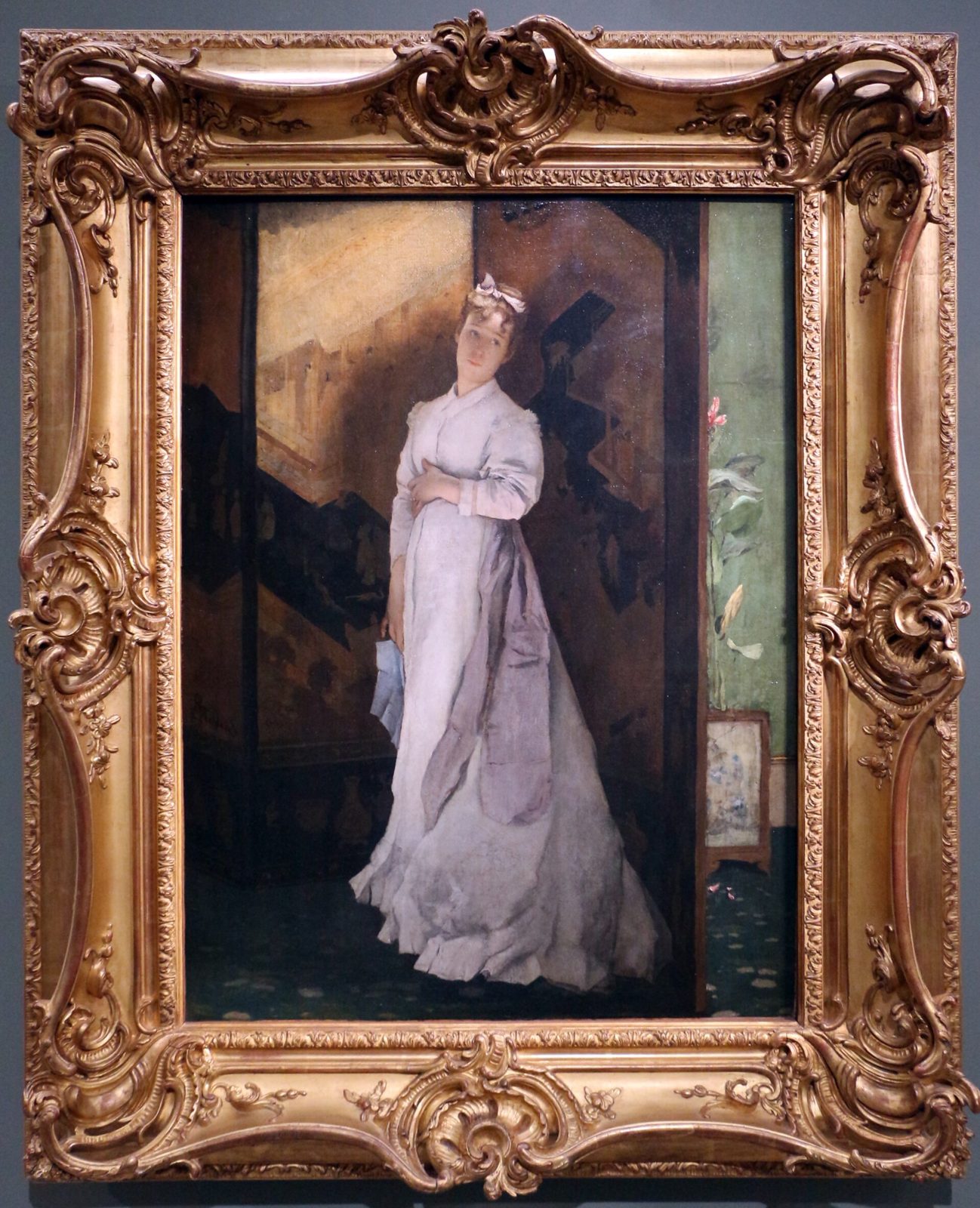
🎧 This work has audio narration — listen in the appThe woman in the flowing white dress stands poised, holding a small book in her right hand, her head slightly tilted as if caught in a moment of contemplation. The lavender sash around her waist contrasts beautifully with the muted tones of the dark interior behind her, where geometric shapes and a floral-patterned green wall hint at a sophisticated space.
This elegant figure, painted by Alfred Stevens in 1867, embodies the complexities of modern femininity during a time when women were increasingly stepping into the public sphere. The delicate brushwork highlights the texture of her dress, while the inclusion of the folding screen and plant suggests a blend of intimacy and decorum, characteristic of upper-middle-class Parisian life.
Stevens, known for his depictions of fashionable women, drew inspiration from the Japonisme movement, which was gaining popularity in the 19th century. His works often reflected the interplay of contemporary fashion and interior design, revealing a keen awareness of the cultural shifts of his time. In this painting, the woman’s serene demeanor and the carefully arranged elements around her invite viewers to ponder the narrative behind her letter, a poignant symbol of personal relationships and societal expectations.
In 1867, Stevens received a first-class medal at the Universal Exposition in Paris, solidifying his reputation as a leading painter of modern life.
Alfred Émile Léopold Stevens, born on May 11, 1823, in Brussels, was a prominent Belgian painter celebrated for his depictions of elegant modern women. Coming from a family steeped in the arts, he was influenced by his father's passion for painting and his brothers' artistic pursuits. After studying at the Académie Royale des Beaux-Arts and later the École des Beaux-Arts in Paris, Stevens quickly gained recognition for his social realist works, notably addressing urban poverty. His painting "What is called vagrancy" garnered attention from Napoleon III, leading to significant social change.
By the 1860s, Stevens had established himself as a leading figure in the Parisian art scene, known for his refined portrayals of upper-middle-class life. His works, characterized by a realistic style and meticulous detail, often featured fashionable women in intimate settings, reflecting the era's fascination with modernity and Japonisme. Despite initial reservations about Impressionism, he later embraced aspects of the movement, evolving his style.
Stevens was well-connected, mingling with notable figures like Édouard Manet and Alexandre Dumas. His legacy lies in his ability to blend genre painting with contemporary themes, securing his place in art history as a master of capturing the elegance and complexities of 19th-century Parisian life. He passed away on August 24, 1906, leaving behind a rich body of work that continues to resonate.
The smooth brushwork creates a delicate texture that brings the woman's flowing white dress to life, while the lavender sash adds a vibrant contrast that draws the eye. The muted palette of dark browns and greens in the background enhances the figure's prominence, making her the focal point of the composition. The use of a folding screen and a plant not only adds depth but also suggests a layered narrative of intimacy and decorum. The geometric shapes in the background hint at architectural elements, grounding the scene in a sophisticated interior. This careful arrangement of elements, combined with the soft color transitions, creates a sense of calm and contemplation, inviting viewers to engage with the woman's story.
Interestingly, Stevens often used the same models repeatedly in his works, which included women from various social backgrounds. This practice not only highlights his personal connections with these women but also raises intriguing questions about identity and representation in his art.
Growing up in a family deeply engaged in the arts provided him with valuable connections and insights, which likely facilitated his entry into the art world.