The Fiancée of Belus
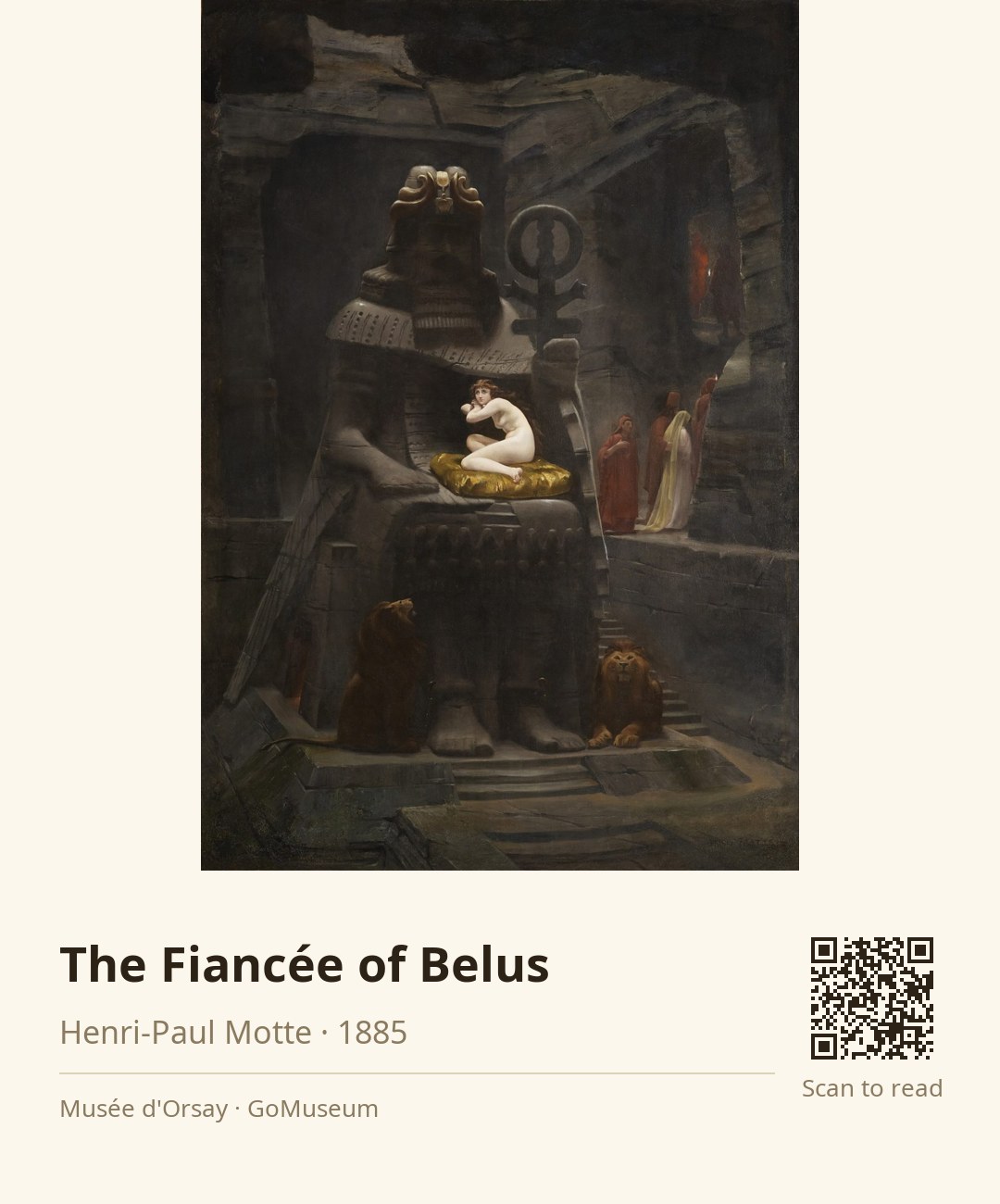
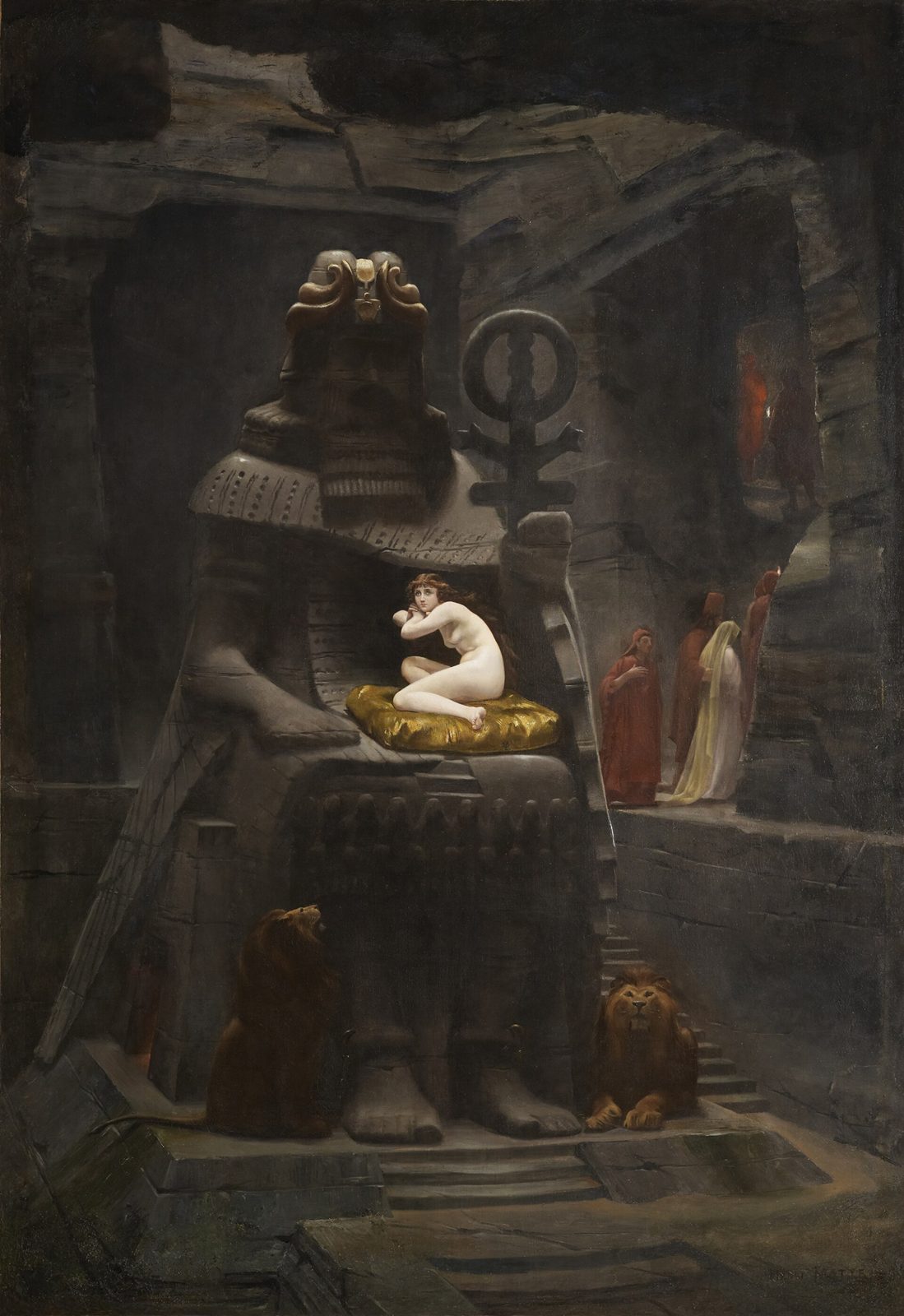
🎧 This work has audio narration — listen in the appTake a moment to really look at "The Fiancée of Belus." Notice the striking contrast between the vibrant colors and the intricate details of the figures. The young woman, adorned in a flowing gown, sits gracefully on the lap of the imposing statue of Belus, her expression a mix of serenity and anticipation.
These details matter because they capture a moment steeped in ritual and symbolism, reflecting the ancient Babylonian practice of offering beauty to the gods. The artist, Henri-Paul Motte, draws us into a world where beauty contests determined fate, and the stakes were as high as they could be.
Motte painted this piece in 1885, inspired by a fanciful interpretation of Babylonian culture, though he relied on a dubious historical account. He meticulously recreated the temple’s grandeur, influenced by Greek architecture, which adds a layer of authenticity to this imaginative scene.
As you stand here, think about the stories that art can tell. What emotions do you think the girl is experiencing in this moment? How does the blend of history and myth resonate with you today?
Henri-Paul Motte was a French painter born in Paris on December 13, 1846, and he passed away on April 1, 1922. A student of the renowned Jean-Léon Gérôme, Motte specialized in historical subjects, capturing pivotal moments in history with a dramatic flair. His career took off with his 1874 painting "The Trojan Horse," which showcased his talent for blending narrative with visual artistry. Over the years, he gained recognition for works like "Richelieu on the Sea Wall of La Rochelle," which reflects his ability to depict complex historical figures and events.
Motte's dedication to his craft earned him prestigious accolades, including the title of Chevalier de la Légion d'honneur in 1892 and a bronze medal at the 1900 Exposition Universelle in Paris. His paintings often drew from classical themes, such as the Siege of La Rochelle and the surrender of Vercingétorix to Caesar, showcasing his interest in both French history and mythology. As a prominent figure in 19th-century French art, Motte's works are celebrated for their historical accuracy and emotional depth, securing his place in the annals of art history.
Henri-Paul Motte's 'The Fiancée of Belus' was painted in 1885 and first exhibited at the Salon of that same year in Paris, where it caught the attention of art enthusiasts and critics alike. The painting is based on a fanciful interpretation of a Babylonian ritual involving the deity Belus, where a girl would sit on the lap of a statue overnight, symbolizing beauty offered to the gods. Interestingly, Motte referenced the Greek historian Herodotus for inspiration, but it was later discovered that the specific quote he used was fabricated. After its debut, the painting changed hands several times, residing at Galerie Vincent Lecuyer before being acquired by the Musée d'Orsay in 2013, where it remains today.
As you gaze at 'The Fiancée of Belus,' take a moment to appreciate Motte's academic style, which is characterized by meticulous detail and a grand composition. The brushwork is both precise and fluid, creating a sense of movement that contrasts with the stillness of the statue. Notice how the vibrant colors, particularly the reds and golds, draw your eye to the central figures, emphasizing their importance in the narrative. The light plays a crucial role here, casting soft shadows that add depth and dimension, making the scene feel almost three-dimensional. The composition is carefully structured, with the young woman positioned in a way that suggests both reverence and intimacy with the statue of Belus. This arrangement not only highlights the ritualistic aspect of the scene but also evokes a sense of anticipation and tension, inviting you to ponder the emotions at play.
Henri-Paul Motte's 'The Fiancée of Belus' stands as a fascinating intersection of history and imagination, showcasing the allure of ancient rituals through a 19th-century lens. This painting not only reflects Motte's academic style but also marks a moment where historical narratives began to blend with artistic interpretation. The painting's presence at the prestigious Salon of 1885 helped cement Motte's reputation, and its later acquisition by the Musée d'Orsay ensures that this unique vision continues to inspire discussions about the relationship between myth and reality in art history.
One curious tidbit about 'The Fiancée of Belus' is that the ritual it depicts—a young girl being offered to the deity Belus—was inspired by a fanciful interpretation of ancient practices. While Motte cited the Greek historian Herodotus as a source, it turns out that the specific quote he referenced was later discovered to be fabricated. This adds an intriguing layer to the painting, as it blurs the line between historical fact and artistic imagination, inviting you to ponder how much of what we consider history is shaped by the stories we tell.
As a pupil of Jean-Léon Gérôme, Motte was trained in a rigorous academic style that emphasized historical accuracy and detail, which is evident in the meticulous rendering of the temple and figures in 'The Fiancée of Belus'.